An Interview With Antony Millen

Antony Millen is a Canadian living and writing in Taumarunui. Originally from Nova Scotia, he moved to New Zealand in 1997. In recent years, he has written three novels and seen short stories published in Landfall and Headland with another to appear in the December edition of Antipodes. He also won the 2014 Heartland short story competition, placed third in the 2015 NZSA Central Districts competition and spoke as a panellist at the 2016 Ruapehu Writers Festival.

Antony blogs regularly about New Zealand books and writers at antonymillen.com.

1) Antony, you publish your work independently. Is that a choice you always intended to make, and in practice, how has it worked out? Would you ever consider seeking to have your work published by a conventional publisher?

I always wanted to write a novel and sat on one idea for over ten years. As far as I was concerned, the night I completed the first draft was the night I accomplished my mission. But the draft begged the question, “what to do with it?” I did submit it to publishers. Random House New Zealand returned a very kind rejection letter.

My main purposes in publishing the book independently had little to do with confidence in the story and more to do with impatience. I could have submitted it to multiple publishers, each time waiting months for their verdict. Even it had been accepted, it would have taken over a year to see publication. I guess, after so long working on it, I was keen to see it in print sooner. I’m happy I did, as many of the experiences I’ve had as a writer since would have been delayed if not missed. Having said that, I did submit the draft of my third novel to publishers, but not many. I would be interested in working with a publisher for the experience of working through the process with one. Distribution is a pain, too, so if I thought someone could have help with that, I’d be keen as.

2) You teach New Zealand literature. What age range do you teach New Zealand literature to, and what kind of reactions do you get to that teaching? What types of New Zealand books work best with your students?

I completed my English Literature degree in Canada, so almost of all of the content I studied was Canadian, British or from the Classical world. Shifting to Taumarunui High School from a primary school six years ago has been a joy and complimented my own writing immensely, especially as I have had to immerse myself in New Zealand literature, both classic and modern. My colleagues have been a great help.

Of course, we study a lot of film as well, and our students aren’t reading as much as I would like. However, we’ve enjoyed work by Frank Sargeson, James K Baxter, Katherine Mansfield, Patricia Grace, Witi Ihimaera, Owen Marshall, Fleur Beale, Mandy Hager, and Graeme Lay.. More recently, I’ve introduced them to poets such as Nick Ascroft and Michael Jackson, short story writers like Tony Chapelle from Palmerston North, and snippets of novels by Jess Richards and Bianca Zander – writers I’ve met, reviewed and featured in blog posts. Tim Jones will get a look at some point. All great stuff.

3) And of course, you are also a reviewer. Do your reviews cover books of all sorts, or do you focus on certain types of books? What do you consider your job as a reviewer entails?

I’ll link this response to that recent infamous article in the NZ Listener, supposedly revealing that New Zealanders don’t like their own literature. In some of the Twitter and blog fall-out from that, the common complaint seems to be that not enough is being done to make people aware of what’s out there and how good it is. I see my role as a reviewer including that task: letting people know about some of the good stuff that’s out there.

I’m not an overly critical reviewer, but I try to feature books I genuinely have enjoyed reading, are topical, and that may need more publicity. So I’ve reviewed Anna Smaiil, Eleanor Catton, and Ted Dawe, but also lesser-known writers like Tui Allen and Nix Whittaker. I sometimes review books making the news or by people I know from Canada, but since I started blogging, my main focus has been on New Zealand literature, regardless of genre as long as it’s interesting to me.


4) You’re based in Taumarunui. What’s the writing scene like there?

I’m glad you asked! I feel it’s really blossomed in a new way in the time since I launched Redeeming Brother Murrihy. For years, there has been an active writing group in the area, facilitated by William Taylor until he passed away. The Taumarunui Historical Society, led by Ron Cooke, of ‘Roll Back the Years’ fame, publishes books about the area on a regular basis.

But now we have myself, along with Nix Whittaker, who works in my English department and writes sci-fi, steampunk romance novels; Stuart Campbell, who writes epic novels about ninja in Feudal Japan; and A.D. Thomas, who is an essayist and poet. Even our head of Social Sciences, Chris Brady, produced a memoir about his experiences living and teaching in London. ‘Iron sharpens iron’ is a good phrase – knowing others are doing it creates a little competition and collegiality. We’re all very independent, but we have our feet in the water. I think I may be mixing metaphors, but you get the point.


5) I grew up in Southland, and I have been back a couple of times for literary events, such as the Dan Davin Festival and its precursor. Taking a writing workshop at one of those events, I was struck by how deeply the writers – especially those writing for a New Zealand audience – felt an isolation and sense of disconnection from the “mainstream” of New Zealand literature. I know other South Island writers who feel this, too. Is this also an issue for writers in and around Taumarunui?

Absolutely. Sometimes it’s easy to take an attitude of ‘I don’t need to be connected’ and strike forward with an independent spirit characteristic of a place like the King Country and, I presume, like Southland. To each their own, but I like connecting and conversing with people who are doing the things I like doing and want to be doing more of. This doesn’t always mean meeting with a group for me. Social media is fun and can sometimes be enough. However, I did appreciate being involved in the Ruapehu Writers Festival last March and, as you know, attending some of the Off the Page sessions run by Thom Conroy and Massey University in Palmerston North.

There is isolation, but there can be ways around it – and I prefer to look at the isolation as an advantage, perhaps offering a vantage point varying from the mainstream, and speaking for those outside it. I don’t mean that to sound like I’m “championing the little guy” as it makes sense that some of the best writers should emerge from all over the place, not just the major centres. Tim Upperton recently pointed out on Facebook that, in his review of Hera Lindsay Bird in Metro magazine, he was acknowledged as a writer and poet from Wellington because, in his own (sarcastic) words, “To be a writer and poet in Palmerston North is impossible.” This is a nominee for the 2016 Ockham award for poetry talking – and, from my perspective, he’s not even from a small isolated place! But I think his comment applies universally to attitudes about where good writing comes from.

6) You’re a blogger who is also active on social media. Are these promotional duties you have no choice but to do, or are they a joy to participate in, or a mixture? And how well do these connect you to the wider writing world?

The only duties I have as a blogger are those that I create for myself. However, sometimes I create obligations I resent having to complete. Resent is probably too strong a word, but this is one reason I’m not reviewing as many books at the moment and instead started the Weekend Name Drop series.

When I started the blog, I had no idea what I wanted to use it for. My first post was about an incident on a flight back from Sydney after seeing a Bruce Springsteen concert! Soon, I was reviewing books and writing about events or adventures I was involved in, including mountain biking trails in the Central North Island. These have connected me to the wider world and I enjoy checking the statistics for posts, I’ll admit that.

The Weekend Name Drop has been an interesting challenge, one that brings me weekly joy although there are times I wish I didn’t have to do it and wonder if it has taken the place of other writing at times during the year. I enjoy reconnecting with people who are doing creative things and deserve some wider recognition. I never wanted to write anything but novels, but now I’m blogging, writing short stories and poetry and even some essays lately.


7) You have a lot going on in your writing life. How do you balance that with the other lives you lead? Have you ever felt that writing was just too much on top of everything else?

Yes! In fact, as I write this, I am on the train to Palmerston North to meet up with my daughter. We are flying to Canada for a few weeks – the first time she’s been back since we moved here in 1997. It’s only my second time back. Other than the Weekend Name Drop and these interview questions, I’ve needed to put all writing aside to work and prepare for this journey. That was not difficult in hindsight, but I have been writing in some form almost daily for a long time now. Perhaps it is time for a break.

When I used to run, it read that runners fear missing a day because there is an omnipresent fear they’ll never start again. I think writers feel the same and, to be honest, I’m tired of writers boasting of all the daily pages they do. I can’t do it, really. I need to work and live and write when I have something to write about. I’ve even had to put aside my partially completed novel draft started during my Spinoff residency at the Surrey Hotel in Auckland last July. As I say, I’ve done it for a good reason and no longer worry that I won’t return to it. Just nobody tell Steve Braunias!

8) What, if anything, can you tell us about writing and writing-related projects you’re working on at the moment?

The novel I started in July is a young adult novel, shorter than The Chain and less ambitious and complicated in terms of plot and settings. However, there is a depth in the relationships between the characters I am enjoying and challenged by. In short, it’s about three teenagers in a rural New Zealand town. One of them has taken off inexplicably, leaving her best friend confused and opening up an opportunity for the third to develop a new relationship. It also has rodeos, Canadian Mounties, girls beating up boys and a lighthouse.

I’ve been researching a much larger project for a couple of years now. It’s thematically related to my second book, Te Kauhanga, but with an eye to forming a trilogy of sorts. I’ve sketched out possible plans for a series for 8-10 year olds, and I am continually on the look-out for ideas for short stories and essays, particularly if they might lead to prize money or publication. Being honest.

The Remarkables To The Sea: Harvey Molloy and Tim Jones Read Poetry In Dunedin On Sunday 9 October

Harvey Molloy and I are both going to be in Dunedin on 9 October, so we thought, why not hold a joint poetry reading? Our publisher Mākaro Press agreed, Dunedin Public Libraries agreed to host the event, and University Book Shop very kindly agreed to come and sell books – so it’s on! Please share this event widely.

When: Sunday 9 October from 12 noon-1.30pm

Where: Dunedin Public Library, 230 Moray Place (Dunningham Room, 4th floor)

Details:

A former Dunedinite, Tim Jones maps both land and sea in his new collection, exploring our increasing intimacy with the sea due to climate change. And Wellingtonian Harvey Molloy’s collection moves from the Lancashire moors of the poet’s childhood to the eco-politics of New Zealand.

Come along to hear these two stimulating poets while they’re in Dunedin for an environmental hui, and bring a poem of your own to read.

The University Bookshop has very kindly agreed to handle book sales at the event.

If you can’t make it, please share this event with your Dunedin friends.

Facebook event: https://www.facebook.com/events/1848403445380889/

The books:

Saving Christchurch’s Notable Trees

Tim says: Christchurch has been through an awful lot since the September 2010 and February 2011 earthquakes. I don’t think Christchurch residents should be deprived of their much-admired heritage of notable trees on top of all that. If you agree, please donate to help save those trees, as Rebekah Lynch outlines below.

Already convinced? Donate now: Give A Little: https://givealittle.co.nz/fundraiser/saveheritagetrees
 

Saving Christchurch’s Notable Trees – We Need Your Help
My name is Rebekah Lynch and I am part of a group of citizens who care about Christchurch’s unique landscape character, which is defined by its legacy of urban trees. We really need your help to support the continued protection of some of Christchurch’s most significant trees – 80% of which have been proposed for delisting from Council’s register, which means they can be felled “as of right”.
In particular, we need help to cover the expert and legal expenses that we have had no choice but to incur, in order to speak for the trees through the Court-style Plan hearings being fast-tracked under the emergency earthquake legislation.
Why We Need Your Help

What has made this process particularly difficult for ordinary people like ourselves is that we have had to go through not one but an unprecedented two hearings, which effectively doubled our costs. Our costs were further increased when Council reneged on a mediated agreement that would have seen 56% of the listed trees return to Council’s register.
As you can imagine, the second hearing and Council’s subsequent action presented an almost impossible hurdle for individual submitters and small Trusts to overcome in order to speak for a public good – and to have any hope of being heard in a Court-style process where outcomes are being determined by expert evidence and legal submission.
Here are some links to articles that chart the Christchurch tree situation and our campaign:
·      Christchurch Tree Owners Allowed to Oppose Protected Status – Again: http://www.stuff.co.nz/the-press/news/81847639/Christchurch-tree-owners-allowed-to-oppose-protected-status-again
·      Christchurch Council Makes Another U-turn on Protected Trees: http://www.radionz.co.nz/news/national/310639/chch-council-makes-another-u-turn-on-protected-trees
What We’re Doing – And How You Can Help:
Fundraising:
We are currently running a fundraising campaign under the umbrella of the Christchurch Civic Trust and donations can be made via:
Or directly to the Christchurch Civic Trust:
Electronically to: KiwiBank Account # 38 9003 0081396 00 (Please include your name and “Trees” as a reference); or
By cheque to: Christchurch Civic Trust, PO Box 1927, Christchurch 8140.
All donations are tax deductible and will be receipted. All funds will be used solely to meet the expert and legal costs of the tree campaign to date and to review the Hearing decisions once they are made.
Social Media and Spreading the Word

You can also help by:
  • linking directly to our Give A Little fundraiser on your own social media pages and/or your blog or website – simply cut and paste in the Give a Little link above; and also
  • encouraging others to do the same by also liking and sharing the link.
We would deeply appreciate our cause being shared with other individuals, organisations, groups, or businesses that you believe may care about the fate of Christchurch’s Heritage and Notable trees. We believe this will assist us greatly.
Contacts and Further Information:
Please contact the following if you have further questions:
secretary@christchurchcivictrust.org.nz (Attention Lindsay Carswell)
Thank you for your time, your support, and your generosity for a cause that is so important to Christchurch’s unique urban character and to its post-earthquake regeneration and recovery.
Yours sincerely,

Rebekah Lynch

Photo Post 1: More Photos from the New Sea Land Launch

My report on last Wednesday’s launch of New Sea Land included a few photos from the launch – now, here are some more!

(All photos by Mary McCallum except for the first, which is by Rohan Molloy. Thank you both!)

How to buy New Sea Land

Copies of New Sea Land are currently available from the publisher, from Ekor Bookshop & Cafe (17b College St, Te Aro, Wellington), from Unity Books, and from your local independent bookseller. If your bookseller doesn’t have them in stock, they can order the book for you. It helps the bookshop if you can give them the following details:
Title: New Sea Land
Author: Tim Jones
Publisher: Mākaro Press
ISBN: 978-0-9941299-6-3

The RRP is $25.

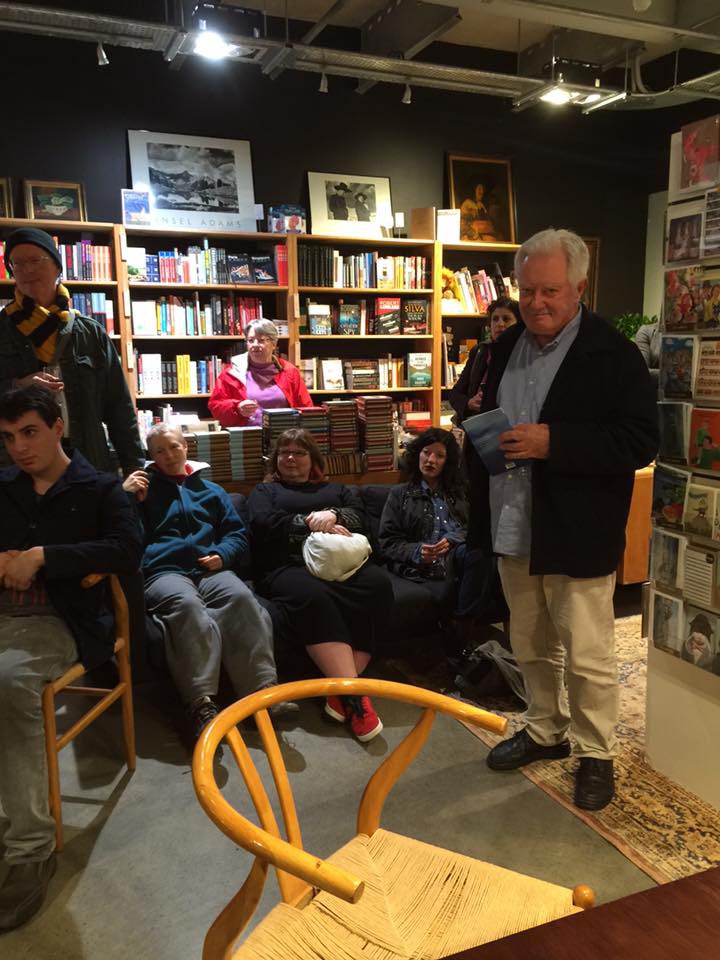
The launch crew: Harvey Molloy, me, Mary McCallum, Paul Stewart
Harvey launches, George listens in

Sue and Lindsay in the foreground, Niki and (I think) George from Ekor at the back left

A beautifully put together display of New Sea Lands – thanks, Niki and George!

One side of the audience…

… and another side of the audience

The height of elegance: Mark and Julia at the launch

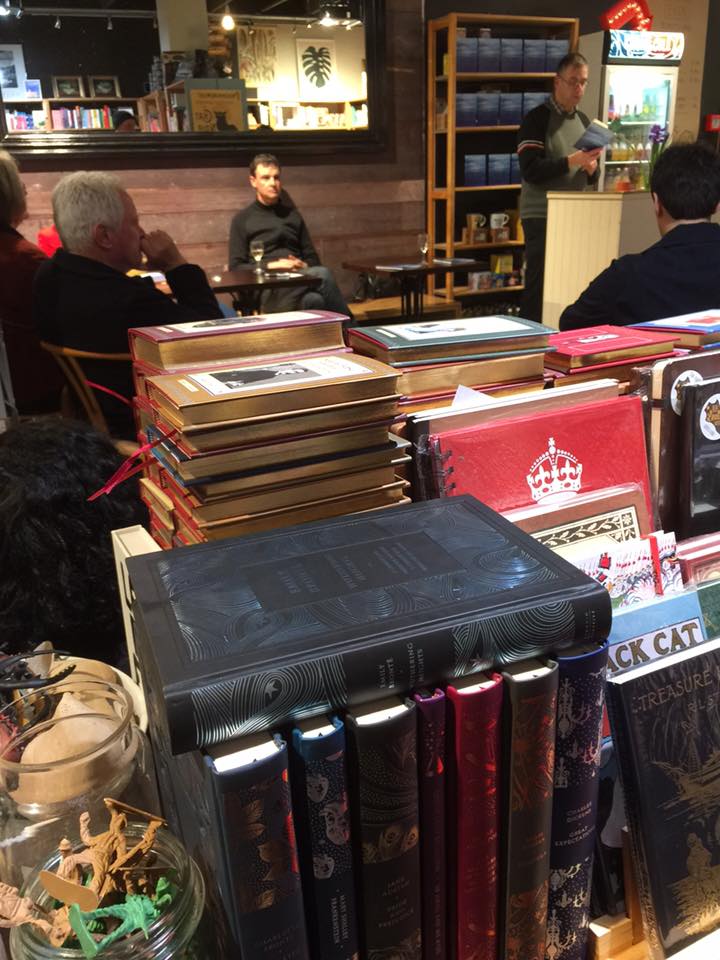
Photographer (possibly a secret agent) lurks behind pile of interesting books to capture photo of launch

New Sea Land Launched: Thanks to everyone who made the event a success!

My fourth poetry collection, New Sea Land, was launched last night at Ekor Bookshop & Cafe in Wellington. The launch went really well – lots of lovely people came, Harvey Molloy gave an amazing introductory speech that made me sound like George R. R. Martin crossed with Sylvia Plath (in other words, chirpy and fun-lovin’), and I spent the evening signing books, which is a gratifying thing for an author at a book launch.

Lovely people, lovely bookshop

Thanks to everyone who helped make this launch a great event – Helen Rickerby for recommending Ekor Bookshop to me in the first place,Niki Ward and George for running the event, Mary McCallum and Paul McCallum Stewart of Mākaro Press for accepting, designing and publishing the book, Harvey Molloy for launching it, Claire Beynon for the lovely cover images, William Carden-Horton for the interior images, and everyone who took part in the launch or sent apologies!

This is a cover version of “Possessed to Skate”. I call it “Poised to Sign”.

(Thanks also to Mary for the photos used in this post. You can find more of Mary’s photos of the launch here: https://www.facebook.com/mary.mccallum.566/posts/10210587683551982)

There were a few people I barely got a chance to talk to at the launch – to all of you, thanks for attending, and I hope we’ll catch up soon!

No rest for the wicked, though – well, a little rest, but then I’ll be taking poems from “New Sea Land” for a spin at three events on National Poetry Day this Friday:

Copies of New Sea Land are currently available from the publisher, from Ekor Bookshop & Cafe (17b College St, Te Aro, Wellington), and from your local independent bookseller. If your bookseller doesn’t have them in stock, they can order the book for you. It helps the bookshop if you can give them the following details:
Title: New Sea Land
Author: Tim Jones
Publisher: Mākaro Press
ISBN: 978-0-9941299-6-3

The RRP is $25.

Tim Jones, Mary McCallum and Paul Stewart. Poet was going for Byronic air of mystery – didn’t quite achieve it.

The New Sea Land Launch Is Tomorrow!

… and if you’re in Wellington, you are most welcome to come along! Here are all the details:

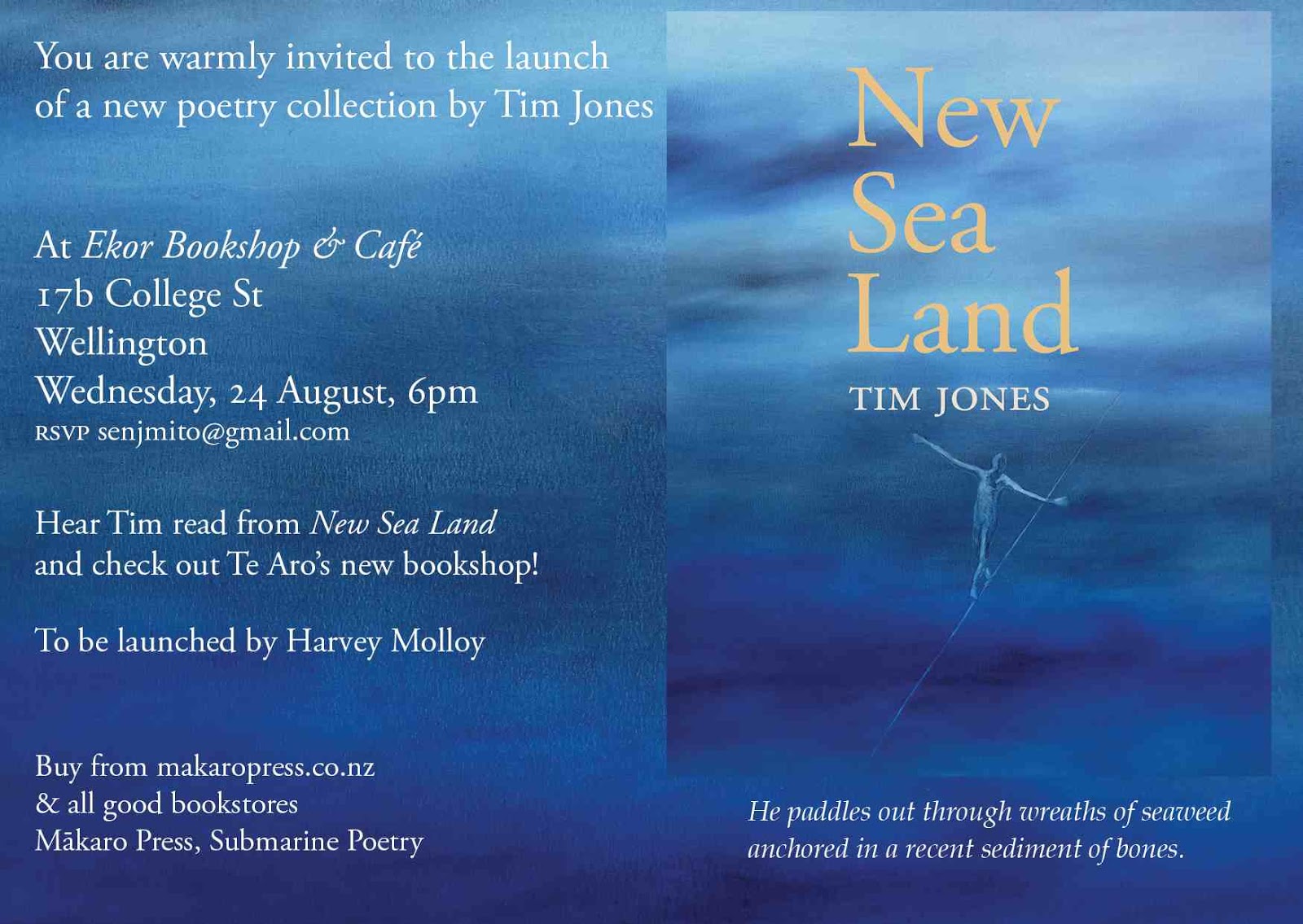
You’re warmly invited to the launch of my new poetry collection, “New Sea Land”, published by Mākaro Press, at Te Aro’s new bookshop, Ekor Bookshop and Cafe at 17b College St opposite Moore Wilson’s (see map).

The launch is on Wednesday 24 August, starting at 6pm with the traditional drinks and nibbles. The formalities will start at 6.30pm, with the book to be launched by Harvey Molloy.

These are poems of the land, sea and shore – and of what happens when the sea rises up to claim the land. I hope you’ll join me to celebrate the launch!
There is also a Facebook event for the launch – please join and share! Alternatively, please RSVP to senjmito@gmail.com


Tuesday Poem: Memorial (for Jonathan Franzen)

Memorial
for Jonathan Franzen

Arms outstretched, the novelist
stands amid the ruins of nature.

It’s a curated nature: his
cultivated rescue garden,

a scoop of hills and plains,
wind large among dead pines and dying needles.

He has gathered all the birds, these valiant
survivors of drought and storm

into one remaining protected preserve:
the last refuge of wildness, this circle of life

kept smoothly spinning by selfless human cogs,
volunteers who’ve let the world go to hell

in the service of saving a fragment. This
is their last best hope, their final stand.

But climate, the revenger’s tragedy of the commons,
cannot be bought off or set aside.

Their predator-proof fences, their best
intentions, have no effect on fire or air.

Lightning sparks a firestorm, trees
adding their carbon to the oversaturated sky.

Birds roast in the updrafts, volunteers
are crisped below. In the aftermath,

the novelist arrives, surveys
the ruins of the little world he’s made,

and stretches out his arms. Tiny skeletons
flutter to perch on his scarecrow bones.


Credit note: This poem is included in my new collection New Sea Land (Mākaro Press, 2016). It is previously unpublished.

Tim says: Why is this poem addressed to Jonathan Franzen? Because he wrote this article for The New Yorker in 2015:

The central thesis of this article, as I read it, is that because contemplating the likely effects of climate change is too depressing, and because taking action on it is too hard, it’s better (or at least, it’s better for Jonathan Franzen) to focus on try to save what he’s most interested in – birds.

I’m a big fan of wildlife conservation and bird sanctuaries – on our offshore islands, on mainland islands, and maybe even nationwide at some point. But to imagine that birds can be exempted from the effects of climate change is short-sighted and self-defeating.

Fortunately, New Zealand groups such as Forest & Bird are well aware of the risk climate change poses to New Zealand’s birds and forests. Jonathan Franzen’s love of birds does him credit,and I’d love to see him place that in a wider context.


National Poetry Day on 26 August: Events in the Hutt and Wellington

National Poetry Day is coming up on Friday 26 August – two days after my new collection New Sea land is launched.

There are events all round the country, including a whole bunch in the Hutt Valley and Wellington.

I’m due to take part in three events on the day, the first two organised by New Sea Land publisher Mākaro Press:

I’ll have my new poetry collection New Sea Land available for sale at these events.


Tuesday Poem: Spitsbergen, a poem from my new collection “New Sea Land”

As soon as winter lifts they come,
straggling up from Europe, blank-faced,
bearing the burdens of families, of the diseases
that chase them north from the burning lands
to those that are merely falling apart.

So many miles of ocean. So small the boats
that thread the lanes of iceberg and storm,
upsetting, overturning, sudden frozen death
in the heaving seas that freshwater melt
keeps no less frigid than before.

Faces greyed with suffering. Tiny bodies

clutched in shivered arms. Small treasures, euros,
tucked into boots and inner pockets. The smugglers
turning south to try their luck again. The shore
a frieze of shattered bodies, splintered wood.

They come north, and we do our best,
here in our slim green habitable fringe
between rising sea and dying ice.
We do our best, but we are overwhelmed,
and there is nowhere further north to go.

Credit note: “Spitsbergen” is previously unpublished. It will appear in my new poetry collection New Sea Land, published next month by Mākaro Press.
Tim says: Spitsbergen is the largest island of Svalbard, an island group administered by Norway in the High Arctic, well north of Iceland and Norway itself. About 3000 people live there, mainly in the capital, Longyearbyen. It’s not a very green place at the moment, but with the High Arctic warming very rapidly at the moment, that could soon change.