Book Review: Triptych Poets, Issue Three

First of all, a disclaimer: P.S. Cottier, one of the three poets represented in this collection, is a friend of mine. I’d actually turned down an opportunity to review her recent collection The Cancellation of Clouds for this very reason, but I decided I felt comfortable – to use a John Key-ism – with reviewing a book in which her contribution makes up a third: hence this review!

A few years ago, I reviewed AUP New Poets 3, which included chapbook-sized contributions from Janis Freegard, Reihana Robinson, and Katherine Liddy. Triptych Poets: Issue Three, published by Blemish Books in Canberra, follows the same pattern. Here the three poets are P.S. Cottier, Joan Kerr, and J.C. Inman.

I liked two of the three sections of the book a great deal, and though I didn’t enjoy J.C. Inman’s section as much overall, I think it contains some fine poems. So let’s look at each section in turn.

P.S. Cottier: “Selection criteria for death”

What can I say? I really like P.S. Cottier’s poetry, and I like this selection just as much – in fact, maybe a little more – than her collection The Cancellation of Clouds.

Her poetry is a powerful and inimitable (at least, I haven’t ready anything else quite like them) concoction of dark humour – humour that often seems powered by an underlying anger – vivid and often witty description, and most of all intelligence. Sometimes, as in the political poetry of “Abbott’s Booby”, that anger steams off the page.

“Intelligence” can be a double-edged sword in poetry – too often, poets confuse it for academicese and an excessive devotion to critical theory – but that is not a problem here. There is no sense of deliberate obscurity in these poems, but there is the sense of a powerful mind at work, teasing out the poems’ diverse strands.

Because P.S. Cottier often uses long stanzas, it can be hard to excerpt a few lines of poetry to show you what I mean, but these lines from “How To Wrestle An Angel” give you some idea:

Clutching is advised; hold him tight as an idea,
well-loved and convenient. Wriggling will occur,
and it is imperative that the wings be kept from play.
What ring could hold an angel, should he unfold,
flex and soar? No ropes will ever net him.
He will reach out with as many arms
as Kali, as many voices as there are prophets,
hoping to flick slow minds into new holds.

Don’t let the title mislead you. There is plenty of life here.

Joan Kerr: “Dying Languages”

Though Joan Kerr’s poetry is quite different from P.S. Cottier’s in many ways – the stanzas are often shorter, the point of view cooler and more detached – her poems share the first selection’s virtues of intelligence and imagination. I found her poetry a little more opaque than P. S. Cottier’s – at times I didn’t know what she was getting at, but I think that is because a lot of her poems refer to colonial and post-colonial moments I don’t have the historical background to fully appreciate.

Perhaps because its subject matter is closer to my own experience, my favourite poem in this selection is “My Father’s Steps”, which in two-line stanzas ranges freely over 80 years of the life of the narrator’s father, with these beautiful closing lines that expand the scope of the poem:

His mind was the world we lived in once,

from Aeschylus to Xenophon, the Odyssey
to Soapey Sponge’s Sporting Tour,

Dante to Beachcomber, Pepys to Perelman.
Ninety years, spanning three thousand years

close into distance, silence and the moon
going its way across this little world.

But there are striking and memorable lines in many of the other poems. How about this, from “Prizegiving”:

My friend has won a prize for twenty years
of hanging on:
her fingers whiten
on the edges of the world.

Images like this show what a talented poet Joan Kerr is.

J.C. Inman: “Lovers and Brothers”

The bio at the front of J.C. Inman’s entry lists him as a “frequenter of the Canberra poetry slam scene” and frequent performer at festivals. The poems in “Lovers and Brothers” are good poems, and I can see them working really well in a performance setting, but for the most part I didn’t find these poems as satisfying as I did the poems by P.S. Cottier and Joan Kerr.

That’s the easy part – the hard part is to say why. I think it’s because poems that go across well when performed because of their directness and impact can sometimes be less interesting when read.

The opening of “I Dream Of Fidelity” is, I think, a good showcase for J.C. Inman’s poetry:

In the dark I could not separate the snores from the sobs
The smell of love hung dank in the spaces between us
Like semi liquid steam.

You were already sleeping when I met you in your dreams
Half formed and imperfect, standing in the Field of Infidelity,
(a field of impatiens and forget-me-nots)
               where the only sport is fucking

It’s got vigour and energy, and a good image in the “field of impatiens and forget-me-nots”, but I don’t think it’s as rich as P.S. Cottier’s or Joan Kerr’s work.

This is J.C. Inman’s first published (part of a) collection. As he adjusts his work from what works best in performance to what works best on the page, I think there will be more and better to come.

Conclusion

I’m hard to please, aren’t I? I want to read poetry that is neither obvious nor obscure, poetry I can at once understand without too much extra reading and not entirely ‘get’ on the first attempt. It’s a pretty narrow sweet spot, and if I applied these criteria to my own poems, I’m sure that a good number of them would fail the test.

As the poet said, don’t be sad ‘cos two out of three ain’t bad, and in this case, I’m going to say two-and-a-half out of three ain’t bad. Triptych Poets: Issue 3 is worth your time and attention.

Tuesday Poem: Before Science Stepped In, by Rod Usher

Before science stepped in with its fancy footwork
A raw youth, I’d scan nights for a shooting star
Crooning like Como to catch one and pocket it
Could it really do the magic? Unhook a girl’s bra?

Ha! They’re not stars, mere fragments of comet
Arcs of burnout in the black canopies of June
Older now, sadder, I leave science to the boffins
Rave on about breasts to an understanding moon.

Credit note: “Before Science Stepped In” by Rod Usher was first published in Eye to the Telescope 2, a special Australian and New Zealand issue of the Science Fiction Poetry Association’s online journal, which I edited. The poem has been selected as a finalist in the Science Fiction Poetry Association’s Dwarf Stars Award for the best short-short speculative poetry published in 2011, and will appear in the 2012 Dwarf Stars Anthology. It is reproduced here by permission of the author.

About the author: Rod Usher is an Australian writer living in Spain. His poems have been published in Island, Meanjin, Quadrant, Going Down Swinging, et al. He is a former literary editor of The Age and senior writer for TIME magazine in Europe. His third novel, Poor Man’s Wealth (2011), is published in Australia and New Zealand by HarperCollins, and is available in paper and e-book formats.

Tim says: A well-executed short poem is a joy to behold, and I very much like the way “Before Science Stepped In” links scientific and romantic disillusion while still holding out the consolation of the “understanding moon”.

The Tuesday Poem: Is actually the Tuesday Poems – each week’s hub poem and all the other poems linked from the left of that page.

Tuesday Poem: On Contemplating The Statue Of Courtney Love Outside The Front Entrance Of Nelson College for Girls

The sculptor has caught Courtney in the act of running away,
her uniform already half removed, the blue of the blazer (optional)
offsetting the pallor of her skin. She lasted just one term
yet is the most famous Old Girl of them all.
No telling what she’s running from: maths, tyranny,
the restraints – petty? essential? – that fence her round.
It’s all in her past, or in her genes. Hardly the College’s fault
that they caught her in the middle of a very difficult year.
As for what she’s running to: the hardest of all fates,
doomed to be more famous for whom she loved
than what she’s done. Kurt is still better known
than Hole, than Celebrity Skin, than the sound of her guitar.
Courtney is caught in the act as she makes a break for town.
One foot is raised, one shoe slipping off.
One hand grasps at nothing, or punches the air.
In the shadow of her plinth, a small boy sells lemonade.
Credit note: This is a new, unpublished (and very possibly unfinished) poem.
Tim says: I wrote this poem in Nelson, inspired by walking past – you guessed it – the front entrance of Nelson College for Girls. Some parts of this poem are true: Courtney did attend Nelson College for Girls for one term, it was a less than ideal experience for all concerned, and a small boy did have a lemonade stand further along the street. The lemonade was very sweet, but also very welcome on a hot Nelson day.
The Tuesday Poem: Is just a poetic click away for all of y’all.

Poetry At The Greytown Arts Festival and at Meow Cafe

Poetry in Greytown

I had a good time last month reading poetry and meeting poets and poetry lovers in Takaka and Nelson. Soon I’ll be joining eight other poets at another poetry destination I haven’t visited before: Greytown.

I’ll be there as part of a nine-strong crew of poets reading at the event Poetry: a lasting peace, which is part of the Greytown Arts Festival. Here is the lovely poster, designed by Madeleine Slavick who has organised and will MC the event, which is on Saturday 20 October at 5pm at The Village Art Shop, 98 Main St, Greytown:

Here is the Facebook event: http://www.facebook.com/events/290166134417646

Some of the participating poets may also be lurking in Greytown during the afternoon, surprising people with poetry. Whether there is a local body bylaw against such activities in Greytown will be an exciting part of the discovery process. (I understand there is a law against wearing rubber-soled shoes on the streets of Nelson, a law which I repeatedly violated last month. Hah!)

Poetry at Meow Cafe

It’s Hammer Time! I’m going to be an MC the week after next: Saradha Koirala, Harvey Molloy and Helen Rickerby are reading their poetry on Tuesday 23 October at 7pm at Meow Cafe, Edward Street, Wellington, and I’m MC’ing. Hope you can make it!

5 Reasons To Vote Takahe For Bird Of The Year 2012 … 5 Days Left To Vote

You have five days left to vote for the takahe as Bird of the Year 2012 – or, if you prefer (though I can’t imagine why), some other bird. And here are five reasons to do so. Several of them are even true.

1. There are only 260 takahe left, and apart from their remnant natural habitat in the Murchison Mountains, they live only in sanctuaries. They need your support.

2. Takahe are incredibly cute. Check this one out:

3. If elected, takahe will reject the baubles of offices, unless the baubles of office consist of the right sort of tussock bases, in which case the takahe will accept them faster than you can say Porphyrio hochstetteri.

4. Many of humanity’s greatest works of art are about takahe. Ke$ha’s “Tik Tok” is her empathetic response to the takahe’s threatened countdown to extinction. Homer’s “Odyssey” is about a takahe called Kevin, and his twenty-year adventure to get home to his beloved Murchison Mountains. And as for Kanye West’s “My Beautiful Dark Twisted Fantasy” … well, some things are better left unsaid.

5. The Vote Takahe campaign will not stoop so low as to fill up its final reason with irrelevant but highly-ranked search terms in a misguided attempt to boost the campaign’s Google search rankings. And Rihanna, One Direction, Justin Bieber, Taylor Swift, Coldplay and Nicki Minaj fully endorse our position on this.

Oh, and because you’ve been good, here are some more factual-type facts about the takahe:

• The takahē is an endangered flightless bird indigenous to New Zealand.
• Takahē once lived throughout the North and South Islands and were thought to be extinct until rediscovered by Geoffrey Orbell near Lake Te Anau in the Murchison Mountains, South Island in 1948. 
• Today’s population is around 260 birds at various sites including the Murchison Mountains in Fiordland as well as the pest-free islands Tiritiri Matangi, Kapiti, Mana and Maud and mainland sanctuary of Maungatautiri, near Cambridge.
• Some takahē have lived for over 20 years in captivity, but in the wild few would live to more than 15 years of age. 
• Since the 1980’s, DOC has been involved in managing takahē nests to boost the birds’ recovery. Artificial incubation of eggs and rearing of chicks is carried out at the Burwood Bush rearing unit, Te Anau, where five pairs are held to form a small breeding group. 

Remember! Vote Takahe, tweet #votetakahe and #birdoftheyear, and disrupt opposition political gatherings with your enthusiastic pecking!

Tuesday Poem: The First Artist On Mars, plus an Announcement

The First Artist on Mars

Well, the first professional artist
There were scientists who, you know
dabbled
but NASA sent us —
me and two photographers —
to build support for the program.

The best day?
That was in Marineris.
Those canyons are huge
each wall a planet
turned on its side.
I did a power of painting there.

You can see all my work
at the opening. Do come.
Hey, they wanted me to paint propaganda —
you know, ‘our brave scientists at work’ —
but I told them
you’ll get nothing but the truth from me

I just paint what I see
and let others worry
what the public think.
Still, the agency can’t be too displeased.
They’re sponsoring my touring show.
That’s coming up next spring.

Would I go back? Don’t know.
It’s a hell of a distance
and my muscles almost got flabby
in the low G. Took me ages
to recover — lots of gym and water time
when I should have been painting.

But Jupiter would be worth the trip!
Those are awesome landscapes
those moons, each one’s so different.
Mars is OK — so old, so red,
so vertical. Quite a place
but limited, you know?

Credit note: “The First Artist On Mars” was first published in Blackmail Press 15 (May 2006) and was included in my second poetry collection, All Blacks’ Kitchen Gardens, where it forms part of a sequence about the exploration of Mars called Red Stone. That sequence was inspired by Kim Stanley Robinson’s superb Mars Trilogy, but this rather conceited artist is entirely my own invention.

Tim says: That note first appeared on Helen Lowe’s blog, on which she kindly published “The First Artist on Mars” as a Tuesday Poem in 2010. I wouldn’t normally ‘re-use’ a Tuesday Poem in this way, but it seemed appropriate this time, because TFAOM was also included in Voyagers: Science Fiction Poetry from New Zealand, the anthology Mark Pirie and I co-edited in 2009 which was published by IP, and … (drumroll please!) …

P. S. Cottier and I have An Announcement: We are going to be jointly editing an anthology of Australian speculative poetry, to be published, all being well, by IP in 2014. Like Voyagers, it will have both a historical and a contemporary component – so we will be trolling the archives for the history of Australian speculative poetry, but also calling for submissions from contemporary poets – though it will be a while before that call is issued, so (if you happen to be Australian) please don’t send your poems to us yet!

Unlike Voyagers, it won’t be restricted to science fiction poetry, but rather will cover the full range of speculative poetry, including science fiction, fantasy, horror, and magic realism. We’ll say more about that in the call for submissions, too.

I am really looking forward to our working on this project together, as if I were the Barney Gumble to her Linda Ronstadt, though I hope no snow-ploughs will be involved in this one. Keep watching the stars, and the market listings!

The Tuesday Poem: Is not a thing of rags and patches, nor yet a wand’ring minstrel, but rather a still point in a turning world.

Tuesday Poem: Watching The Birds

An old woman in a bathchair
appears on the lawn
hair freshly combed
rug newly straightened.
Her attendants
relieved
move away
two hours future-proofed.
She is watching the birds
the impudent birds
blackbird, thrush
sparrow
looking for bread
raven, crow
corvidae
tugging at rings
waxeye
fantail
grey warbler
trying to perch.
The old woman
stares straight ahead
eyes wide in delight
watching
roc
moa
elephant bird
vast as the house
she shared with her mother
when Father was gone to the war.
They push at her face with their beaks.
An old woman. The insolent birds.

Credit note: This poem was first published in my second poetry collection, All Blacks’ Kitchen Gardens.

Tim says: There is something lacking from this poem: The Takahe, which I encourage you all to vote for as New Zealand’s Bird of the Year 2012

The Tuesday Poem: Can be found in all its multifarious magnificence on the Tuesday Poem blog.

Poetry Readings In Takaka And Nelson

I’m off soon to a part of Aotearoa I’ve never visited before: Golden Bay. I’ve judged the poetry division of this year’s Golden Bay Literary Awards, and I’m attending the prizegiving ceremeony in Takaka on Thursday night.

The following day, Friday the 21st, after an event at the local school (I have no idea what this involves yet!), I’m reading at the Takaka Memorial Library at 1pm. Here are the event details:

http://itson.co.nz/2012/4689-takaka-library-poetry-reading-with-tim-jones

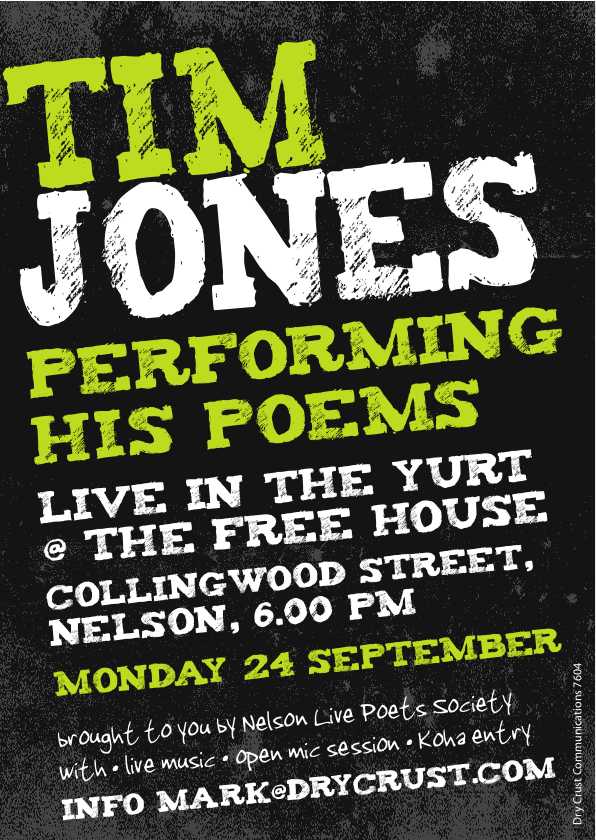
Then, after a few days’ break during which I’m really looking forward to get some writing done, I am reading – in a yurt! – as the September guest for Nelson Live Poets. There is a Facebook event for this one: http://www.facebook.com/#!/events/380878888650908/ – if you have friends in Nelson, please invite them to this event.

The poster and the press release for the Nelson reading are below. I’m not sure whether I feel masculine enough to live up to the press release – it may be time for a quick course of testosterone supplements before I travel south!


Media Release – 6 September 2012
Manhood and science fiction – out of this world poetry at the Free House
Science fiction and manhood are set to do a merry dance at Nelson’s Free House this month as poems from the collection Men Briefly Explained and the science fiction poetry anthology Voyagers, get an airing at Nelson Live Poets.
Tim Jones, poet and science fiction writer from Wellington, is the featured guest at the Nelson Live Poet’s Society’s September gathering.
Jones will be performing poems from Voyagers: Science Fiction Poetry from New Zealand(Interactive Press, 2009, co-edited with Mark Pirie), and will also treat the audience to samplings from his latest collection of poems, Men Briefly Explained (2011).
Men Briefly Explained, his third book of poems, explores all aspects of contemporary manhood, the humorous and not so humorous, and lifts the covers on where men are in relation to women and to society in general!
The mix of science fiction and manhood promises an entertaining night in The Yurt at the Free House as Live Poets continues to encourage and promote a wide range of both local and national poetic talent.
Among his other recent books are the fantasy novel Anarya’s Secret(RedBrick, 2007) and a short story collection Transported(Vintage, 2008).
Voyagerswon the “Best Collected Work” category in the 2010 Sir Julius Vogel Awards and was listed as one of the Listener‘s 100 Best Books of 2009.  Jones was also awarded the NZSA Janet Frame Memorial Award for Literature in 2010.
As well as performing his poems at Nelson Live Poets, Tim Jones will be attending the Golden Bay Lit awards as this year’s guest judge.
Local poets also get the opportunity to perform their work during the regular and legendary open mic sessions. These sessions give Live Poets its beating heart as first-timers and established performers stand together to deliver words of wisdom and wonder!
Open mic performers, who have slots before and after the night’s guest, can register on the night. Jim Doak will open the evening with song and guitar.
ENDS
Live Poets Society
FeaturingTim Jones
In the Yurt @The Free House
Collingwood Street, Nelson.
on Monday evening, 24 September , 2012
Doors open: 6.00 pm
Music from 6.30 pm.
Koha entry.
ENDS
Further information:
Carol Ercolano – 03-545 0162
Mark Raffills – 03 544 4975
Nelson Live Poets Society

Vote Takahe Campaign Denies Public Money Used For Campaign Video

The Vote Takahe campaign today denied that public money had been used to promote their Bird of the Year 2012 election campaign. Rival birds claimed yesterday that the following promotional video about Takahe had been made by a TV channel funded by public money:

Members of the Takahe campaign refused to come into the studio to answer this allegation, but the campaign did provide the following video response:

Experts in Takahe language have interpreted this statement to mean “Vote Takahe as Bird of the Year 2012!”, and you can do just that at the Bird of the Year site.

Some actual facts about takahe

  • The takahē is an endangered flightless bird indigenous to New Zealand.
  • Takahē once lived throughout the North and South Islands and were thought to be extinct until rediscovered by Geoffrey Orbell near Lake Te Anau in the Murchison Mountains, South Island in 1948. 
  • Today’s population is around 260 birds at various sites including the Murchison Mountains in Fiordland as well as the pest-free islands Tiritiri Matangi, Kapiti, Mana and Maud and mainland sanctuary of Maungatautiri, near Cambridge.
  • Some takahē have lived for over 20 years in captivity, but in the wild few would live to more than 15 years of age. 
  • Since the 1980’s, DOC has been involved in managing takahē nests to boost the birds’ recovery. Artificial incubation of eggs and rearing of chicks is carried out at the Burwood Bush rearing unit, Te Anau, where five pairs are held to form a small breeding group. 

(Taken from http://www.scoop.co.nz/stories/AK1208/S00260/tiritiri-matangi-island-loses-iconic-bird.htm and posted in memory of Greg the Takahe, who died in August.)

You can read more about the Vote Takahe campaign here and join the campaign on Facebook.

Tuesday Poem: Prove You Are Not A Robot, by P. S. Cottier

Prove that you are not a robot.
Affirm android is what you’re not.
Prick a digit, we’ll watch the blood flow
(though nanovamps may swim, and grow).
Indicate a lack of chips embedded –
that you are only fleshy headed,
with just the right amount of brain
to reason, love and feel all pain.
Now fill in the code that we select –
words unknown to mortal intellect.
Quickly, for we’re losing time –
our batteries run down at nine.

Credit Note: This is an original poem by P. S. Cottier and is published here by permission of the author – and if you have not already done so, you should check out her blog.

Tim Says: The first time I saw the command to “Prove that you are not a robot”, I suffered a prolonged period of existential dread. Might I, in fact, be a robot? Might there be telltale signs? How could I prove I wasn’t?

P. S. Cottier did something more useful. She wrote a poem – and here it is. I really like it.

The Tuesday Poem: One does not simply walk into The Tuesday Poem. One clicks.