An Interview With Penelope Todd

Penelope Todd is a writer, editor and manuscript consultant currently living in Dunedin. She has had seven young adult novels published by Longacre Press, including her Watermark trilogy, and a memoir, Digging for Spain: A Writer’s Journey. Her latest novel is Island, published by Penguin (2010), an adult novel.
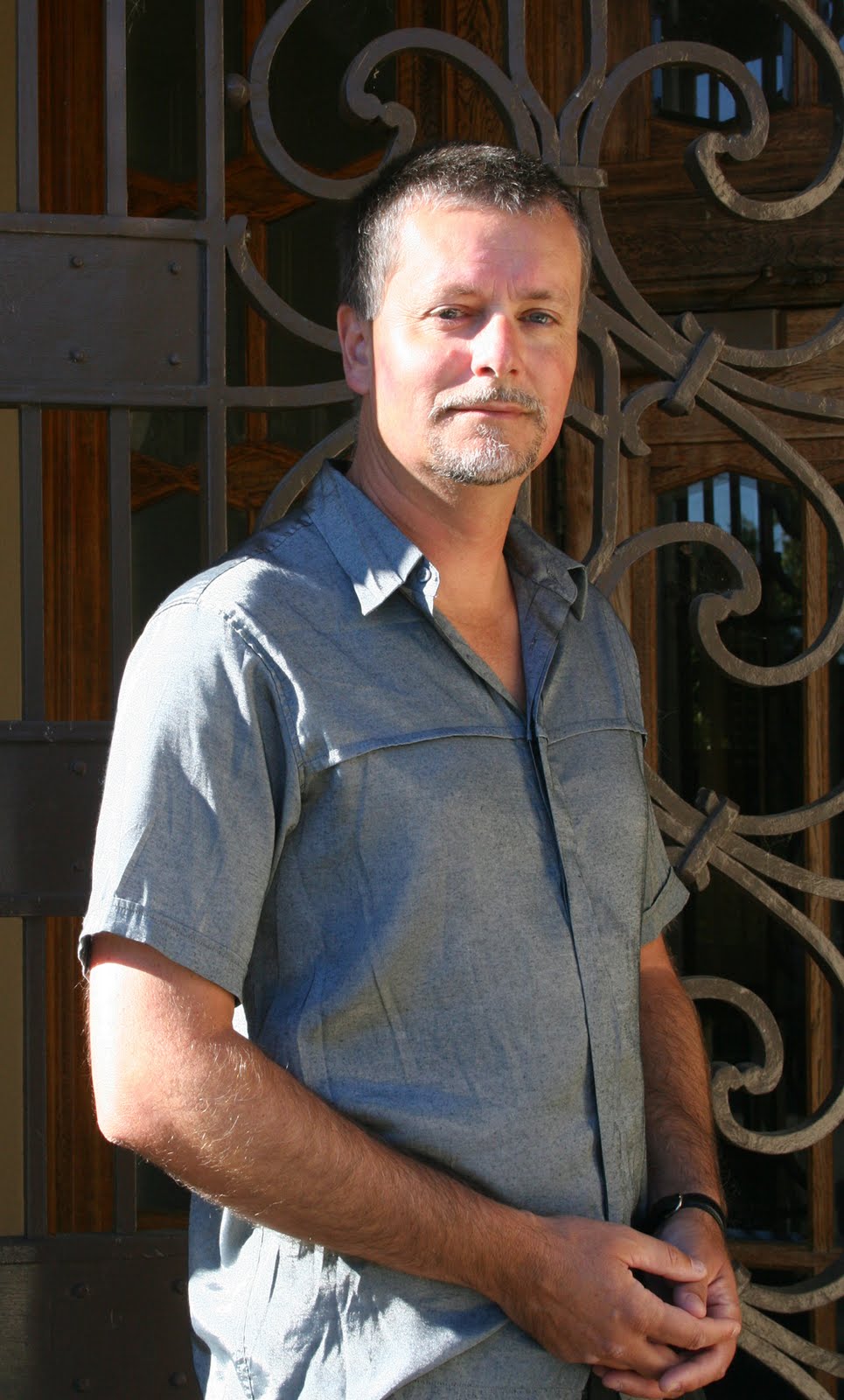
(Photo of Penelope Todd by Claire Beynon)

Has it been a difficult transition from writing fiction for a young adult audience to writing fiction for an adult audience – and is it a transition you had been intending to make for a while?

I think the transition is proving more problematic for marketers and reviewers than it has been for me. One wrote of my having to ‘leap a gulf’ but I consider the distinction more or less arbitrary. I’ve always written what I wanted to write. After seven novels about teen experience, I wrote a memoir in which I outlined the changes, inward and outward, that had been precipitated by so much fiction writing (or that had precipitated the fiction – cause and effect are not easily distinguishable). That seemed to mark a shift also in my method of obtaining the story – as if through the airwaves instead of digging it up from underground – a much lighter process in some respects.

I knew Island would interest older readers so I allowed interactions, events, and my characters’ thoughts concerning desire, fate/destiny and mortality (themes evident in all my fiction) to play out more fully. So, no, the transition wasn’t consciously made but my characters had been growing older with each YA novel so, looking back, a shift in marketing was inevitable.


When I saw the title of your book, I thought of Quarantine Island in Otago Harbour. Was your own experience of visiting Quarantine Island an important source for the geography and “feel” of the island in your book, even though the location of the titular island is not specified?

We used to hop (in a boat) across to that island – a.k.a. Kamau Taurua or St Martins Island – when our children were young, to stay weekends in the big old house. We’d wander over the hills and shore, pat the donkeys, fish off the rocks and visit the sad little graveyard with its small earth mounds. I absorbed the atmosphere of the place and a sense of its history, and have since overlaid it with my own fictional island and 130-odd years’ distance. However, this might be any quarantine island near any colonial port late in the 19th century. While historical accuracy is important, detailed recreation mattered far less to me than the viability of this fictional community, its members, and their relationships.

Penguin’s publicity material for Island describes it as “literary fiction of the highest quality, and an intensely romantic page-turner”. Do you think that’s a fair description of what you are trying to achieve in Island? If so, how easy a balance is that to maintain?

Well, the blurb came later so I wasn’t aware while writing of teetering on that particular tightrope. I enjoyed diving into a deeper language pool than I would writing ‘current’ fiction, and my sentences are always written with an ear to sound and rhythm. Besides that, I hate to bore myself or the reader so the unfolding story is reasonably pacy and yes, there’s attraction and desire, a little sex, varieties of love – eros, philia and agape, at least.

As for romantic? I might be happier with the r capitalised. It’s not a ‘romance novel’. However, a late mountaineering uncle (Colin Todd after whom the hut was named) was recently described as ‘a romantic idealist’. That weakness runs in the family. But mixed in with the human warmth generated on the island is the grit of an attempted suicide, a diphtheria epidemic and several deaths. I’ll leave readers to judge whether the publicity is fair.

Looking at your entry on the New Zealand Book Council website, I’m intrigued and impressed to see that you recently “travelled to Argentina in order to complete the writing, translation and adaptation of a bilingual novel with Argentinian writer Elena Boss”. That sounds fascinating! How did this project come about, and what can you tell us about it?

I can tell you that I feel very privileged to have had this experience. A fuller account of the process is to appear in the next Booknotes, but Elena and I met on the International Writers’ Programme in Iowa in 2007 and, in order to keep in touch, wrote a novel together – employing characters from each of our countries, and taking alternate chapters. I met Elena again in Buenos Aires last year so we could firm up our translations. We now have a bilingual novel of which Elena is currently entering the Spanish version in MS competitions in South America before we look for a publisher in English, too. I dare say it’s the first-ever bilingual NZ-South American collaborative novel!

In one of your New Zealand Book Month blog posts in 2007, you mentioned the continuing lack of visibility afforded in New Zealand to writers – and in particular woman writers – from south of Christchurch. Quite apart from the inequity of this, it can’t help when promoting a new novel. How can this be circumvented?

Oh, sigh. If anyone has answers to this, could they please tell us, and our publishers? Should we move north to where the publishers, the media engines, the book organisations and the money (in Auckland recently, I heard ‘super-yacht’ slipped into several conversations – what is that?) reside? If it were simply our own invisibility it would hardly matter, but when new work slips through the cracks so quickly, it gets irksome. Getting better at what we do seems not to make an appreciable difference.

There’s some beautiful, under-sung writing happening down here, but we get awfully tired of saying, ‘It’s the process that matters’. Apart from that, I suppose we could all aim to become younger, more attractive, more extroverted… Or, roll on the digital revolution with the democratisation of the publishing process. I’m doing my bit towards that.

Which writers have been most influential on your own writing, and which are your personal favourites? Are there any writers who haven’t received the publicity they deserve that you’d like to recommend?

I hate to single out writers down here – too many are friends and acquaintances -but I name a few in the link above. Off the top of my head, I’ll be eager and curious to read Emma Neale’s and Maxine Alterio’s next novels, and Sue Wootton’s next volume of poetry. The whole country should be. Thoughtful readers should read Ruth Pettis’s two novels. She died two years ago this month – she’s really invisible now, but her work ought never be.

Do you have a plan for how your writing career will unfold? If so, and if it isn’t a secret, where do you see yourself and your writing in five years’ time?

I’m quite a good plodder so I see more fiction unfolding, back and forth in time and place. I always have some longish thing on the go. Meanwhile I want to work more collaboratively so I’m also plodding towards the production of an ebook publishing site – excellent writing carefully selected, sensitively edited and artfully designed, for global sale. But that’s complex and I’m learning on all fronts as I tackle the brand new aspects of this project.

How to buy Island

Island is available online from Fishpond. It should also be available at all good independent bookstores, and is available from some Whitcoulls branches.

An Interview With Sally McLennan

Sally McLennan says she writes strange fairy tales and lives stranger ones. She was once the tooth fairy of a small mountain town and she has been the editor of two American health care newspapers (The Medicare Pathfinder and The Medicare Navigator). She has lived in Australia and Thailand. Her time in Thailand gave her the ability to speak passable Thai, carve a pumpkin into really interesting shapes, and she gained her parachuting wings with the Thai Royal Airforce. After living in Thailand, Sally studied at Canterbury University where she gained a First Class Honours degree in English literature. Now, some years later, she divides her time between many bookish works in progress.

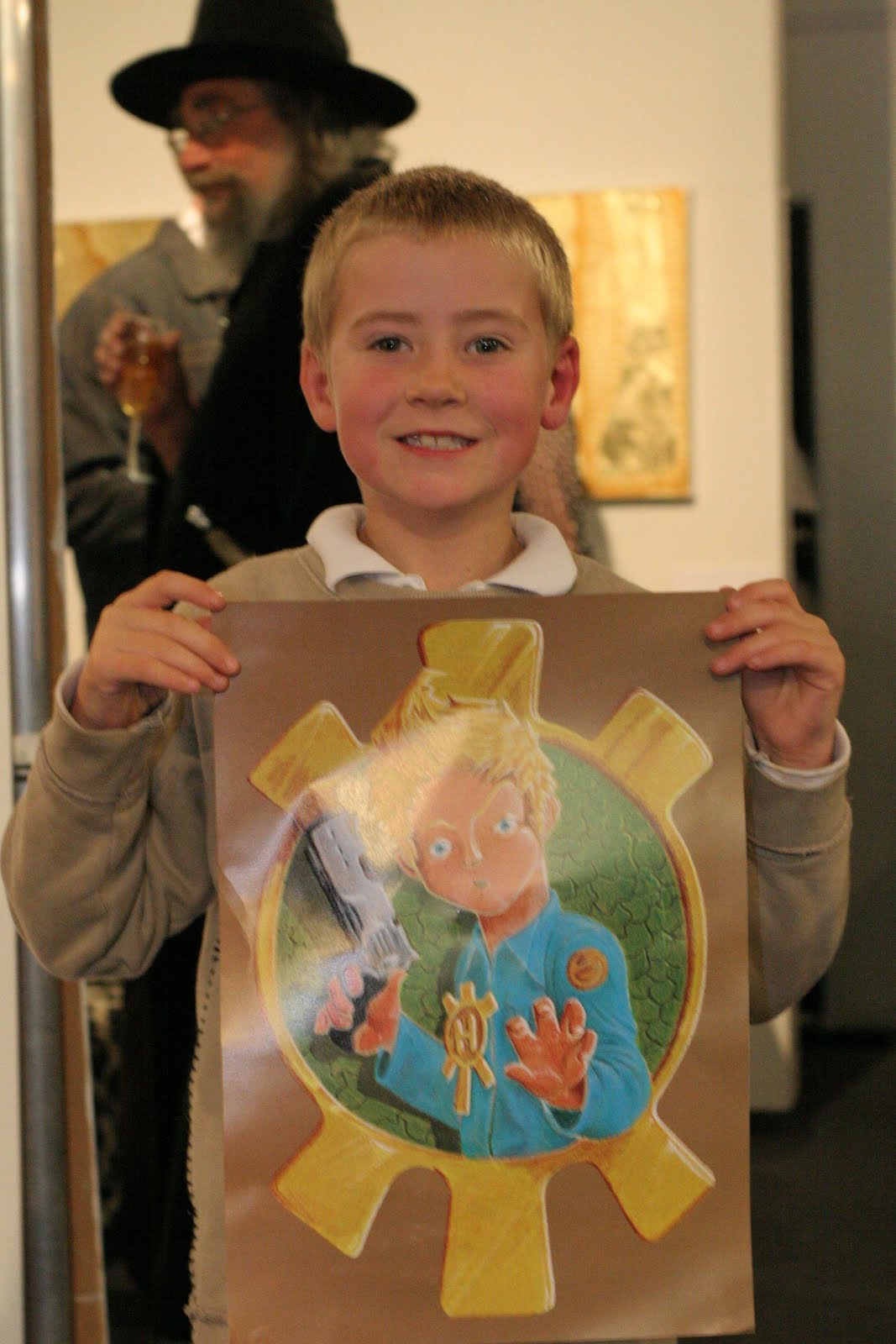
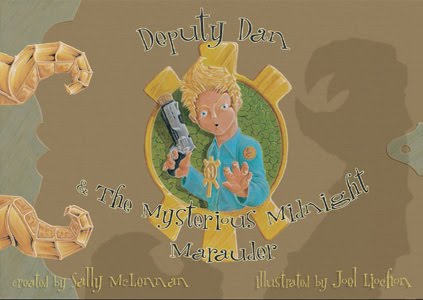
Sally’s first book, Deputy Dan and the Mysterious Midnight Marauder, recently won the Sir Julius Vogel Award for the Best Professional Publication. It is a picture book heavily influenced by graphic novels. Sally describes the book as the story of ‘a crime spree so unfathomable that the law enforcement agencies are stumped, and the public is captivated, and a criminal so strange that nobody could guess who the culprit might be.’ Dan, the hero of the book, sets out to solve the crime and bring the criminal to justice. This is a story about magic and regrets, about learning to feel more and judge less, and the true treasures in life.

Deputy Dan and the Mysterious Midnight Marauder can be purchased from Te Papa’s Kid’s Store, Barbara’s Books, Scorpio Books, The Children’s Bookshop, Unity, Storytime, Vic Books, Arty Bees, The Christchurch Cathedral shop, UBS Canterbury, The Arts Centre Bookshop in Christchurch and from Sally’s website.


Sally, there’s all sorts of stuff I want to ask you about, but to begin with, how did you manage to get the Wizard to compere the launch of your book? Also, the launch of her first book is a very special time for any writer – how was this launch for you?

Ah, Jack the Wizard was lovely. It was no trouble at all. I randomly mentioned how much I wished the Wizard was my compere to the Town Crier of Christchurch, Steven Symons, after someone introduced us. I’m not even sure how it came up! It turned out they were friends and within a day he gave me the Wizard’s contact information so I was able to make a very nervous call to the Wizard. Luckily, he was pleased with the idea, and played along with everything beautifully. He said a wonderfully theatrical blessing of the book which would have been perfect if he had been able to actually remember its name. Instead he called it by five or six different titles and I think this added greatly to the charm of the event. We did two launches; one each in Wellington and Christchurch. The reason was that my publisher is based in Wellington, and we wanted an event that coincided with the National Science Fiction convention held there, as the people involved have been very supportive of my writing. However, everyone else who worked on the book – and there was a large team – was based in Christchurch.

The Christchurch event was huge. We started with dinner served in trams circling the city while jazz musicians played their way through the carriages. Then, we had the launch ceremony at the Design and Arts College of New Zealand where Joel (the illustrator) studied. Five hundred individual cakes were served that night and a segment from the book was narrated in sign language. It was completely special. One of the best nights of my life. I think for both launches Joel and I floated – leading up to them there is this strange terror that something will be wrong with the book or people wouldn’t love it somehow – then momentum takes over and the launch itself is a blissful dream come true sort of experience. Its a feeling I can highly recommend and one with lasting sweetness.


What was the path that led you and Deputy Dan and The Mysterious Midnight Marauder from first thought to publication?

It was long and twisty, that path. It started with a dream while I was still studying. In it a blond boy was trying to track down a robber… who it turned out was not a robber at all! I asked myself if I could write that boy’s story and – just for kicks – write it into verse. It was a sort of joke with myself, an experiment, and I suspected I was insane for wanting to try it. Twelve years later the book was published and my suspicions had been confirmed! I wrote Deputy Dan during tea breaks from my day jobs – ten minutes at a time – all that time. After several years of that my health abruptly deteriorated. I was – mistakenly – told by one Doctor that my condition was terminal. I decided that I preferred to fulfill the dream of being a writer, and finish Deputy Dan, rather than succumb. I finished the story while still very ill. When she was out with him for a business lunch my sister told Tim, the publisher, that he had to read my work. He declared it all publishable. At about the same time I submitted the story to the judges of the Conclave Award (for Fantasy Poetry) as a handful of photocopied sheets and it won.

Production began. I had an idea that as the book started life as the work of a student I wanted another student to illustrate it. I ran a competition with the Design and Arts College of New Zealand and the student who came up with the most apt character sketches won the chance to illustrate the book. That was Joel and we worked closely together for almost a year and a half. We were, under Tim’s direction, involved in all the processes of publishing. Tim wanted to teach us what was involved. Finally, at about 1.30am on the 17th of March, 2008, the first printed pages of the book began rolling off the presses. It’s an amazing thing to experience on the ground as I did.


Why do you write? What do you hope to achieve from any by writing, both in personal terms and in terms of the effect your work has on readers and on the literary community?

Writing is a strange illness that nobody has found a cure for. For me, its a compulsion, and I am happiest when fulfilling that absolute need, instead of hiding from it. I feel like I am talking with the world I am part of when I write. I reach out, and see if anyone reaches back, while breathing life into characters and their world; communication and creation at the same time. In personal terms I hope to make a book people might enjoy. I also try to write beauty more than ugliness (inner and outer). I don’t know if I think of having an effect on the literary community – it seems like such a big thing – but I do have a few ideals I cling to about what I want my work to do socially. I want to wise up children rather than dumbing down books. In other words, I don’t like limiting my vocabulary or ideas when I write by trying to direct them to an age group. I think that breaks your writing and I don’t want to patronise readers. I think using more challenging words well encourages kids to learn them.

How do you fit writing in with the rest of your life? Where and when do you like to write?

At the moment it’s really difficult. I am transitioning between cities and that is taking its toll on me physically. So, I am in a hiatus. In the past six months, I’ve done a fair bit of editing and written ten thousand words of the series I am most focused on. I’ve also written a short story. Now I am at the tail end of that transition, I am really looking forward to more writing time. I think to myself that I’ve just had the rite of passage now I want the writing of passages!

I’ve learned I am someone who needs a dedicated writing corner of some sort. Now, I have bought a home and it has a long, narrow, office at the top of three stories looking out over trees. I am really looking forward to writing in that tower like crevice. I do most of my writing in bursts late at night in my office and in cafes during the afternoon. I am also often running ideas around in my head when I am seemingly otherwise occupied. I do some of my best writing while drifting off to sleep or doing the dishes. I have learned to carry paper everywhere.

Some writers say that they find it hard to read for pleasure – that, willingly or not, they read with one eye on how the book they’re reading achieves its effects, or they read to see what other authors in their genre are up to, or what’s selling well at the moment. Are you an analytical reader, or do you read primarily for pleasure? Can you tell us some of your favourite writers?

I read with absolute indulgence for pleasure. I know the book is failing for me when I become super analytical and start pulling out my inner editorial red marker. I write the sort of stories I enjoy reading – YA, Children’s books and fantasy/ slipstream. My absolute favourites are Robin Hobb, Catherine Valente, Neil Gaiman, Margaret Mahy, Diana Wynne- Jones, Keri Hulme, Paul Stewart, Phillip Pullman… well, its a long list and one I could add to for a while!

I know that you really enjoy New Zealand’s national science fiction conventions. What’s so good at about them?

I’ve found the people there to be incredibly enthusiastic and supportive – its a great community. I’ve learned more about writing at those conventions than through any other forum – its invaluable to meet the experienced guest authors they host each year – and the convention members themselves have sometimes benefited by the years and years of exposure to these guests. So they are also really knowledgeable around the craft of writing. I’ve learned a lot about how to get published (ah, the debate about the necessity of agents continues though!), generating ideas, and by seeing how other authors work. I found that many use sensory keys to tell themselves its work time, such as a particular drink, or piece of music. When that music is played or that drink poured its time to sit down and write. It almost becomes self hypnotic the association becomes so strong and that’s a good thing; the hardest part of writing is sometimes to start doing it.

Why are the Sir Julius Vogel Awards so special to you?

I think its huge that New Zealand has its own trophy for Science Fiction and Fantasy writing. Its got a great lineage, being named for the Prime Minister who wrote science fiction back in the Victorian era, and with the trophies themselves crafted and donated by Weta Workshops. It seems like each year the award gains significance and gets more noticed. The award has its origins in the grass roots of fandom and is an absolute credit to the teams of volunteers who have devoted years to running it for little or no recognition. The service they do to the writing community is amazing. To be awarded one was an incredibly proud moment and especially because it put me in the company of a group of author friends. On the actual night of the awards Helen Lowe and Nalini Singh and I all sat together and all, happily, got at least one Vogel (Helen did really well and got two!). It made things even more special, if possible.

You have been involved in the Books In Homes scheme. What is so good about this scheme, and have you found your involvement rewarding?

Duffy’s Books in Homes is a wonderful programme. They have given away over five million books to kids in lower decile schools in the fourteen years they have operated and their 588 schools show a 35% increase in mean reading levels. So: that’s great. But the Books in Homes focus on learning and achieving through goal setting – with reading as a tool and a focus – seems to have a massive impact on entire communities around participating schools. Parents are taught and encouraged to read to kids, jail rates fall away in these communities, bullying and truancy diminish. Camberley school reports that vandalism of school property dropped by 90% as a result of involvement in Books in Homes. Adult literacy improves and job opportunities are derived as a result. The programme involves kids in pre-school, primary school, and then High School kids become role models. Parents – especially Dads – and grandparents are encouraged to participate. It’s inspired.

I went into the programme as a role model. This means I visited schools talking about how reading has made a positive difference in my life, to encourage kids to read, and I gave out their free books at the awards ceremony afterwards. I thought I was engaging in an act of service but, in fact, it has proven at least as inspiring for me as it was for the kids. I was the Books in Homes role model for Van Asch Deaf Education Centre in Sumner. The kids there, and their teachers, were amazing. I never saw anything as expressive as one of the teachers signing part of Deputy Dan to the kids. Their whole language of gesture is beautiful and an art form in itself. Later, they hosted me at a school performance of Oliver which was really special. Then, at the book launch, a senior student named Mark signed part of the book. His skill dumbfounded everyone who watched – I was mobbed by people wanting to talk about how theatrical it was afterwards – and it was a powerful moment. He gave me a brooch bearing a golden butterfly which made me an International Friend of the Deaf – it apparently is recognised all over the world – and which symbolises the Deaf Community: silent but beautiful.

What’s next for Sally McLennan? What writing projects do you have underway, or in mind?

I’m dying to get settled into my new home and stuck in! I want to have as much as possible, if not all, of the Somewhere Else trilogy finished ahead of World Con (AussieCon 4: The World Science Fiction convention in 2010). The first book is about a group of kids who are translated into another world, one linked with our own, and at war. Of course, as in all fantasy stories of this type, there is the expectation that the children will be heroes. Of course, this story is a little more true to life about what happens to young people who suddenly find they are in the middle of a war. It’s quite gritty and I am really enjoying writing it. A series about an imaginary friend who comes to life is ticking along nicely – the Jessica and Spuds series – which is definitely in prose. I also have, way on the back burner, a sequel to Deputy Dan.

While all that is going on Joel wants me to pen words to his graphic novel about JoJo, a boy in a circus, in space. That is a perfect continuation of our partnership: he has had to put images to my ideas now I have to match words to his images. I love working with Joel. He is my creative brother. Together we could come up with almost anything.

An Interview with Frankie McMillan


Frankie McMillan is an award winning short story writer and poet. She held the CNZ Todd Bursary in 2005 and this year was the winner of the New Zealand Poetry Society International Poetry Competition. She lives in Christchurch with her partner (in a 130 yr old house) in the inner city. She is a keen cyclist and lives within biking distance of family members and her workplaces: The Hagley Writers’ Institute and Christchurch Polytechnic.


Frankie, your first poetry collection, Dressing for the Cannibals, was launched on Thursday 20 August as part of the Christchurch Central Library’s 150th anniversary celebrations. How did the launch go?

It was great, thanks. A bit of chaos beforehand; the venue was changed an hour beforehand from the second floor of the library to the upper staffroom floor (where alcohol was allowed). Michael Harlow almost didn’t make it; he’d booked the wrong flight, and Robyn who was to speak on behalf of the library was too busy stuffing people into lifts, to be there for the speeches! About 50 -60 people were there, some fine speeches were made by David Gregory (Sudden Valley Press) and Michael Harlow. Live music was played, kids ran about, books were signed and the wine didn’t run out!

You’ve had poetry published extensively, and your poem “My Father’s Balance” won the NZ Poetry Society International Poetry Competition in 2009. But let’s suppose someone is coming to your work completely fresh. What would you like to tell that person about your poetry, and about Dressing for the Cannibals?

My poems are characterised by humour, accessibility, with an often faux naïf narrator who makes observations about how it is we are ‘so mysterious to ourselves and to the world.’ The poems are fictional but have an underlying emotional truth. They reflect my interests; theatre, folklore, memory, family and the peculiarities of being human.

Themes vary, from the nature of illusion – there’s some tricksy type poems about the world of magic shows and travelling circuses to power – who holds it on a world scale or in a family context. (The poems on cannibalism were prompted by a childhood horror of being eaten.) There are a number of prose poems in the collection, a form I find really exciting to work with.

I hope the reader always knows where they are in one of my poems, but not necessarily where they are going.

Are you a poet for whom the formal aspects of poetry are particularly important?

No, the formal aspects are secondary to what I see as the exploration of an idea. I attend to certain poetic elements and the overall structure but am led more by the process whereby words/thoughts are attracted to each other. (The premise that the first idea is often the best idea possibly reflects my training in improvisational theatre.)

Dressing for the Cannibals has a very striking cover, and I see from Helen Lowe’s preview of the book on Beattie’s Book Blog that the cover painting is by your daughter, Rebecca Harris. Was this painted especially for your book, or was an existing work that just fitted perfectly with what you had in mind for the book?

The painting, Night Visitor, was of an existing work (2006) which was part of a series exploring the early contact between Maori and Pakeha. There is a sense of mischief in Rebecca’s work which resonates with my writing and yes, it fitted perfectly with the book’s themes. (Rebecca is represented by Milford Galleries.)

I recently interviewed Joanna Preston, and elsewhere she has commented that Christchurch is the Motown of the New Zealand poetry scene. (I think she was talking about the level of activity and productivity rather than a penchant for perfect pop singles.) I know that you’re an active participant in Christchurch poetry events; do you agree with Joanna that Christchurch is a particularly happening place for poetry at the moment – and if so, why do you think this is?

When I came back to Christchurch eight years ago, I was amazed at how many poetry groups there were but even more surprised at how many poets belonged to more than one or two. Recently a few of us ex IIML graduates living in Christchurch (fiction and poetry) have expressed an interest in getting together so possibly yet another group will form! Why do writers, poets, in particular, have a hunger for belonging to groups, I don’t know. I do know the poetry group (of which Joanna is a member) has been enormously helpful to me but possibly so too would a fiction group of which there seems relatively few in Christchurch.

I have noticed previously that poets seem to be more likely to get together, and work together, than fiction writers. Why do you think this is?

I suppose the obvious answer is that poetry, being a small form, lends itself well to discussion – there are usually no more than thirty lines to consider, unlike a 3,000 word short story or much longer novel. In a two hour meeting up to eight people can receive feedback on at least one poem each. Performance poetry can also be tried out on a small group to gauge a response. Also I think some newcomers to writing try poetry first and like the the support/feedback a group offers.

We each had our first short story collection published in 2001: in my case, Extreme Weather Events, in yours, The Bag Lady’s Picnic – and, in fact, we read on the same panel at the Christchurch Book Festival in 2002. Are you writing fiction at present? If so, what fiction projects are you working on?

I’m about two thirds of the way through another short story collection. Recently my work has been chosen for Best NZ Fiction, 2008 and 2009 (Vintage) which has been encouraging. Now that my poetry book has been launched, I’ll probably alternate between the short story collection and further poetry.


How do you work? Do you have fixed times when you write, or do you grab a few minutes’ writing time whenever you can?

I’m a binge writer. I think it’s more sensible to write each day but because my teaching and family responsibilities can’t always be timetabled I work flat out when I’ve got the time. I often seem to be working to a deadline which makes me incredibly focused. In that state I can work up to six hours without a break.

Which writers (of fiction and poetry) have been most influential on your own work, and which writers do you most enjoy reading?

Alice Munro, Raymond Carver, Richard Ford, Flannery OÇonnor, Annie Proulx, William Trevor and Lorrie Moore have all been enormously influential on my work. To that I’d have to add playwrights, Beckett and Pinter. New Zealand influences have been Owen Marshall and Shonagh Koea.

Poetry influences have been varied. I like this quote from Bill Manhire:

The thing you know already is the last thing you want your poem to record. Apart from anything else you want the words you use to be part of a process of discovery, part of the poem’s life not simply a recording mechanism for an entirely familiar set of observations.

And here’s one from Billy Collins:

Poetry is my cheap means of transportation. By the end of a poem the reader should be in a different place from where he started. I would like him to be slightly disorientated at the end, like I drove him outside of town at night and dropped him off in a cornfield.

NZ poets that I enjoy include Michael Harlow, James Norcliffe, James Brown, Chris Price, Bernadette Hall and Cliff Fell. Prose poem writers include Russell Edson, Robert Bly and Charles Simic.

Do you have more readings or other events lined up to mark the publication of Dressing for the Cannibals? If so, where can people see and hear you?

No, the launch activities are all sadly finished. My next public reading is under the banner of 5 NZ Poets at Our City, Worcester St Christchurch on October 2nd. Fliers are coming out with more details.

Working in the halfway house
by Frankie McMillan, from Dressing for the Cannibals

I pick up bad habits like smoking
on the back porch after lights out
and a tendency to see dead people

passing across the sky as stars
say, Freddie Baxter, who jumped

from the Takaka bridge his pockets
weighted with stones, he’s there
next to the South Celestial pole

Yours was a slow reckoning
not until spring did your bones
turn to chalk. There’s nothing

to dying you said and a small
pride lit your eyes as if you’d

mastered the trick; a clever horse
tapping its name out in letters

would you laugh to know I still
wait for your crossing, matches
in hand to frighten the dark.

Availability details for Dressing for the Cannibals

RRP:$20.00.
ISBN: 978-0-9864529-0-1

At present books can be purchased
– in Christchurch from Madras Café Books, Scorpio and University Bookshop.
– in Wellington from Unity Books and University Bookshop
– in Auckland from Parsons and the University Bookshop (UBS)

You can also direct order Sudden Valley Press: email canterburypoets (at) gmail.com

An Interview with Tim Upperton


Tim Upperton’s poetry and fiction have appeared or are forthcoming in AGNI, Bravado, Dreamcatcher, Landfall, New Zealand Books, New Zealand Listener, North & South, Reconfigurations, Sport, Takahe, Turbine and Best New Zealand Poems 2008.

Tim has won first prizes in the New Zealand Listener National Poetry Day Competition, Takahe magazine’s poetry competition, and the Northland and Manawatu short story competitions. He is a former poetry editor for Bravado, and tutors creative writing, travel writing and New Zealand literature at Massey University.

Tim, your first collection, A House on Fire, was launched on Montana Poetry Day, Friday 24 July, in Palmerston North. What are the key things that you would like prospective readers to know about this collection?

It’s a various collection, ranging across different forms and engaging with familiar aspects of domestic life as well as with things that interest me but which are remote from my daily concerns. So one poem is about making lunches each day for my four children, and another is about history as successive erasure, one forgetting piled on top of another. The first poem I ever published is in the collection, and that was ten years ago. And the most recently published poem, “History”, is also there, and appeared in New Zealand Books in June. So the collection is a record, I guess, of my published writing over a decade.


Is the collection representative of your poetry as a whole, or does it focus on one or more particular aspects of your poetry?

It’s representative in that most of my poems have found their way into it! Though there are exceptions: a few poems that have been previously published in magazines didn’t seem to belong, and have been omitted.

How did you become involved in writing poetry? Which, if any, poets have been most influential on your writing?

I studied literature – mostly English – at university, and had some ambition to be a writer, without actually writing very much. I wanted to write fiction, but the first piece of writing I submitted was a poem, and I was lucky to have it published in Sport. So of course I submitted a further batch of poems to Sport, which were duly rejected. And that was the start, for me – I kept writing, kept submitting, and the rejections and the acceptances came in. Fail better, as Beckett says. It took me a long time to realise that you don’t have to be very smart to write poems. I don’t think I have any particular wisdom to offer, and I’m bored generally by poets who do. Language is smart, so I don’t have to be – I try to listen to language, alert to the wisdom that’s inherent in it. And I arrange it on paper, a bit like shaking a kaleidoscope and looking to see what patterns emerge.

I often look to overseas models – British and American – when writing my own poems, and often not-so-recent poets with a formalist bent – Elizabeth Bishop, Weldon Kees, Sylvia Plath, Ted Hughes, Theodore Roethke. But lately in my capacity as poetry reviewer for Bravado I’ve been reading and enjoying a lot more contemporary New Zealand poetry. And I’ve been teaching New Zealand literature at Massey University this year, so I’ve been reacquainting myself with Curnow, Bethell, Baxter and so on. I admire the sense of place in contemporary New Zealand writing – there’s an ease and confidence there that I would wish to emulate.

I very much enjoyed my introduction to the Palmerston North poetry scene in June, when I visited to read as part of the Stand Up Poetry series. Do you regard yourself as an active member of that scene, or do you prefer to work away on your own for the most part?

Well, I’m active in that I attend most poetry gatherings, and there is a lot going on – tonight, for example, I’m reading with half a dozen other poets at Te Manawa, the Palmerston North museum, and that will be the third poetry event I’ve attended this week. Such events are fun, and they draw surprisingly large audiences, but they’re in stark contrast with the actual business of writing, which is generally solitary and difficult.

On July 20th, you and many of the other poets whose work is included in Best New Zealand Poems 2008 read together in Wellington. What did it mean to you to have a poem chosen for this collection, and did you enjoy the reading?

I was very pleased to have a poem included in Best New Zealand Poems. It is of course one person’s – in this case, James Brown’s – take on what is best; the selection process is hopelessly subjective. But I found myself in good company, and I caught up with a few friends on the day, including you! It’s a pleasure – and this is true also of the local events I mentioned previously – to be among people who take poetry’s importance and centrality as a given.

You teach creative writing at Massey University. Does working as a creative writing teacher have a good (or even a bad) influence on your own practice as a poet?

It must be a good influence, as I’m writing more these days than I did when I worked as a manager in local government. Writing is a series of delicate decisions, and as I review the decisions my students have made, I can’t help but reflect on my own.

You have been a poetry editor, and judged poetry competitions. I’ve enjoyed the editing I’ve done, but found that I don’t write much poetry while I’m looking at lots of other people’s poetry submissions. Has this been a problem for you?

Yes, my experience has been similar. I enjoyed editing, and also judging the Bravado poetry competition last year. But the work seemed to use up the writing part of my brain, and I didn’t produce many poems of my own at that time.

Turning away from poetry for a moment, I was intrigued by some comments you made, when we talked in Palmerston North, about your dislike of narrative in short fiction. Would you care to elaborate?

It’s of course a very general comment, and I can immediately think of exceptions. I’ve just reviewed Charlotte Grimshaw’s volume of linked short stories, Singularity, for example, and I admired it very much. But as a general comment, it’s true – narrative doesn’t particularly interest me. All that cause-and-effect, establishing motive, character development, the workings of plot – it’s like some rusted, obsolete machine cranking away. I love the economy of poetry – a short lyric poem can convey an effect that it may take a whole novel to produce. I can see that this is a personal prejudice. The contemporary fiction that interests me most is the kind that upsets our expectations of narrative – W.G. Sebald’s work, for example.

Finally, what literary project or projects are you now working on?

I’ve started writing poems again, which is a relief after some months of grooming my already-written poems for book publication. I sincerely hope my next collection won’t take as long to write as my first one.

Kindness
by Tim Upperton

Evening light, olive oil
poured from a high jug: streaming
over the burnished back of the cricket
riding its bowing grass stem; glossing
the spade with its broken handle
leaning on the strainer-post that is itself
leaning, its crumbly lichen glowing,
the wire tired and slack; pooling
on the surface of the leylandii stump,
with its surround of buttery chips
from inexpert swipes of the axe.

Light is light, it is not kindness,
but if kindness had a colour, perhaps
it would be this – yes, you turn away
impatiently, yet it’s you who cannot
bear to crush a snail; who once, in heavy
traffic, abandoned the car, and in tears
strode to a maimed pukeko that fluttered
beside the wide road; you who killed
that bird with a swing and a crack –

stay with me, as the light goes
from gold, to grey, to black.

Book availability

A House on Fire, by Tim Upperton, Steele Roberts, 61pp, $19.99, ISBN 987-1-877448-68-3
Available from:

  • The publisher (www.steeleroberts.co.nz)
  • Bruce McKenzie’s, Palmerston North
  • The author (t.l.upperton (at) massey.ac.nz)
  • Or by ordering through your local bookshop

An Interview with Joanna Preston


Joanna Preston’s first solo poetry collection, The Summer King: Poems, has just been published by Otago University Press. The manuscript won the 2008 Kathleen Grattan Award.

Joanna Preston was born in Sydney and spent her childhood in outback New South Wales. In 1994, she migrated to New Zealand, although from 2003 to 2006 she lived in the UK, where she gained an MPhil in Creative Writing from the University of Glamorgan. Her poems have been widely published, and won awards, in New Zealand and internationally. She has had work published in The Best Australian Poems 2005, edited by Les Murray, and in the prestigious 2007 Carcanet anthology New Poetries IV, edited by Eleanor Crawforth.


Joanna, The Summer King was launched on Montana Poetry Day, 24 July. How did the launch go?

It was a great night – the weather that day was horrible, but cleared up just in time. We had a full house, and the atmosphere was really buzzing. A real party feeling.

I am very impressed by the production quality of The Summer King – it’s a credit to the designer, Sarah Maxey, and to the publishers, Otago University Press. Are the physical qualities of a book important to you, or are you a person for whom it’s mainly about the words?

The words, every time. If the book is rubbish, then no amount of gorgeous presentation will save it. But … it’s a bit like the question from Gentlemen Prefer Blondes. “Don’t you know that a boy being rich is like a girl being pretty? You wouldn’t marry a girl just because she’s pretty, but my goodness, doesn’t it help?”

There are some books that you just can’t help picking up. You hope that the cover design will make people want to look at the book, and that the contents will make them want to keep it. I think Sarah and Wendy have delivered exactly that, and I am so incredibly grateful to them.

In her preview of The Summer King on Beattie’s Book Blog, Helen Lowe described you as a narrative poet. ‘Narrative poetry’ makes me think of Sir Patrick Spens and the Border Ballads. Do you think of yourself as a narrative poet, and if so, in what sense? How is that manifested in the collection?

I grew up with the Australian poetic narrative tradition, so I’ve got those sorts of inclinations fairly deeply ingrained. As much as anything, I call myself a narrative poet because I’m not really a lyric poet. There’s almost always a story behind the poem. It’s most obvious in persona poems like “Lighthouse-keeper”, but it’s there in most of them. I guess it comes down to how you define “narrative” and “lyric” poetry, and it may be that the distinction is no longer useful.

You are a poetry reviewer yourself. Does that make you more, or less, or not at all nervous about the critical reception The Summer King may receive?

Tim, I’m absolutely terrified. I am a complete and utter coward. Of course I want everyone to love the book, but I know that there will be plenty of people who don’t.

My intention is to try to not read the reviews. If there’s something that needs to be addressed, I’m sure I’ll be told and will try to address it. But ultimately the reviews have nothing to do with me. You don’t review a book for the author – you do it for other readers.

(That sounds impressively adult, doesn’t it? I suspect the truth will involve a lot more cringing, but we’ll see.)

You lived in the UK for three years, where you completed a Master of Philosophy in Creative Writing at the University of Glamorgan. Do you still have a strong connection to the poetry scene in the UK in general, and to your tutors and peers at the University of Glamorgan in particular?

Once a Glam Girl, always a Glam Girl! There’s a private mailing list for alumni, so we all keep in touch and up to date with each other’s successes. It’s a fantastic resource – no matter what the literary question, one or other of us will have an answer. We actually form a surprisingly extensive international network. It’s a little bit skewed by the fact that I was the only survivor of my cohort …

“The only survivor of my cohort” sounds distinctly ominous. Please explain!

Well that’s a slight exaggeration. Two of us (out of eight) made it to the final residency, but so far I’m the only one to have gone through submission and viva. I think Barbara is planning to submit everything in the next few months, so I’ll be sitting on the (virtual) sidelines cheering for her when viva time comes.

The course is pretty highly thought of, and they fill the eight places a good six to eight months in advance. There’s usually two or three who drop out over the course of the two years (putting your life on hold for a one year full time course is one thing: much harder to juggle the same amount of work over a two year period while trying to maintain a normal life), but we ended up losing everyone except the two of us. Nothing sinister, just life getting in the way. Job promotions; illness; personal upheavals.

We started second year with three people deferring for another twelve months, and ended up with only two of us there for the last two residencies. It made for the most intense critical focus I’ve ever experienced – terrifying, exhausting, and quite exhilarating by the end. I think it ended up being about an hour and a half per session, just on one person’s poems. Then it’d be the other person’s turn. Then a change in the tutors, repeat, repeat again, and come back tomorrow to do the same again. Two residencies in a row! I don’t know how we survived it.

From what you’ve written on your blog, and from reading The Summer King itself, I’ve formed the impression that the craft of poetry is very important to you: that is, that a concern for the technical aspects of poetry is very strong in both your own work and your reaction to other poets’ work. Is that a fair assessment?

Absolutely. I’m a formalist by inclination, and that was only strengthened by my time in the UK. Welsh poetry in particular is incredibly musical. (And much loved by ordinary people – surely not a coincidence?) It’s not ornamentation: it’s an integral part of poetry. There are too many tin-eared poets. The Irish poet, Michael Longley, summed it up beautifully: “if many of the folk who call themselves poets were tightrope walkers, they would be dead.” Without craft, what do you have? Chopped up prose? Meaning is important, but it’s at least 50% in the hands (mind, rather) of the reader. Craft is the poet’s business.

Where’s the line between “poetry” and “chopped up prose”, and how do you determine what side of the line a particular piece of writing falls?

Good question! I’m sure there will be plenty of disagreement, but for me it comes down to music. If there’s no music, no rhythm, if the linebreaks don’t seem to be doing anything other than acting as airbags against the right hand margin … that’s prose, surely? The music doesn’t have to be pretty – it can jangle and be ugly, as long as it’s doing that for some sort of reason. I tell my students that poetry is, above all else, patterned language. There’s plenty of grey areas on the margins, and that’s what margins are for – to be the zone of “still awaiting classification”, or “other/pending review” or “mixed source, parentage uncertain”. Craft, craft, technique and craft.

But as I said, that’s my personal view. Not universally held, and subject to revision on a case-by-case basis.

Which poets have been most influential on your own work, and which poets do you most enjoy reading?

Oo, a long list, and it varies wildly. I’d have to start with Shakespeare, Donne, Coleridge, some Wordsworth. Elizabeth Barrett Browning, Christina Rossetti. Lorca I fell in love with when I was little, and he still makes me tingle. Of recent years – Kate Llewellyn, Geoffrey Lehmann, Les Murray (of course), Hughes and Heaney (ditto), Carol Ann Duffy, Simon Armitage, Selima Hill, Pascale Petit, Louise Glück, Carolyn Forché, Mary Oliver, Mark Doty, Li-Young Lee … if I add the NZ contingent we’ll be here all night.

Influences – Les Murray and Ted Hughes are fairly obvious. (I was given a copy of Lupercal when I was ten or eleven, and I still find his shamanistic poems utterly compelling.) And I’m trying to absorb some of the wildness of Pascale Petit’s work – she’s an criminally underrated poet. I can spend hours pouring over her poems, trying to see what makes them tick and how I can use that myself. Same with Louise Glück. And I have to work hard to not pick up Duffy-isms if I’ve been reading her.

What writing projects are you currently working on?

Trying to get back into the flow of writing properly! One of the downsides from the MPhil was that I burnt myself out a bit, getting everything completed and ready to hand in before we left the UK. It’s a little over three years since I finished, and I’ve really only written a handful of decent poems since then. It’s taken me quite a while to come to terms with that. But I’ve started to feel them again.

Finally, my favourite poem of the many fine poems in The Summer King is “Phlogiston”, and you’ve been kind enough to let me reproduce it below. I’m not going to ask you “what it’s about”, because its air of mystery is one of the things I like best about it. But I’m interested in the way its two-line stanzas (and single one-line stanza) work together. How do you decide the length of stanza to use for each poem you write?

You break lines for all sorts of reasons to do with rhythm and pattern and sound and emphasis, but a stanza break is a bigger thing. The best explanation I’ve come across is something that Stephen Knight worked hard to drum into my skull: there should be some sort of payoff to reward the reader for trusting you and crossing that white space into a new stanza. It sounds extreme, but it’s a good mental check. Maybe it’s a rhythm choice; maybe you’re following the logic of new thought: new paragraph. And those reasons work well. But … I like the idea of “little dramatic moments” (another Stephen Knight-ism – he was a very good tutor!), of the poem being like riding a cross-country jumping course – logs and fences and ditches, and the need to position the reader so that the flow through the poem is as true and exhilarating as possible. It’s not a bad aim to start with.

Phlogiston

by Joanna Preston

It glowered from its box
growling and hissing,

a beautiful thing, caged
behind a brass screen.

I hugged myself, stared
back at it for hours,

its scent draped
around me like fox-furs.

Dangerous
was just a word

until it escaped one night
and the neighbours came home

to nothing.

The calcined skull
of their yap-dog

crunched under my heel
like frozen grass.

“Phlogiston” was first published in Magma 35.

An Interview with Mary Cresswell

This is the first of three interviews I will be running over the next few weeks with New Zealand poets whose first solo books of poetry are being launched on or near Montana Poetry Day on Friday 24 July.


Mary Cresswell is a Wellington poet who lives on the Kapiti Coast. She came to New Zealand from Los Angeles in 1970, after having lived in various parts of the US, in Germany, and in Japan. She graduated from Stanford University in California with a degree in history and English literature. She is a freelance science editor and proofreader and has spent at least one lifetime in the Wellington workplace.

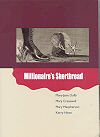
Her first book appearance was with Mary-Jane Duffy, Mary Macpherson, and Kerry Hines as co-authors of Millionaire’s Shortbread, published by the University of Otago Press in 2003. This book is illustrated with collages by Brendan O’Brien, has an afterword by Greg O’Brien, and introduced these four poets to the Wellington scene.

Mary, your first solo book of poetry, Nearest & Dearest (Steele Roberts, 2009, NZ RRP $19.95, illustrated by Nikki Slade Robinson) is a book of humorous poetry, which is a side of your work I’ve not seen before. Have you always written humorous poetry alongside your serious poetry, or has that been a recent development?

The opposite, actually. I stopped writing serious poetry when I was about 17 and only took it up again the year I turned 60. All the years I didn’t write serious poetry, I’ve frequently come up with silly stuff for friends, for occasions in the office, or for family. That’s been a constant. I just wish I’d kept copies!

How did you become involved in writing poetry? Which poets have been most influential on your writing?

I was raised in a family where capping verses (usually limericks) was a standard indoor sport, so I have emitted poetry as long as I remember. Important poets? My sense of rhythm owes a lot to Anon. and to Cole Porter. My parents lived on folk songs and cabaret songs, hence my need for accentual (rather than accentual-syllabic or free) verse. Individual poets: Lewis Carroll, Auden, Eliot, Poe, Dorothy Parker, Donne, Walter Scott, Byron, Longfellow, Ogden Nash, Sidney Lanier… for starters. These days I’m reading Kay Ryan, Marie Ponsot, Robert Alter’s new translation of the Book of Psalms, among others.

“Humour” and “playfulness” are not words often used to characterise the literary scene in New Zealand. Indeed, there seems to be a view here that purse-lipped seriousness is the only acceptable literary stance. Have you run foul of such attitudes, or is this just me being paranoid?

I think “literary” is the operative word here, and no, you’re not paranoid. But this isn’t poetry’s fault: A lot of people last thought seriously about poetry in the fifth form and settle for genteel obeisance to Beauty and Nature when they think of it at all; light verse is for greeting cards, and they can’t imagine a serious message coming via humour. — And there’s also literary fashion. Humour is difficult in personal-experience poetry written in free verse, with no formal aspect. In New Zealand, we have to go back a generation to, say, Denis Glover to find a top poet writing humour, especially black humour, with a sting in it. Was Glover ever considered literary? I don’t know; I wonder if his contemporaries kept him in a category of his own.

Not many Americans write poems that feature cricket, such as “Willow Green Willow” in Nearest & Dearest. Do you now feel thoroughly ‘acclimatised’, if I may use the term, as a New Zealand poet?

After forty years in New Zealand, I’m about as acclimatised as I’ll ever be. I switched to correct [sic] spelling early on, though my spoken accent will never change much. I’m not sure, though, if any poet can or should aim for the mainstream. I know that both Americans and Kiwis think I don’t really belong, and the discomfort that comes from this seems to keep my satiric side alive and healthy.

Several of the poems that I most enjoyed in Nearest & Dearest are parodies of or based on other poems, several from the Victorian era. I know I like reading these – what attracts you to writing them?

They’re easiest to get started. Many of them (like the office manager’s Shakespeare sonnet (see below) or playing games with Wordsworth in the ‘Pass at Grasmere’) are based on poetry I read years ago, and they’re part of my sensibility in a way more recent poems aren’t. So a phrase—a few lines—perhaps a rhyme for ‘schadenfreude’— will pop into my mind by surprise; then I spend hours and hours trying to polish a humorous poem that also is a credit to the original.


Your poem “Metastasis” appears in Voyagers: Science Fiction Poetry from New Zealand, and you work as an editor of science publications. How much of an influence has science had on your poetry? Would you describe yourself as a “science poet”?

Not a “science poet” in that I rarely take scientific principles into account; “Metastasis” is a bit aberrant. I take notes of and am definitely influenced by goofy-sounding phrases I run across in the course of proofreading fearsomely technical material. (Who would be a “ring-based indole”, I ask you?) The US magazine Umbrella publishes an annual light supplement, Bumbershoot. This poem: http://www.umbrellajournal.com/summer2009/bumbershoot/light_verse/LabNote.html reflects a temporary passion for technical terms beginning with “Sq”.

Are copies of Nearest & Dearest available in bookshops yet? If so, where can people find it?

Absolutely. In Wellington, try Unity Books; Moby Dickens and Paper Plus in Paraparaumu; Bruce Mackenzie’s in Palmerston have it for sure. Books a’ Plenty in Tauranga. If you don’t see it on the shelf, ask for it. Supporting your local bookseller is admirable, virtuous, and a sign of high intelligence. If all else fails, the book’s available from the publisher and from Fishpond.

Finally, what’s next for Mary Cresswell as a poet?

Write more. Read more. Read more. Write more.

Watch this space.

THE OFFICE MANAGER ADDRESSES HER MIRROR
by Mary Cresswell

Shall I wear the Gucci scarf today?
It’s far more lovely and more corporate
than what sleek young managers affect
in all the offices up and down the way.

It gives an air of strength, they always say,
classic looks for classic power dressed,
Look and feel and act as though you’re best
and the rest will follow, as the night the day.

No dangly earrings! What women call
postmenopausal zest, in other places
gives a bad impression overall.
I will notice all their airs and graces,
a quiet woman, not looking to outwit them…
I shall run the show before they know what hit them.

This interview is the first stop in Mary’s “virtual book tour” for Nearest & Dearest. The next stop is on Janis Freegard’s blog.