Blog

How To Buy My Books: Anarya’s Secret, Transported, Voyagers, And More

Welcome! Since I’m between blog posts at the moment, here are details about how to buy some of my books. You’ll find my recent posts listed on the left-hand side of this blog.

You can find details of all these books at my Amazon.com author page.

You’ll also find my work in these recent anthologies:

Poetry Day Post

Today is New Zealand Poetry Day. As a Tuesday Poet, I should have put up a post on this theme on Tuesday, but I, er, didn’t. (Never explain, never apologise – or wait, isn’t that Rupert Murdoch’s credo?)

Anyway, I thought I’d use the occasion to direct your attention to the excellent work of those who did. Renee Liang did double duty by both posting a wonderfully phrased poem about Christchurch on her blog, and editing the week’s post on the hub Tuesday Poem blog, with poems from the three finalists for the 2011 NZ Post National Book Awards. If if you look in the sidebar to the right, you’ll find Poetry Day posts from lots of the Tuesday Poets, with poems and news of poetry events.

I’m embarrassed to say that it’s a long time since I have written a poem – what writing time I have had lately has been going into writing short stories – but I’ve had quite a bit to do with poetry nevertheless.

First, I’ve selected the poems by Australian and New Zealand poets for inclusion in Eye To The Telescope 2, and should be able to deliver the introduction, poems, and bios for this to the Science Fiction Poetry Association by my self-imposed deadline of 25 July.

Second, planning is proceeding apace for the book tour at the end of October which will launch my collection Men Briefly Explained and Keith Westwater’s collection Tongues of Ash, both published by Interactive Press. Once we have all the details settled, we’ll start to spread the word about the details of the tour – but, right now, we have venues confirmed in four centres.

In the meantime, enjoy Poetry Day!

Slightly Peculiar Love Stories Is Launched


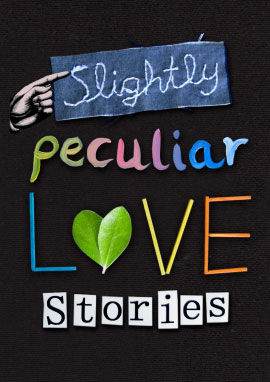
At 5.30pm Wednesday, New Zealand time, Rosa Mira Books launched Slightly Peculiar Love Stories, an anthology of 26 love stories by New Zealand and international authors, edited by Penelope Todd, and including my tale of love and literary funding, “Said Sheree”*

What a range of authors! They come from Israel, the Philippines, the UK, the USA, Greece, Argentina, and Hong Kong, as well as Aotearoa. Some are internationally well-known; some are well known within their own countries; some are near the start of their literary careers, and some well along in those careers. One is pseudonymous.

I haven’t read the anthology yet, but from what I’ve read about the contributors and their stories on the excellent Rosa Mira Books blog, I expect some of these stories to be slightly peculiar, and some deeply peculiar. Which is appropriate, because that’s the way love is.

I’m delighted to be in the company of so many writers I greatly admire. Please raise a glass to Slightly Peculiar Love Stories. Please help it make its way into the world.

*First published in Transported.

Five Questions With Anna Caro, Co-Editor Of “Tales For Canterbury”


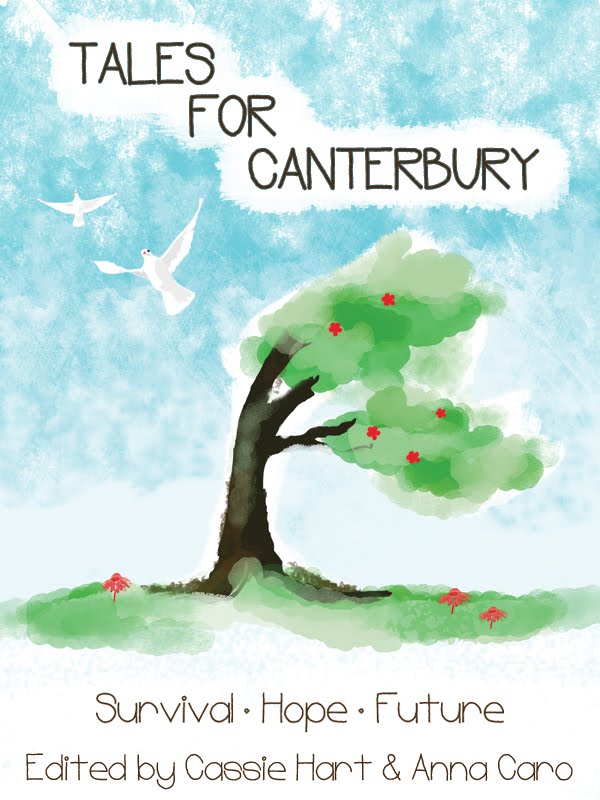
Since the Christchurch earthquake of 22 February, editors Cassie Hart and Anna Caro have done an amazing job of pulling together Tales For Canterbury, a fundraising anthology to benefit the victims of the earthquake, with all proceeds going to the New Zealand Red Cross Earthquake Appeal. All the stories have been donated by their authors, and so far, just over half the fundraising target of $5000 has been raised – something you can help with by buying the book as an ebook or paperback.

I asked Anna Caro five questions about Tales for Canterbury, and here are her answers:

1. How soon after the February 22 earthquake did you have the idea for the anthology?

My original answer for this was “pretty quickly – within a few days”. Then I went back and checked my emails and found that Cassie emailed me with the idea only a few hours after the quake. Before I’d left work for the day the idea was already taking shape and we were contacting friends and people we’d worked with on other projects.

2. The list of contributors is impressive to say the least – a great range of New Zealand authors, and also such overseas luminaries as Neil Gaiman, Gwyneth Jones, Jay Lake, and someone whose story I’m especially keen to read, Jeff Vandermeer. How did you manage to get so many prominent speculative fiction authors involved in the project?

One of the things putting together Tales for Canterbury made me realise was how far our networks reached. Over the past few years both of us have been building up contacts through editing, events including conventions, involvement in SpecFicNZ and membership of critique groups, and we had a lot of people to call on when we needed them.

Our individual networks didn’t quite reach the name’s you’ve mentioned – but we knew people who knew them and were happy to get in touch with them for us. The exception is Neil Gaiman who Cassie (with a bit of encouragement) emailed directly after seeing he made a blog post mentioning the earthquake – his wife was in Christchurch at the time.

3. Tales for Canterbury isn’t all speculative fiction, though. Can you tell me about some of the literary and general fiction authors who have work included in this anthology?

Around two thirds of Tales for Canterbury is speculative fiction of some description, but we have some excellent examples of literary or general fiction. Amongst the authors are Kate Mahony, who I first met in an undergraduate class at the IIML, Janis Freegard who lives in Wellington and I knew primarily as a poet and of course yourself (Tim Jones), and subjects range from being a New Zealander overseas, through misfit and eccentric characters to an imagining of life after the earthquake.

I think the fact we imposed only quite broad restrictions on what we were looking for encouraged writers to submit work outside of their usual genre, and several – including Mary Victoria, Philippa Ballantine, and my co-editor, Cassie Hart – who are primarily known for speculative fiction contributed more realistic pieces of work, though the influence of the genre is often apparent. The technology in Mary Victoria’s ‘Daughter of the Khan’, though historically accurate, is perhaps even more frightening and magical to the characters as an alien ship might be to us – and she makes us believe it.

Also worth mentioning here is A.J. Fitzwater’s ‘My Father, the Tuatara’, which I would describe as magical realism, a genre frequently claimed as both speculative and literary fiction. Throughout the story, you’re never quite sure whether this is an elaborate metaphor, or a fantastical event, which handled with less skill could be jarring, but here is poignant and thoughtful.

We also have a couple of stories from other genres; I hope there is something everyone will appreciate included.

4. The anthology is divided into three sections – “Survival”, “Hope” and “Future”. Did you have that division in mind from the start, or did the stories you received naturally fall under those headings?

It came quite early on. We wanted to give the anthology some form of structure, but nothing that excessively limited the stories we included. We played with a few ideas and ended up with this one which mirrored, if in a simplistic way, the stages of a recovery. There were a number of stories that fitted quite naturally under more than one of the headings, and a couple we had to think about a bit before placing them anywhere but I hope the categorisation we ended up with adds something to how readers think about the stories.

5. I know from my own experience how much work goes into co-editing an anthology, let alone publishing it. You’ve taken an anthology from nothing to completed and published in three months. How on earth did you manage it; have you been able to keep your own writing going during the process; and what lessons have you learned from the experience?

To put it succinctly: with lot of help. I admit we struggled at times but we had so many people helping out behind the scenes, be they our team of volunteer proofreaders, who got through a section each on a very short timeframe, or those who brought us caffeine when we’d been up far too late. There were some circumstances in our favour; in particular, the fact a number of the stories were reprints meant many needed close editing. We also decided early on that the anthology needed to be invitation only; in the past I loved reading work by authors new to me, but in this instance we just weren’t able to handle a large slush pile.

I think at times our own writing did suffer for both of us, but within a week of Tales for Canterbury being sent to the printers, both Cassie and myself independently sat down and just wrote, so the damage was definitely temporary – and in any case, I think editing, closely reading other people’s work, really does help in the long run.

Lessons? After the previous anthology I edited I had all these bright ideas for improving things, and then when Tales for Canterbury came up I implemented some, but many just got lost in the tight timeframes. So I guess the fact that every project is different would be a lesson. On a personal level, though, I think the biggest lesson I learned was about sharing responsibility. I’m hopeless at delegating, but working with Cassie, who is superbly committed and reliable, and the effects of both having otherwise busy schedules, helped to change that. We passed things back and forth, one picking up when the other was busy, and swapping tasks when things just weren’t happening, and having that very positive experience has, I’m sure, taught me a lot about taking a step back and trusting other people to get it right.

Tuesday Poem: This is the way the world ends, by Helen Rickerby

 
This story is about remembering
and forgetting

Not knowing where you are
or if it’s real

But you can die with a martini in your hand

                          *

The girl in pink, skating towards you
has an automatic weapon
behind her back

and this drug will take you to Jesus
if Jesus is a chorus
line of short-skirt nurses

                          *

There is too much sun in California
for shadows

                          *

There are other people
in this story

The bride and groom who laughed themselves to death

the boy who lost hope

the pirate soldier, the man with two souls

the porn stars, the family

the whole city

the whole world

                          *

This is an apocalypse

in an ice cream truck

                          *

Twiddling his fingers
While LA burns

‘He’s going to die,’ says one blonde, sadly
‘There’s nothing we can do,’ says the other

as they dance cheek to cheek
hand in manicured hand

There’s nothing they can do

Credit note:“This is the way the world ends” was first published in Trout 16 and is reproduced here by permission of the author.

Tim says: Helen Rickerby and I have something more in common than being Wellington members of the Tuesday Poets. We like something that, to many, is a subject to be scorned, feared, or ridiculed. We like Richard Kelly’s movie Southland Tales.

Southland Tales, Kelly’s followup to Donnie Darko, was a critical and commercial disaster, a great, sprawling, baffling, infuriating mess of a movie that goes nowhere and everywhere at once. The thing is, though, that it is full of the most wonderful images and concepts. It’s like someone put Andrei Tarkovsky’s soul inside Michael Bay and gave TarkoBay (Baykovsky?) a few mill to go and play with. It’s the postmodern “Heart of Darkness”. It’s nuts. You should see it.

But that’s enough about me … from this raw material, Helen has fashioned another of her marvellous poems inspired by movies.

You can read all the Tuesday Poems on the Tuesday Poem blog – the featured poem is on the centre of the page, and the week’s other poems are linked from the right-hand column.

An Interview With Janis Freegard

Janis Freegard is a Wellington-based writer of poetry and fiction. She was born in South Shields in the North-East of England and spent part of her childhood in South Africa and Australia, before her family settled in New Zealand. Her poetry collection, Kingdom Animalia: The Escapades of Linnaeus, was published by Auckland University Press in May. Her writing has appeared in many journals and anthologies including AUP New Poets 3, Big Weather: Poems of Wellington, Voyagers: Science Fiction Poetry from New Zealand, The Iron Book of New Humorous Verse, The NZ Listener, Landfall, The North (UK), JAAM, Poetry NZ and Trout. She works in the state sector and lives in Vogeltown with an historian and a cat. She also has a blog: http://janisfreegard.wordpress.com

Janis’ poem A Life Blighted By Pythons was my Tuesday Poem this week.

First things first: why Linnaeus?

I wanted the book to have some kind of structure. As the poems were about animals (or at least had an animal in them somewhere), it seemed like a good idea to arrange them according to their taxonomic classification. I’d learned a little about taxonomy at university and when I worked at the Department of Conservation (trying to prevent trade in endangered species).

Our modern classification system has so many categories, though, that I soon realised it was going to be too hard to write poems for every different class of animal. That’s when I hit on using Linnaeus’ six groupings (mammals, birds, amphibians, fish, insects and worms). Linnaeus was the eighteenth century Swedish naturalist who came up with the two-word classification system for plants and animals that we still use today (such as Homo sapiens for human beings).

Once I started organising the poems into the six categories, I decided to write about Linnaeus himself as well. He was an extraordinary man. I can’t help but admire his commitment and tenacity in trying to categorise every plant, animal and mineral on the planet.

More generally, why zoology? (As someone who can proudly boast of being a BSc in Botany (Failed), I am naturally hoping that the other kingdoms will get a look-in in future collections. I can’t help feeling that the Archaea, for example, are not well represented in contemporary poetry.)

I agree that the Archaea are sadly neglected, and I hope poets everywhere will rise to the challenge of remedying that! I have a Botany degree, so zoology might not seem like an obvious choice. But I do seem to write a lot of poems about animals and I thought the animal kingdom would be a good theme for a collection.

I very much enjoyed your selection of poems in AUP New Poets 3. Is there a lot of continuity between those poems and the poems in Kingdom Animalia, or do the new poems mark a sharp break with your previous work?

Thanks Tim. Several of my poems in AUP New Poets 3 have animals in them (such as the ‘Animal Tales’ sequence) so I do think Kingdom Animalia carries forward some of the strands from that selection. Both books also contain some prose poems and both have elements of surrealism.

If someone described you as a “nature poet”, would you be pleased, alarmed, indignant, or unruffled?

I don’t mind being described as a nature poet, but I’m not sure it gives the full picture. Perhaps I could be a sometimes absurdist nature poet who also writes about life in the city and love.

You are great at running fun, memorable book launches. How do you manage it?

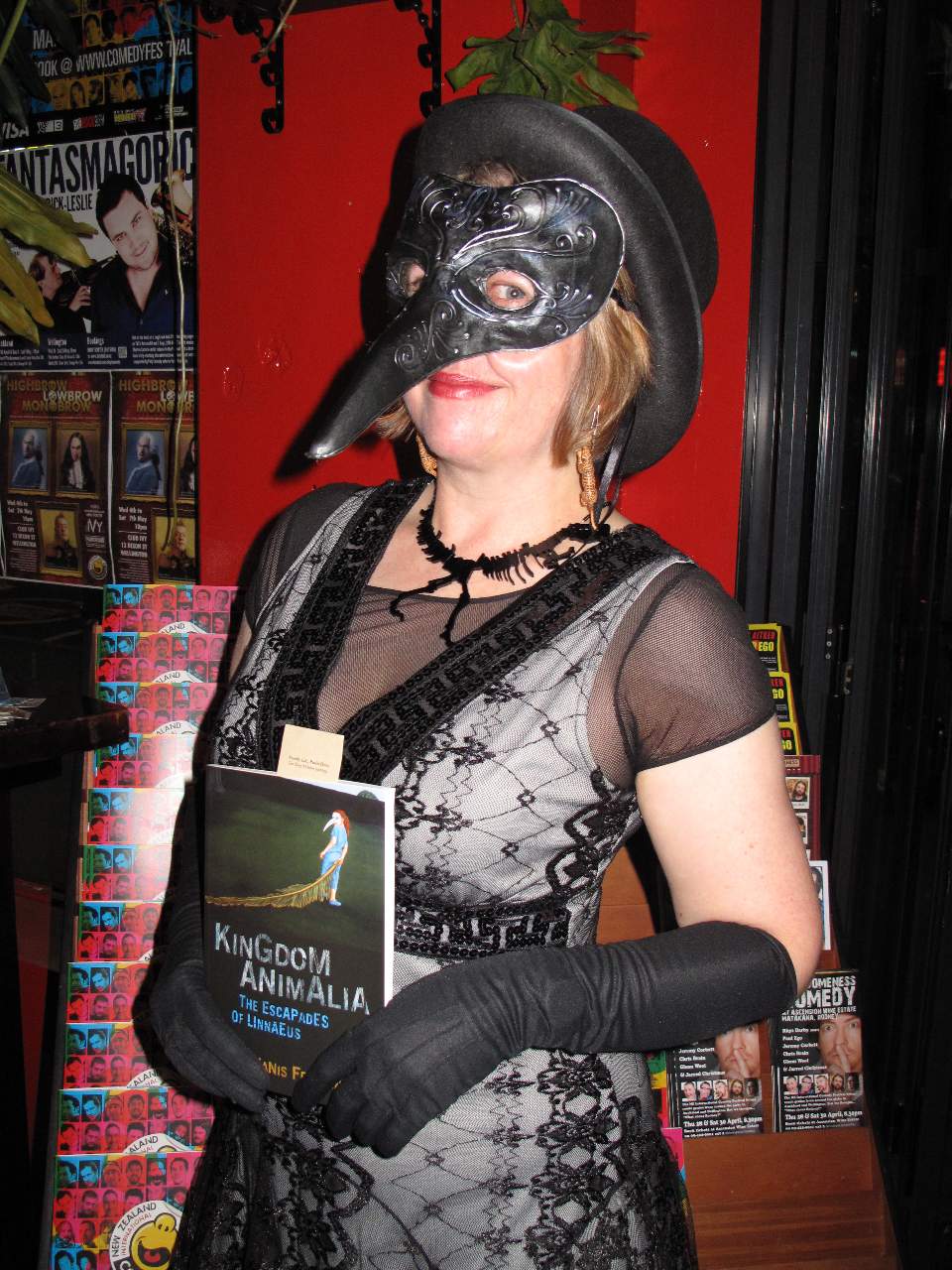
Thanks Tim, and thanks for coming to the launch! I see a book launch as an excuse for a bit of a party – I want people to feel entertained and enjoy themselves. And the planning is just as much fun as the event. I had such a good time designing the invitation, choosing the venue, making the fresh asparagus rolls and dressing up in a bird mask (like the one on the cover of the book). I also had some great helpers on the night.

My knowledge of your work is mainly through your poetry, but it is bookended by fiction; I first heard your name when your story “Mill” won the Katherine Mansfield Award in 2001, and I’ve just received my copy of the Christchurch earthquake appeal fundraising anthology Tales for Canterbury, which includes your story “The Magician”. Have you kept writing fiction as well as poetry?

Yes, I’ve always enjoyed writing both poetry and fiction, although at times one takes precedence over the other. Poetry had the upper hand while I was focusing on Kingdom Animalia and now I’m getting back into fiction a bit more. I haven’t written many short stories over the past few years, though, as I’ve been focusing on writing a novel. Sometimes the lines between poetry and fiction get a bit blurry – I like writing prose poems, which seem to belong in the grey area between the two.

Is being a member of a writing community important to you, or could you work away just as happily in isolation from other writers?

I really value opportunities to interact with other writers. I belong to a long-standing poetry group that meets monthly to share poems and give each other feedback. I often take along poems that aren’t quite working and it’s very useful to hear others’ thoughts on how I might improve them. It also means I get to read everyone else’s excellent poems. I also enjoy being part of the New Zealand Poetry Society and going along to Poetry at the Ballroom Café in Newtown.

I belong to a great fiction writing group too, which has been meeting for about eight or nine years. I could work away quite happily on my own, but it is good having the groups. They also act as a helpful spur to write.

Which poets would you recommend to readers who enjoy your poetry?

People who like my poetry might also like Vivienne Plumb’s work (I know I do) and Mary Cresswell’s (ditto). I have too many favourite poets to list them all (and my poetry mightn’t have much in common with theirs) but I’d have to include (alphabetically) Simon Armitage, Jenny Bornholdt, Selima Hill, Gerard Manley Hopkins, Roger McGough and Bill Manhire. I like punk era performance poets too, like Patti Smith, John Cooper Clarke and Linton Kwesi Johnson. And I’ll go and watch Sam Hunt read any time I can.

Similarly, who are some of your favourite fiction writers?

Jeanette Winterson’s top of the list – there’s one of her short stories (The 24-Hour Dog from The World and Other Places) that I have read over and over and every time I read it, I think: I might as well give up writing now because I’ll never be able to write something that good! Sometimes I just read the first paragraph and sigh because it’s so wonderful. I’m also a big fan of Canadian writer Jane Rule (one my favourite books is This is Not for You), Jean Watson (Stand in the Rain, The World is an Orange and the Sun, The Balloon Watchers, Three Sea Stories), Noel Virtue, Lewis Carroll, Banana Yoshimoto (I’ve just finished reading The Lake), Ronald Hugh Morrieson, Haruki Murakami, Sarah Waters and Tove Jansson (better known for the Moomin books, but her adult fiction is also wonderful, in a very understated, quiet way). I could rave on, but I’ll stop there.

Finally, if you don’t mind me asking, what projects are you working on now?

I’m working on two poetry collections (which may converge eventually) and I’m finishing the first draft of a novel. I’m also planning a collaboration with an artist.

How To Buy Kingdom Animalia

Kingdom Animalia is available from most book shops that have a good poetry selection, such as Unity Books, university bookshops and Te Papa, and many online booksellers, including Fishpond and Wheelers, or people can get it directly from Auckland University Press.

Tuesday Poem: A Life Blighted By Pythons, by Janis Freegard


waiting at the bus-stop
all I can think about
is how my hovercraft is full of eels

but it’s not, of course it’s not
my hovercraft is practically empty
my eels are few

in fact they’re not eels at all
but a netload of whitebait
and it isn’t even a hovercraft

I’ve never owned a hovercraft in my life
I wouldn’t know what to do with one
it’s not even a dinghy

it’s a reusable eco-friendly shopping bag
and they’re definitely not eels
and not even whitebait

the truth is, I’ve never been whitebaiting
they’re just vegetables
and I only have one thing to say:

your eels
my hovercraft
now, baby, now

Credit note: “A Life Blighted By Pythons” is republished by permission of the author and of Auckland University Press from Janis Freegard’s first solo collection, Kingdom Animalia: The Escapades of Linnaeus.

Tim says: I am reading Janis’s marvellously entertaining collection at the moment, and I love this poem so much not only because of its intrinsic qualities, but also because of the shared cultural heritage it so vividly evokes. You can catch more of Janis’s wit and wisdom in my interview with her, which I’ll be posting later this week.

You can read all the Tuesday Poems on the Tuesday Poem blog – the featured poem is on the centre of the page, and the week’s other poems are linked from the right-hand column.

Do You Love Reading? The Altrusa Literacy Quiz

 
Official announcement:

Do you love reading?

The Altrusa Club of Wellington presents a Literacy Quiz fund raiser to benefit Storylines, who promote the importance of reading and literature for children, and Literacy Aotearoa, who are adult literacy providers. Celebrate International Literacy Day in style at the Amora Hotel on Thursday the 8th of September from 7pm.

Support your local community and test your knowledge alongside our special guests; Tessa Duder, Tim Jones, Martin Bosley and more [TJ notes: This modest ‘more’ includes Jenny Pattrick and Elizabeth Knox!]. Invite a friend or gather a team, but be sure to get your ticket to be in to win over $2500 in prizes.

Buy tickets and find out more at http://www.altrusa.org.nz/literacyquiz.html

Join the Facebook event, and invite your friends, at http://www.facebook.com/event.php?eid=220369684647916

Tim says: I like quizzes! Especially if the questions are about international cricket averages (1969-2011), the members of 1970s bands – did you know that Ari Up of The Slits (a sad loss to the world last year) was the stepdaughter of Johnny Rotten? – and the science fiction of R L Fanthorpe.

I’m not sure I’ll be getting too many questions in those categories in the Altrusa Literacy Quiz: in fact, the questions are divided into these categories:

Cool Characters

Our favourite fictional characters

Number Crunchers

Do your answers add up?

Classic Literature

What’s in a name? They used to call me Piggy!

Catching the Current

Off the page, do you know what’s going on in the world?

Silver Screen

Was it better as a book?

I think it’ll be a fun night. If you’ll be in Wellington on 8 September, it’d be great if you could come along.

An Interview With Laura Solomon

Laura Solomon has an honours degree in English Literature (Victoria University, 1997) and a Masters degree in Computer Science (University of London, 2003). Her books include ‘Black Light’, ‘Nothing Lasting’, ‘Alternative Medicine’, ‘An Imitation of Life’, ‘Instant Messages’, ‘The Theory of Networks’, ‘Operating Systems’, ‘Hilary and David’, In Vitro and ‘The Shingle Bar Taniwha and Other Stories’. She has won prizes in the Bridport, Edwin Morgan, Ware Poets, Willesden Herald, Proverse Hong Kong and Essex Poetry Festival competitions.

Laura’s poem Janet Frame’s Adversaries Have Their Way. Janet is Lobotomised and Spends Her Life Selling Hats in Oamaru. was my Tuesday Poem this week.

Laura, you are best known as a writer of fiction, and in vitro is your first collection of poetry. Have you been accumulating the poems in this collection for a while, or have they all been written recently?

I wrote the poems between 2006 and 2009.

For those who don’t know your work, how would you describe your poetry – does it follow a particular style or poetic tradition?

Fairly experimental, but also quite lyrical.

While I was reading in vitro, I noted down descriptions like ‘clinical’, ‘forensic’, and ‘disenchanted’ – though, lest this make the book appear too gloomy, many of the poems are also very entertaining! But do you think these adjectives can fairly be applied to these poems?

Some of the poems are quite bleak or severe in subject matter, but lightened up with comedy.

I see that you have published several novels as e-books in Hong Kong. Was it a difficult decision to have them published in e-book format, and are you happy with the result?

Happy with e-book for Hilary and David, not sure yet whether the sequels to Instant Messages are going to be ebook or normal printed book yet.

I have the impression – forgive me if I’m wrong – that you, like I, write fiction that doesn’t fit neatly into the categories that New Zealand publishers, and perhaps other international publishers, are comfortable with. Do you ever think “Oh, if only I’d written good old realism”, or, “time to get cracking on that paranormal romance”?

No, I just write what I feel like and hope for the best.

How do you think the publishing scene overseas compares to the New Zealand scene, particularly in its hospitality to work that doesn’t fit neat category definitions?

Just the same, difficult to break into UK market, none of the agents or publishers seem interested, so I just keep entering UK competitions from NZ. Seem to do better in comps, than just straight submitting to agents and publishers, not sure why.

Which (if any) poets would you describe as influences on your work?

Atwood, Rich, Plath.

How about writers of fiction?

Atwood, Angela Carter, Jeanette Winterson.

If you have the opportunity, what direction(s) do you see your writing heading in next?

That’s a secret!! ☺

Book availability

Laura’s collection in vitro is available from HeadworX, and there are more publication details of Laura’s other books on Beattie’s Book Blog – check the first comment.

Tuesday Poem: Janet Frame’s Adversaries Have Their Way. Janet is Lobotomised and Spends Her Life Selling Hats in Oamaru., by Laura Solomon


What good would she have been anyway,
left the way she was, full of dotty ideas, half-crippled by madness?
There’re enough raving lunatics in the world,
we don’t need one more curly-haired crazy,
lolloping about the streets, spilling prophecy.

What good would she have been anyway,
claiming to be from her Kingdom by the Sea,
perching on gravestones in the Otago Cemetery,
staring into the far distance,
like somebody who could see something we couldn’t?

And see her there, so happy, all her pain chopped out, eradicated,
along with all her brilliance. Smiling, always smiling – so what if the eyes look dead?

It’s not visionaries the world needs, but hat sellers.

She was something that could not blend in,
too many sharp angles, too many gaudy colours,
and gawd that hair,
but anything, you’ll find, can be reduced to black and white,
anything can be shoved into a box,
it’s just a question of how much has to be chopped off
in order to get it to fit.

After all, anybody can write a book. It’s retail work that’s tricky,
all those numbers to add up and subtract,
when you tally up at the end of the day (that’s if they choose to grant you such power),
all those hats to keep in those tidy little piles,
same colours, same shapes, all together, all neat,
a place for everything. Everything in its place.

All those people to so faithfully serve.

Don’t ask me who made the mould – somebody else, a long, long time ago.
Who cares now, when that thing was created, or how?
we all managed to squeeze ourselves into it,
so why shouldn’t she be forced to do the same?

Who cares what she could’ve or would’ve achieved,
left to her own devices?

The important thing is that we maimed her while we had the chance,
before she grew too big for the boots we wanted her in.

O please now, children, don’t make a fuss,
She could’ve been one of the greats, they said,
now she’s one of us.

Note: This poem is published in Laura Solomon’s collection in vitro (HeadworX, 2011). Look out for my interview with Laura later this week.

You can read all the Tuesday Poems on the Tuesday Poem blog – the featured poem is on the centre of the page, and the week’s other poems are linked from the right-hand column.