 UPDATE: An extended version of this interview will appear in the Journal of New Zealand Literature during the first quarter of 2010.
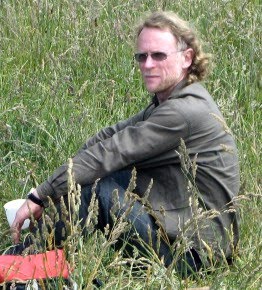
After serving as a pyrotechnics supervisor for acts such as Metallica and Janet Jackson, David Howard retired to Purakanui in order to write. His collaboration with photographer Fiona Pardington, How To Occupy Our Selves, was published in 2003. A draft of the opening poem “There You Go” featured in Best New Zealand Poems 2002; the full text was set for mezzosoprano, narrator and piano trio by the Czech composer Marta Jirackova. “The Harrier Suite” appeared in both Best New Zealand Poems 2004 and The Word Went Round (2006).
In 2007 David worked with Brina Jez-Brezavscek on a sound installation, The Flax Heckler, in northern Slovenia. On 18 September 2009 soprano Judith Dodsworth premiered Johanna Selleck’s setting of his lyric “Air, Water, Earth Meld” at Melba Hall in Melbourne; a recording is planned for release by Move Records later this year. David’s texts for composers are collected in the limited edition S(t)et (Gumtree Press). His poetry has been translated into German, Italian, Slovene and Spanish.
David, I hope I’m not being unfair when I say that your profile as a poet is comparatively low within New Zealand, despite your impressive track record. On the other hand, you have worked extensively with overseas artists. Is the international aspect of your collaborative work a matter of choice, necessity, or a little of both?
Profile, which is periodically if irregularly the consequence of talent, is determined by third parties who are immovable objects before the irresistible force of authorial ego. I prefer pyrotechnics and production management to talking about words; my modest profile reflects my immodest choices.
Choice is, in part, the acceptance of necessity. I can’t regret working with the All Blacks or touring with Metallica, so I can’t regret the invitations that never came to present my poems – nor can I deny that I’d have enjoyed such invitations. Am I saying that the book world is like a classroom where the noisiest pupil gets the most attention? Only on Black Fridays – although a talent for self-promotion naturally turns heads and gets bums on seats. There’s no conspiratorial mystery here. Despite my physical absence, I’ve enjoyed ten fifteen twenty years of respectful reviewing. It began with Kendrick Smithyman:
David Howard’s poems are accompanied by photographs from Paul Swadel. These are formidably sophisticated. They may make you doubt that you are intellectually up to them. The poems may have a similar effect at first, certainly a sense of shock, an uncommon astonishment at the extraordinary poise which is part and parcel of these usually quite short pieces. They are admirably judged, they last long enough to get their various effects but not longer. A certain authority matched with an appreciable intelligence, a body of information used with taste guides the reader into puzzling and on to delight, under government and restraint . . . Howard’s collection comes from 10 years, 1980-1990, his twenties. It should be exciting seeing what he produces in his 30s. (Auckland Sunday Star, 30 June 1991)
And it continues with the younger generation of Richard Reeve, Anna Livesey, Emma Neale and Kapka Kassabova:
David Howard is a mystery figure on our poetic landscape. Sparse in his output, virtually invisible to the media and involved for the last few years in staging entertainment shows around the world as a pyrotechnician, he belongs to an endangered species: the truly independent artist who remains quietly active throughout the years… In poems like ‘Care of the Commanding Officer’, ‘Cain’, ‘On the Eighth Day’, ‘Dove’, ‘To Cavafy’, to name but a few, the cerebral blends with the visceral with a brilliant lightness of touch. (New Zealand Listener, 2-8 Feb 2002)
So it’s valorizing crap to quote Hofmannsthal, ‘Die andern wollten mich daheim zu ihrem Spiel,/ Mich aber freut es so, fur mich allein zu sein.’ (‘The others wanted me to join them in their games,/ But to roam freely and alone is what I like.’) The latter is true but if I haven’t been invited to join then it’s partly due to my curiosity for exploring the byways of elsewhere.
Like everyone else, I need to work with people who are interested in what I do. After all, the faithless man discards himself. For me collaboration is a halfway house between the private ideal and public service. Perhaps it’s a corollary to the pastoral/urban tension, with genre rather than geography providing the frame.
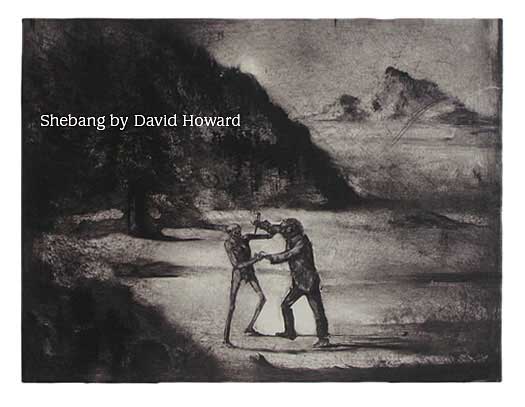 Shebang, by David Howard, on Trout
Having happily collaborated with artists Paul Swadel, Jason Greig, Fiona Pardington, Kim Pieters and Garry Currin I wanted a more compressed, essential process so my interest shifted to music. Who? Anthony Ritchie has creditably set poets but I don’t like his music. I’d like to like it however, as philosopher Alan Musgrave points out, we don’t choose our likes or dislikes, nor do we choose our beliefs. So far I’ve worked with three composers: Marta Jirackova of the Czech Republic, Brina Jez-Brezavscek of Slovenia, and Johanna Selleck of Australia.
When most of my contemporaries (and potential listeners) are rocking backwards and forwards to variants of popular song, why am I attracted to the art song, oratorio and songspiel? The latest hit song gives us the liberty to be superficially involved but still enjoy; it is the artistic corollary of casual sex. A contemporary classical piece demands commitment before it surrenders its charms. Karlheinz Stockhausen, speaking about Stimmung, asserted: ‘One listens to the inner self of the sound, the inner self of the harmonic spectrum, the inner self of a vowel, the inner self.’ I hear that as a Kantian challenge to respect the autonomy of whatever and whoever. Each of my collaborators has the modesty of one who understands ‘the fascination of what’s difficult’ (Yeats). They care more for the material than for attention; otherwise why set a poet from New Zealand? Marta’s answer: ‘I see that it is a country of miracles.‘
Reading Richard Reeve’s 2002 interview with you in Deep South, I got a strong impression that you are largely out of sympathy with the current state of poetic practice in New Zealand – both with much of the poetry being produced by individual poets, and with the infrastructure by which poetry is published, reviewed, and brought to the attention of its potential audience. Is that fair comment, and have your views changed since 2002?
As the view has got darker (it must have, look at all those stars!) so have my views. But I’ve been lucky enough not to wake up a curmudgeon who is bruised by youthful failure. I still smile at the horizon as I sip coffee that is stronger than my attraction to the NASDAQ. When I arrive at my desk I find the draft of a literary quiz; it begins ‘Which top or leading New Zealand poet is the subject of these lines?’
Because his subsidy comes from the State
For teaching self-expression to the masses
In jails, nut-houses; worse, in grad-school classes
In which his sermon is (his poems show it)
That anyone can learn to be a poet.
With pen in hand he takes the poet’s stance
To write, instead of sonnets, sheaves of grants
Which touch the bureaucrats and move their hearts
To turn the spigot on and flood the arts
With cold cash, carbon copies, calculators,
And, for each poet, two administrators.
In brief, his every effort at creation
Is one more act of self-perpetuation
To raise the towering babble of his Reputation.Small wonder that his subject matter’s taken
From the one sphere in which his faith’s unshaken
As, fearful of offending powers that be,
He turns his gaze within, exalts the Me,
And there, neither with wit nor with discretion,
Spews forth page after page of mock-confession
Slightly surreal, so private, so obscure
That critics classify his work as “pure”
Because, in digging through the endless chatter,
They can’t discern what is the subject matter,
And so, instead of saying they don’t get it,
They praise the “structure” they invent to fit it.
He has no fear, for when his work’s reviewed
Friends do it; thus, he’s never gotten screwed.
He’ll do the same for them, and they remain
Pals in the literary daisy-chain
Where every year, like Hallowe’en surprises,
They pass each other fellowships and prizes,
Include each other in anthologies
And take their greedy cuts from poetry’s moldy cheese.
You’re wrong, it’s not Bill Manhire. But your inference makes my point. I hear you clear your throat. Of course the question was unfair – a low blow intended to double up the reader, albeit with laughter. That excerpt is from The Narcissiad (Cedar Rock Press, 1981) by the American satirist R.S. Gwynn so the situation described is typical rather than particular. Typical of what? An institutionalised poetry scene such as has developed here over the last three decades.
When Richard Reeve interviewed me after my return to the mainland I affirmed that the first responsibility of an institution is to export its values, its valuations, in order to extend its longevity and therefore make more money. The imperative is economic rather than poetic. This means that statements by the representatives of institutions should be viewed as propaganda regardless of their truth quotient. In other words, whether the statements are true or not, their primary purpose is to impress rather than inform. The IIML is infamous for referring to itself as famous; the frequency of repetition is Orwellian yet commercially irreproachable.
Institutional or not, we do seem desperate to puff up our chests and strut like roosters across a painfully small backyard. Even the finest suffer. When Andrew Johnston asserts that Manhire is ‘our best poet’ then I hear Johnston’s ambition rather than Manhire’s achievement, which is (brilliantly) derivative and acknowledged as such by him. Curnow’s polished poems appear to have been written primarily so they (and their author) could be admired, while Baxter insists on repeating stage directions out loud. Karl Stead (institution and iconoclast in one) is the world authority on C.K. Stead; we learn this by reading any recent essay by him irrespective of its stated topic. In an age when reviewers crib press releases, assertion of will is a determinant of reputation (it was Dan Davin who mentioned ‘the plasticine of truth’) but evangelical self-regard is rather different to the verdict(s) of history.
Look back a century – what most people believed then is not what their descendents believe now. Future generations will have a plurality of responses to today’s poetry, responses that will negotiate the leverage of today’s institutions and discard authorial special pleading. Who knows what will settle where and for how long? Our superior collections have had mixed fates: Michele Leggott’s Dia deservedly won the New Zealand Book Award for Poetry, whereas Graham Lindsay’s stringent The Subject was sidelined. Both books were published by Auckland University Press in 1994 so imprint, release date, publicity and distribution were comparable and therefore neutral factors. Admittedly, as a Christchurch resident, Lindsay was disadvantaged – and this despite the presence of literary historian Mark Williams who, like a colonial functionary, looked to the main chance of Wellington.
Tim, since you speak Russian, here’s an instance where the main chance was a missed chance. This example avoids the prickly pear of reputation; instead it squeezes the lemon of ignorance. Had Williams put down Sport long enough to browse the Christchurch journal Takahe, which I co-founded in 1989, then he could have read the editorial of Takahe 3 (Autumn 1990) by Tatyana Shcherbina and R.V. Smirnow. “The New Zealand Project”, an open letter sponsored by 42 Russian signatories, called for an autonomous laboratory of new artists, asserting:
The geographical place where this autonomous laboratory will meet the new age, and perhaps be realised in its integrity, we call New Zealand. This is a land out of fairy-tales, belonging to the Queen of Great Britain and to God in equal measure, islands at the «end of the world» which, compared with the rest of the world, are governed with more ecological sensitivity, which have preserved a culture and a political purity that quite miraculously turn out to be parallel, new and independent in relation to the rest of the world. So it is to this country that we would like to present our computer-bucolic project of a community of free people.
Williams could have looked through Curtainless Windows: Contemporary Russian Writing (Takahe 5, Spring 1990), discovering poems from Mikhail Aizenberg, Tatyana Shcherbina, Alexandra Sozonova, Ludmila Stokowska, and Sergey Stratanovsky – all translated by J. Kates, whose Zepyhr Press published The Complete Poems of Anna Akhmatova (1990). He would have learnt that the Cyrillic alphabet abbreviates ’emergency ration’ to ‘N.Z.’, but for Shcherbina
N.Z. is now only New Zealand.
Once it made me think of emergency rations,
I mean, a touch of the commie state – not its ill-wishers
but its orphans (that obscene look never wears thin)
a touch ever more unfeeling, without strands of wool
on its pelt, nor birthmarks.
You can love a hag’s eyes and touch eyelids
where the eyelashes have fallen out, white and iris –
shot off into space at an enemy.
Only a single husk left over, a foil
with the superficial depth of a hologram.
You can scrutinize it, and wait until it revives,
skewer it on a Finnish knife –
the way spectators got into silent movies,
now that N.Z. is an antique canvas.
In America this material was commended by the likes of Marilyn Hacker, who wrote of Mikhail Aizenberg: ‘American readers are introduced to the work of an important contemporary Russian poet, whose world-view and aesthetic will seem at once welcome in its otherness and pertinently familiar… In J. Kates’ translations, these poems have a new and discrete life in English.’ But not a life our scholars share – there’s no acknowledgement in either Mark Williams’ introduction or Gregory O’Brien’s preface to Land of Seas: An Anthology of New Zealand Poetry (with E. Pavlov, Novoe literaturnoe obozrenie, 2005).
Perhaps this is forgiveable; their task was to showcase New Zealand poets to Russian readers, not to catalogue contacts. But Landfall 213: Russia (OUP, 2007) shows that a history missed is a history rewritten. What are we to make of the failure by Jacob Edmond, Gregory O’Brien, Evgeny Pavlov and Ian Wedde to recognise a direct precursor, “The New Zealand Project”? They are scholars not enthusiasts rapping in a back yard as the barbecue spits. How can an essay entitled “No Place like Home: Encounters between New Zealand and Russian Poetries” fail to cite (to sight) the Kates’ translations, which also appeared in Takahe 15 (Winter 1993), especially when Edmond discusses the samizdat issue (Leningrad, 1989) of the open letter? [To be fair, when I directed his attention to this he was enthusiastic and apologetic.]
It’s simple. When there’s a lot of noise from one direction then heads naturally turn that way. Scholars of contemporary poetry look to Wellington with good reason. The obligation is not on the IIML/VUP/Sport nexus to quieten down, but on scholars to explore elsewhere before drawing conclusions. Too often when they turn their backs on the capital it’s to use a Claude glass. Rita Angus’ absurdist quip from 1947: ‘New Zealand is, in essence, medieval’ could be whimsically applied today, with Bill Manhire our urbane Aristotle: an influential teacher, a model of professional generosity, whose centrality is simultaneously inspiring and an obstacle to seeing clearly.
Perhaps, all said and nothing done, I have woken up as a curmudgeon. If I think of New Zealand poetry then I think of a schoolchild in the front row, arms tightly folded, seeing no one but the registered teacher. If I think of, say, Arabic or Spanish poetry then I think of a schoolchild in the back row, arms wide open, looking over dozens of others, perhaps adopting this one’s posture but that one’s gesture then abandoning both. And I know that Arabic and Spanish are greater for engaging with an overt subject rather than pirouetting on a pinhead, which is the indulgence of the privileged. I can’t regard the cynical non-poetry of Damien Wilkins as more deserving than that of the committed Bill Sewell, who wrote to Iain Lonie: ‘no doubt/ the palace seems full of intruders.’
Again based on your interview with Richard Reeve, you are not enamoured of the role of artists within a capitalist system…
Privilege and barbarism should be strangers; instead they are close relatives. Capitalism is that procedure whereby we sanctify greed. When our politicians reinforce the imperative of ‘economic growth’ they are enlarging the cathedral – in order to maintain the cemetery out back. Poetry is what marks the headstones and honours those below. It is antipathetic to systems. William Morris offers the consolation, but also the impotence, of hope: ‘It is not this or that…machine which we want to get rid of, but the great intangible machine of commercial tyranny which oppresses the lives of all of us’ (Art and Its Producers, 1881).
Privation magnifies appetite, but so does abundance. Whether blue or white, New Zealanders are greedy (once, say 10.47am on 17 June 1996, even I was greedy). We consume well above our share, and we go into debt to do so. That can’t last, nor should we try to make it last. Dr Megan Clark (CSIRO) warns that ‘in the next fifty years, we will need to produce as much food as we have ever produced in the entire human history.’ How? Our lifestyle is founded and founders upon impossible assumptions, our arts are regarded by administrators (who should know better) as consumables, and more people ask themselves ‘When Madonna adopts an orphan does she get stretchmarks?’ than worry over global warming.
I’m too worn to believe that the lyric fosters intimacy beyond a one-on-one reading – it’s not a blueprint for unity between people(s). But I recall Charles Brasch’s early pointer:
…the arts do not exist in a void. They are products of the individual imagination and at the same time social phenomena; raised above the heat and dust of everyday life, and yet closely implicated in it. Any serious consideration of them is bound to involve an inquiry into their place in society and the social functions which they fulfil – what part they play in life, what use they are. This in turn must lead sooner or later to questions about society itself and what it exists for, and, eventually, about the nature of man. (Landfall 1:1, March 1947)
After reading material from the winners of the seven literary prizes highlighted this week, I have to ask: Did we wean ourselves from an imperial motherland in order to suck the tit of free market globalization? Following New Zealand’s political reorientation, our poetry has turned from British to American (rather than indigenous) models. This is change but not the liberation that many claim.
Yes, this is a young country – but that doesn’t mean we have to trumpet the infantile. Perhaps the reward of sentiment and bathos is one indicator of our exhausting immaturity as a literature. Reading Jenny Bornholdt’s The Rocky Shore, which is anecdote leached of the life it purports to honour, I recall Christopher Lasch’s warning: ‘The record of the inner life becomes an unintentional parody of inner life. A literary genre that appears to affirm inwardness actually tells us that inner life is precisely what can no longer be taken seriously.’ E.M. Cioran is sharper and blunter: ‘art, on its way to exhaustion, has become both impossible and easy.’ There’s an ocean of talk but no one is walking on water. I take pleasure and hope from those prepared to ask harder questions than ‘How much attention?’ and ‘How much?’ Sally Ann McIntyre and Robert McLean, both of whom have yet to publish collections, can think and write beyond the obvious.
I remain a naturally reclusive character who, politically, is committed to the notion of community. There are many ways to approach that notion. For the poet Thomas James, whose stony tenderness I admire, it was through the theatre of extremity. You might write yourself into a corner, yet a corner is also a social place.
It’s my impression that some poets are writing primarily for an audience – writing to be heard, or read – whereas others are writing primarily for themselves. Do you think there is any truth in this distinction, and if so, which “camp” would you put yourself in?
Logically it’s possible to do both simultaneously. It depends on your temperament. You need to be extroverted to work the populist (rather than the public) vein with integrity. An audience may be the intended but it is not the only beneficiary of fine writing. Here some poets proceed, filled with a rather bumptious enthusiasm, on the basis that they are required to entertain primarily rather than secondarily – and they do violence to their work by trying to be stand-up comedians. They may be praised for a gritty accessibility (Tuwhare, Colquhoun, Camp) but, after picking up their collections, my fingers are left sticky because the appeal is often sentimental. I don’t feel either capable or obligated to enter the bun fight for popularity so I suppose I write for my self.
If I attend then language will provide entry points for that silence which is the reservoir of the reader’s memory – although I know it is impossible to reach let alone satisfy an undifferentiated mass. ‘I write for the people’ is meaningless, whereas ‘I write for the person’ means a good deal. Like many others I attempt to make sense of the senseless, to move with purpose through the arbitrary, to learn from instances of hate how to rage my way into the impassioned calm that is love. You don’t have to be a poet to do this. A gardener might have more success. But poetry is my method and my madness. Because language is social then I necessarily have a social vision – it’s not coherent but it is motivating.
More generally, why do you write poetry?
Poetry is a way of knowing. My poems work to limit the claims of pathos as they announce them.
You have previously worked as a pyrotechnics technician and SFX supervisor for acts including Janet Jackson and Metallica. Has it left traces on your poetry?
Pyrotechnics promised a wider collaboration with the musical, sporting and entrepreneurial worlds than was possible in literary New Zealand. While visceral, fireworks are impersonal and I wanted clear of the word writer. Perhaps my poems had come, like the trees of Birnam Wood, to rout the person who owned them. I withdrew from the submission-publication-review cycle. I fell silent, only it didn’t feel like falling.
What then? Kenosis. Fireworks were and are part of that challenge to empty. They appear to dominate the sky but it’s a percussive illusion; they get their power through surrendering to the night. By vanishing they stay with us. Seeing is not believing; belief comes after the seeing, when you’re gazing at black. And with poetry you have to listen for what’s not there. An attentive listener knows the word partners something larger than a dictionary definition. On tour, rigging in gantries, then smoking at four in the morning under security lights rather than the moon – it all helped me to weigh silence.

Designing fireworks displays, articulating space, gave me the strength to attempt longer poems: I was now confident of my ability to structure the unseen, the becoming. How? If site provides context then fireworks don’t so much map as transcend it because they take the viewer into an apprehension of the eternal through the momentary. The report of a launching charge is more than a deafening report on experience. Exposed by the exploding shell, perhaps site is akin to the light-sensitive paper that photographs are printed on – but a paper that has not been treated with fixative. When the spreading charge transforms common chemicals into uncommon effects, then the audience participates more than the pyrotechnician. No exposure matches that of the spirit – it cannot be captured. After all, is this so different from what happens with language? Words turn around the world, searching the pockets of discarded jackets for secrets. See, here is a piece of crumpled paper. It is the charred casing of a star shell.
If it were possible, would you want to be a full-time poet?
A poet is like an alcoholic: dry or wet, he remains one until he runs out of time. My maternal grandfather and uncle both died at 61. They were only 11 years older than I am now. I’d like the opportunity they never got to work uninterrupted. So many poems have been lost because of my peripatetic history, however I’m still writing. I’m conscious of the sustained silence of talented poets like Rob Allan, Julia Allen, Blair French, Brian Garrett and Michael Mintrom; also of the passing of Michael August, Iain Lonie, Joanna Paul, Nancy Ragland and Bill Sewell. I wear a ring which was made in Moesia shortly after the death of Ovid. Whenever I’m worried by trivia I admire the bezel. It tells me that I have all the time in the world, which is no time at all.
ORIGINALITY
Freighters destabilized by their cargo,
poets nose into the bar
and take on water.
The resigned smile of a lemon slice;
the parasol that drags like an anchor.
What a to do
now there’s nothing to be done.
*
The strength of the current
measureless, everyone was swept
off – even the historian
before he could take note.
You never know muttered Mum,
tucking in her skirts
as the sun came up for air.
*
Too ridiculous alluding to Odysseus:
One man they hate and another they love…
The terror of being
overlooked, the pleasure of obscurity
balance on a blade of grass
moved by sharp gusts rather than gods
who are edgy yet blunt.
*
You can’t take the faces with you
but they come. No miracle
on the road, just haze
and the dust ahead, although
direction is neither here nor there.
The signposts are left-overs:
Lehman Brothers, Fannie Mae, Disneyland.
UPDATE FROM TIM: This interview has sparked off a very interesting discussion on Ross Brighton’s blog. Worth checking out!