Coming Attractions – Part 1

At the end of August 2026, I stepped down after four years as President of Living Streets Aotearoa, the national advocacy organisation for pedestrians. (Do you sometimes walk from A to B? Then you should join!)

That was very worthwhile mahi – but it was a lot of work, and it wasn’t till after I stepped down that I realised just how tired it had made me. So I’ve been largely lying fallow for the last few weeks, as the world of events slid by outside.

I’m starting to recover my energy, though, which is a good thing as there is plenty going on – even without referring to the upcoming election, which presents a sharp choice between the potential for positive action, and a further descent into a fossil-fuelled, regressive, racist hellhole. (My tips: don’t vote for the hellhole parties, and do vote strategically.)

There are quite a few events worth your time in Wellington this month! Here is Part 1 of Coming Attractions – watch out for Part 2 early next week.

Friday 9 October: Motonormativity: How we struggle to see the problems of car dependency

6:30pm – 8:30pm

Lecture Theatre 1 (LT1), Te Kura Hoahoa | School of Architecture and Design Innovation
Wellington,

Hosted by Cycle Wellington

Tickets (free): https://events.humanitix.com/motonormativity-poneke

Why do we expect pedestrians to stand and wait in the rain while people in cars are given priority? Why do our media present deaths and injuries on the road as unpredictable, and outside our control? Why do people think nothing of transporting four empty seats around with them at all times?

This talk suggests that these outcomes all arise from a shared blindspot within our culture, known as motonormativity. This makes us see driving as the default mode of transport, and makes us see the many problems arising from living with cars as inevitable.

Ian Walker looks at how motonormativity arises, how it is shaped, and most importantly what we might do about it if we want to enable healthier, more inclusive and more sustainable lifestyles.

I’ll be one of the discussants after Ian Walker’s speech. I may discuss an $3 billion example of motonormativity that the current Government is trying to push right past the Architecture School’s front door.

Sunday 11 October: Launch of Michelle Elvy’s new poetry collection Motion Sickness

3-4pm

Aurelia Books, 109 Willis St

With guest readers Reihana Robinson, Bram Casey, Gill Ward, Madeleine Slavick, David Coyle, Noa Noa von Bassewitz, Tim Jones, Ya-Wen Ho and Vivienne Plumb

Motion Sickness was Shortlisted for the 2025 Kathleen Grattan Award and runner-up for the 2026 John O’Connor Award. More about Motion Sickness.
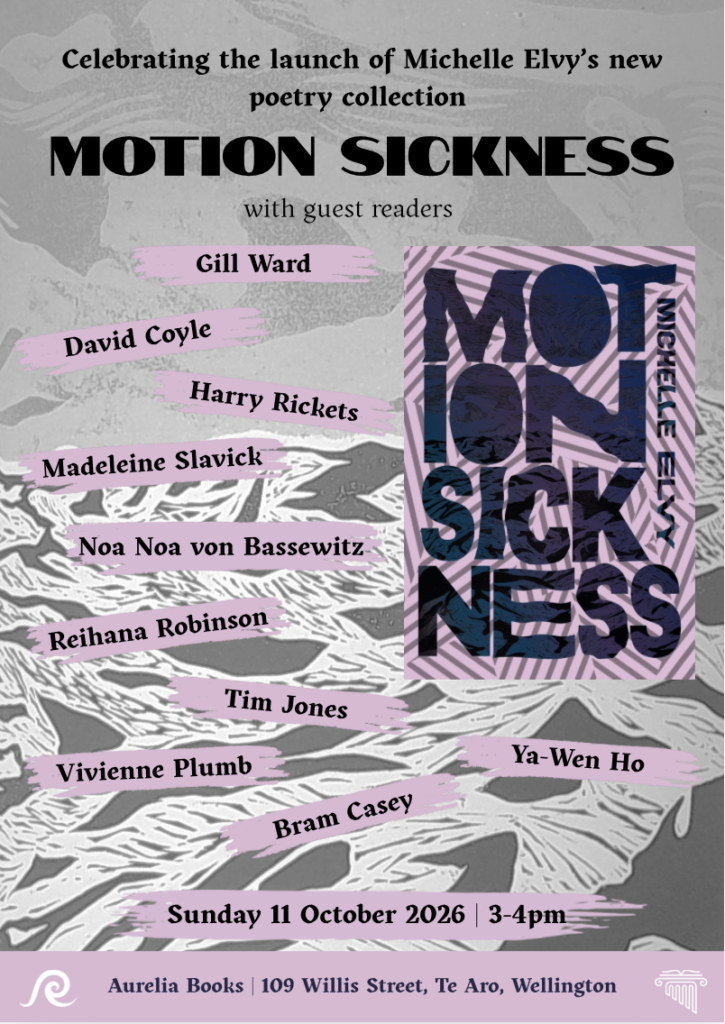

Poster for the launch of Michelle Elvy's new poetry collection Motion Sickness. Black text on a grey and pink background, giving information also contained in the text of this post

Stupid, Wasteful, and Dangerous

Last night I attended a public meeting to oppose plans by the Wellington City Council, Greater Wellington, and Transit New Zealand to “solve” central Wellington’s transport problems by building more roads and digging new road tunnels, despite the considerable body of evidence (such as this report) that shows this approach does nothing but induce more traffic onto the roads, thus causing further congestion.

I was peripherally involved in organising the meeting, and I’ll be making a submission on the issue. I went along hoping the meeting would go well, and it did: we got over 100 people, lots of whom stayed around afterwards to offer help with the campaign. But the meeting did something I didn’t expect: it made me angry.

Not angry at the presenters, but angry at Wellington’s transport planners who, year after year, decade after decade, trot out the same “solution” to the problem earlier “solutions” have helped to create. Despite the massive contribution of private car transport to greenhouse gas emissions; despite the mismatch between the world production of oil and world oil demand, which is the underlying reason behind high oil prices, and which will only get worse as oil production peaks and then declines; despite the body of research which shows that there are better ways of solving transport problems; despite all that, these planners repeat their mantra that we have to build more roads to take more cars.

There’s some extenuating circumstances. New Zealand’s bizarre transport funding rules mean that local government can get central government to pay for 100% of certain roading projects, but only 50% of non-roading projects. Wellington’s Mayor has openly said that road tunnels are essential, no matter what comes out of the public consultation process. There’s a whole heap of construction companies eager to put on the hard hats and the fluorescent jackets one more time and let the asphalt flow out and the money roll in. And, of course, by no means are all transport planners stuck in the past.

But in an era when climate change and oil depletion are both accelerating, when cities overseas are moving away from the private car, when transport alternatives are available, to keep pushing the same old failed solution is stupid. It’s wasteful – roads are massively expensive to build, more expensive than the alternative options. And it’s dangerous, because it fails to face up to the reality of our urgent energy and environmental problems, and diverts resources that should be spent on tackling those problems.

It’s stupid, wasteful, and dangerous. And it has to stop.

• Reports of the meeting by Matt Bartlett (PDF) and Eye of the Fish.
• Make a submission (deadline is 22 February) and read the planning report