Blog

A Short List Of Greenlandic Placenames

Aasiaat (which means “Spiders”)
Alluitsup Paa
Ilulissat
Ittoqqortoormiit
Kangerlussuatsiaq
Narsarsuaq
Nuuk (the capital)
Qaanaaq (where the Inuit people removed by the builders of Thule Air Base were relocated)
Qaqortoq
Sisimiut
Uummannaq (“Heart-Shaped”, referring to the mountain behind the town)

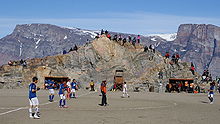
A game of football in Uummannaq

From time to time, I develop obsessions with places – especially cold places. A couple of years ago, it was Svalbard. Now I’ve got Kalaallit Nunaat, aka Greenland, on the brain. It’s a country I very much doubt I’ll ever visit – it would be hard to find a justification for the greenhouse gas emissions entailed by doing so, especially given the effect that climate change is having on the country – but I have been poring over the Lonely Planet Guide to Greenland and the Arctic, and Gretel Ehrlich’s fascinating memoir This Cold Heaven: Seven Seasons in Greenland.

The paradoxical effects of climate change on Greenland – the way in which it is simultaneously disrupting the Inuit hunting culture of the north and opening up farmland in the south; the way in which increased outflows from Greenland’s vast central icecap are affecting land and sea alike; the Greenland administration’s search for income from the very forces, such as oil exploration, that are helping to destabilise their environment – are both fascinating and disturbing. But that’s a topic for another time: what I wanted to say here is that Greenlandic is a beautiful language that befits a beautiful country. Wouldn’t you rather live in Aasiaat than Spiders?

Tuesday Poem: Echolalia, by Saradha Koirala

Echolalia

This morning’s northerly
throws death out in my path
a tiny carcass blown from a rubbish bag
a broken bird
at the bottom of a plate glass window.

A paper bag twists itself into the gutter
a butterfly has its wings torn off.

An old man walks into a bar
moving like shaking out a rug
he smells of wood-smoke and rain.
No
like wet logs burning.

I think of houses I’ve visited
with apple cores browning under beds

a cat licking the ends of breakfast
off a bowl in the sink
and the use of words I wasn’t allowed
words I wouldn’t dare use
and words I’d never heard before.

(First published in Moments in the Whirlwind, New Zealand Poetry Society, 2009)

Tim says: I posted this poem for three reasons: first, I love the word “Echolalia”; second, I love the poem that follows it as much as the word; and third, Saradha Koirala is the guest poet at November’s “Poetry at the Ballroom Cafe” session, which will run from 4-6pm at the Ballroom Cafe, cnr Riddiford St & Adelaide Rd, Newtown, on Sunday 21 November. The session will start with an open mike, followed by musicians Josie & Mary Campbell, followed by Saradha’s guest slot.

I understand that Saradha will read a mix of poems from her debut collection Wit of the Staircase and uncollected poems. I’m really looking forward to it.

You can check out all the Tuesday Poems on the Tuesday Poem blog.

Welcome To My Blog

Welcome! You’ll find my recent posts listed on the left-hand side of this blog. Since I’m between posts at the moment, here are some of my books, and how to buy them.

  • My short story collection Transported, which was longlisted for the 2008 Frank O’Connor International Short Story Award, has recently become available for the Kindle.
  • My fantasy novel Anarya’s Secret is available in hardback, paperback or ebook format.
  • Voyagers: Science Fiction Poetry from New Zealand, an anthology I co-edited with Mark Pirie, won the 2010 Sir Julius Vogel Award for Best Collected Work. You can buy Voyagers from Amazon.com as a paperback or Kindle e-book, or buy it directly from the publisher at the Voyagers mini-site.

You’ll also find my work in these recent anthologies:

An Interview With Douglas Van Belle

Douglas Van Belle is a pain in the ass/arse/backside/butt when it comes to getting something that might be called a bio. The biographical statements that have appeared with his fiction have described him as: Not Canadian; Genetically similar to a human; The winner of the 1973 Noble Prize in Quantum Astrology; Abducted and raised by a herd of hyper-intelligent buffalo and; That ‘special’ kid that was also sent to Earth shortly before Krypton exploded.

Asking him for something more believable doesn’t really help. He just uses that as an opportunity to deny any responsibility for ABBA, sweater vests, dogs that are smaller than cats, Baywatch, the ridiculous way the French spell things, Australia, El Nino, and Kevin Costner. He also insists that nothing happened in 1986, absolutely nothing, so quit asking.

Thanks to the Internet and the massive dossier that was eagerly provided by the CISE (the Canadian Intelligence Service Eh) – including this mugshot of Doug, taken from the CISE 10 least wanted list – when it comes to Doug’s fiction, it’s a little harder for him to deny, misdirect, and misinform. His 2004 novella, “A Small Blue Planet for the Pleasantly Insane”, is one of two stories that have been selected for Andromeda Spaceways Inflight Magazine’s Best-of volumes and it was one of the key publications in the portfolio that won the Sir Julius Vogel Award for Best New Talent in 2007. He’s been a finalist in one or more SJV categories every year since then.

This year he’s offering two novels. The first is a limited, collector’s edition of The Care and Feeding of Your Lunatic Mage, which you can only get with a new or renewed subscription to Andromeda Spaceways Inflight Magazine (ASIM) and the second is Barking Death Squirrels, published by Wellington publisher Random Static.

Two novels coming out close together, two different publishers, two different countries. Brilliant marketing plan, pure chance, or somewhere in between?

Actually, there were supposed to be three novels out this year. Rabid Pixies of Doom was pencilled in for a January 2010 launch in the U.S. and the idea was to use that as a foundation for helping both ASIM and Random Static get some market traction for the other two. However, Pixies never actually went into the production stream. It was frustrating at the time, especially for a magazine and a small New Zealand press hoping to leverage off that book, but it turned out to be a blessing. I was able to use the delay to get Pixies back in my hands and it looks like the new deal will be far better, for both me and the publishers of those other novels, all of the way around.

I take part in a weekly Twitter book discussion called “South Pacific Book Chat”, under the hashtag #spbkchat.* I mentioned the title “Barking Death Squirrels” on #spbkchat – purely on the strength of that title, people immediately asked where they could buy the book! How did you come up with such a great title?

If you look at what I’ve published you can probably tell that I like playing with titles. I like to try to find something memorable, a little bit campy, a little bit twisty and a little bit ironic, but still a title that reflects the heart of the story. I think I hit that pretty well with this one. I explain the meaning of the title near the end of the first chapter, but its origin is one of those stories of quirky bits and pieces coming together.

I was on a dinosaur dig in North Dakota and I discovered that they call prairie dogs barking squirrels. Other than a chuckle, I didn’t think much of it at first, but as I sat in camp one night and watched the prairie dogs darting in and out of their underground warren of tunnels, that connected to the work I was doing on living underground as the solution to the radiation problem in space colonization and that immediately connected to the stories I was just starting to put together about humans as the rodents of the universe.

I played with variations on Barking Squirrels until I settled on an alien invasion story as the first story and twisting the alien insult of Barking Squirrels into Barking Death Squirrels seemed like the kind of thing a makeshift guerrilla army might do.

The cover artist turned the Death part of the title into a graphic element that I liked so much that I decided to make sure I could carry it forward through all four books, so the other three books are now titled Dances with Squirrels, Squirrels Barking Dread and Dawn of the Squirrels.

What was the genesis (the xenogenesis?) of Barking Death Squirrels?

Vegas Baby!

Seriously.

My brother and I managed to get our respective business trips to overlap with a layover in Vegas and we were just kind of hanging out and wandering through the big casinos when I realized that Vegas in August (40+ Degrees C) was just as inhospitable as space. The solutions that Vegas architects applied to that challenge would translate into space colonization. So I took a serious look at the way the interiors of the gigantic casinos were being designed and the illusions of space being created and the way shopping malls worked, and the way that places like Cuba Street in Wellington could be recreated in underground caverns. I put those details into a story about someone who was part of the team building those kinds of spaces and eventually ended up with the novel.

The Care And Feeding Of Your Lunatic Mage is being published by Andromeda Spaceways Inflight Magazine (ASIM), and will be available as a free giveaway to print subscribers to that magazine. How did that arrangement come about?

There was a discussion of what ASIM might do at the Aussie WorldCon and somewhere in there I offered to let them print a couple hundred copies of Lunatic Mage and give them away to new subscribers. I could justify it in terms of advertising and exposure and such, but I really just wanted to do what I could to help keep ASIM on solid financial footing.

I know that ASIM has been important in your career, and, looking at the fiction nominees for the Sir Julius Vogel Awards in recent years, it’s clear that it’s important for many other NZ speculative fiction authors as well. Why is ASIM so special?

I think it’s mostly because it’s a very democratic publication. Every story gets read by at least two slushers, so you get an automatic double check on the initial judgement. Stories that are recommended by at least one slusher get a reading by a third and fourth, and if one of them recommends it, it goes into a pool that issue editors select from. As a result, it’s very unlikely that a story will fall victim to the whims of any one person. Good stories consistently make it through and stories that aren’t ready not only get sent back to the author relatively quickly, the slushers usually take the time to offer at least a couple of comments on why it was rejected. All of that combines for a good experience for authors and a diverse collection of good stories for the readers. I think that is why it’s so prominent in both the Vogels and the Ditmars.

What got you started on writing fiction?

Never really started, I just always have.

I gather than you do your writing on the train to and from the Kapiti Coast. Have you thought of going for a position as writer-in-residence on the Wellington commuter rail system? What are the best and worst things about writing on public transport?

The key to writing on public transport is to create a microcosm of a normal working environment. The best way to do this is to announce, loudly and frequently, that you are an award-winning science fiction author. If you do this when you step onto the train and every time the train stops, people will respect your need for working space and they’ll leave all the seats around you empty. And the guy who works PR for Invisible Moses was kind enough to let me know that wearing rugby headgear is the accepted way to let everyone know that they need to let you concentrate on your work. It works really well. Train commuters are incredibly polite.

Eager readers of your novels might get a shock when they set out to order more of your work and discover that you are the lead author of, among others, Media, Bureaucracies, and Foreign Aid: A Comparative Analysis of the United States, the United Kingdom, Canada, France and Japan. Do you find it easy to switch between the groves of academe and the wild woods of speculative fiction?

Uhm, no. In a purely functional sense, switching between the two types of writing is easy. You have to remember that the difference between them is more than just style. They are fundamentally different, but they are still just two different skill sets, two different things you learn to do. And to be honest, the academic stuff is really easy to write. Simple, formulaic, highly structured, step-by-step argumentation. Fiction is one hell of a lot more challenging. The difficulty is that the academic stuff is work, a lot of work. Fiction is a joy. Every year it gets harder and harder to put the fiction down and get some work done.

Are there particular writers whom you regard as being influences or inspirations?

If you look at my wall of books you’ll see a lot of old-school kinds of stuff, Heinlein, Asimov, Wells, Verne, Burroughs, Larry Niven, Piers Anthony, Greg Bear, Greg Benford, Ursula K. Leguin, and I’m a big fan of Vernor Vinge, but I read all kinds of stuff and I read a lot. I even have a rule about mixing in authors that I’ve never read before. Personally, I don’t think people take enough risks with fiction, either as readers or writers.

Unlike (as it transpired) the Cylons, do you have a plan – for your writing, if not for world domination? If so, are you prepared to share it with us?

Possums

As every manchild (ages 13 and up) knows, the key to world domination is to put all your armies on New Zealand, take Australia and use the bonus for owning a continent to build up a pile of armies big enough to go after either Africa or North America. The problem with that strategy is that building up your stack of armies in New Zealand is really, really tough. I’m pretty sure the New Zealand Air Force’s motto is “We never shoot at anyone” and they’re the aggressive branch of our military.

So I tricked the New Zealand government into training a massive army of possum commandos. They shoot at them, poison them, trap them, run them down with cars; it’s a brutal, Darwinian training regime, but slowly, generation after furry little generation, the survivors have been transformed into the ultimate marsupial fighting machine. The guys at Weta Workshop can’t understand why I want the little tiny tanks and guns to actually work, but as soon as they deliver I’ll ship all sixty million of the little buggers back to Australia and the West Island will be mine, all mine. Mwahaha.

Where to get hold of Doug’s novels

Barking Death Squirrels: http://randomstatic.net/index.php?main_page=product_info&products_id=47

The Care And Feeding Of Your Lunatic Mage: http://www.andromedaspaceways.com/lunatic-mage-an-andromeda-spaceways-special-project/

*Tim adds: The South Pacific Book Chat book discussion takes place on Twitter each Thursday evening at 6pm Japanese time/8pm Eastern Australian time/10 pm New Zealand time. If you join Twitter, you can then join the chat by adding the hashtag #spbkchat to your tweets at that time, and searching for other tweets with the #spbkchat hashtag. You can also see recent #spbkchat tweets online.

Tuesday Poem: Now My Love Is Not The Same, by Sergei Esenin, translated by Tim Jones

Now My Love Is Not The Same

(to Kliuev)

Now my love is not the same.
Ah, I know, you grieve, you
Grieve that pools of words
Have not spilled from the moon’s broom.

Mourning and rejoicing at the star
Which settles on your brows
You sang out your heart to the izba
But failed to build a home in your heart.

And what you hoped for every night
Has passed your roof by once again.
Dear friend, for whom then did you gild
Your springs with singing speech?

You will not sing about the sun
Nor glimpse, from your window, paradise
Just as the windmill, flapping its wing
Cannot fly up from the earth.

Tim says: Sergei Alexandrovitch Esenin (or Yesenin), 1895-1925, was a Russian poet of peasant origin who lived and worked in the period before, during, and after the Russian revolution. Well-known and much-loved as a poet in Russia, his work has received less attention than it deserves in English-speaking countries, where he may be best known as the ex-husband of Isadora Duncan.

In the final year of my BA in Russian, which I completed in 1995 at Victoria University, having started it several years before at Otago, I translated 15 of Esenin’s poems into English, and wrote an essay about him, as my final-year project. The translations are still pretty rough about the edges, but I’m keen to get them out into the world: I did this a little bit last year in the Esenin Translation Project on LibraryThing, and from time to time, as I tidy them up, I will publish some of those translations here.

I’ll say a little more about Esenin, his writing, and the poetry of the time as I do so.

Notes:

The “Kliuev” of the dedication refers to Esenin’s near-contemporary, poetic mentor, and (according to some biographers) lover Nikolai Kliuev (or Klyuev), one of the earliest peasant poets to gain some measure of acceptance in pre-revolutionary St Petersburg. The essay I wrote to accompany my translations notes:

Kliuev and Esenin began to perform together in public, dressing in idealised peasant style to flatter the expectations of their audience. Esenin took to accompanying himself on an accordion; although the tal’ianka and garmonika are important motifs in his poetry, his skill in playing them lagged behind his skill in writing about them.

An “izba” is a Russian peasant hut.

Bougainville Library Project Book Fair This Weekend

There’s a book fair being held this weekend in Wellington to raise funds for a library in Bougainville on behalf of the Bougainville Library Project.

The book fair runs from 10am-4pm on Sat 6 November and Sun 7 November at the Portrait Gallery, Shed 11 , Wellington Waterfront.

The Bougainville Library Project also has a Facebook page.

This book fair sounds like a win all the way round for book lovers and for Bougainville, so I hope that, if you’re in Wellington, you’ll be able to make it along.

My Story “The New Neighbours” Is Included In The Apex Book Of World SF, Volume II

Earlier this year, I was delighted to hear from author and editor Lavie Tidhar that my story “The New Neighbours”, first published in my short story collection Transported (2008), had been accepted for inclusion in The Apex Book Of World SF, Volume II, scheduled for publication in mid-2011.

At the time, the news wasn’t public, and so I duly sat on it. But I sat on it too long – engrossed (embroiled?) in revisions to my current novel manuscript, I missed Lavie’s September announcement of the Table of Contents for the anthology.

Apex Book of World SF, Volume II: Table of Contents

Rochita Loenen-Ruiz (Philippines)–Alternate Girl’s Expatriate Life
Ivor W. Hartmann (Zimbabwe)–Mr. Goop
Daliso Chaponda (Malawi)–Trees of Bone
Daniel Salvo (Peru)–The First Peruvian in Space
Gustavo Bondoni (Argentina)–Eyes in the Vastness of Forever
Chen Qiufan (China)–The Tomb
Joyce Chng (Singapore)–The Sound of Breaking Glass
Csilla Kleinheincz (Hungary)–A Single Year
Andrew Drilon (Philippines)–The Secret Origin of Spin-man
Anabel Enriquez Piñeiro (Cuba)–Borrowed Time (trans. Daniel W. Koon)
Lauren Beukes (South Africa)–Branded
Raúl Flores Iriarte (Cuba)–December 8
Will Elliott (Australia)–Hungry Man
Shweta Narayan (India)–Nira and I
Fábio Fernandes (Brazil)–Nothing Happened in 1999
Tade Thompson (Nigeria)–Shadow
Hannu Rajaniemi (Finland)–Shibuya no Love
Silvia Moreno-Garcia (Mexico)–Maquech
Sergey Gerasimov (Ukraine)–The Glory of the World
Tim Jones (New Zealand)–The New Neighbours
Nnedi Okorafor (Nigeria/US)–From the Lost Diary of TreeFrog7
Gail Har’even (Israel)–The Slows
Ekaterina Sedia (Russia/US)–Zombie Lenin
Samit Basu (India)–Electric Sonalika
Andrzej Sapkowski (Poland)–The Malady (trans. Wiesiek Powaga)
Jacques Barcia (Brazil)–A Life Made Possible Behind The Barricades

I’m delighted to be included in such a rich lineup of authors from around the world, from Argentina to Zimbabwe, with such fine authors as Ekaterina Sedia and Nnedi Okorafor, plus many others whose work I don’t yet know and look forward to reading. Science fiction is so often thought of as being an Anglophone preserve, and in particular the preserve of American and British writers: good on Lavie, and Apex, for demonstrating through this anthology series, and through the World SF blog, that this is not the case.

In the meantime, I suggest you check out The Apex Book of World SF, the first volume in the series, which received this detailed review by Andy Sawyer in Strange Horizons.

Tuesday Poem: Baxter Between the Wickets, by Michael O’Leary

Tim says: This week, I’ve chosen an anthologised poem that is also part of a novel. Confused? You won’t be…

A Tingling Catch

“Baxter Between the Wickets” is one of several poems by Michael O’Leary in the excellent anthology A Tingling Catch: A Century of New Zealand Cricket Poems 1864-2009, edited by Mark Pirie, which was launched at the Long Room of the Basin Reserve, the test cricket ground in Wellington, on Sunday. I had the great pleasure of reading my poem Swing at the launch.

I was going to spend some time telling you how good A Tingling Catch is – starting with this cover painting of the Basin Reserve by Jocelyn Galsworthy, who, I think it’s safe to say, is the world’s leading cricket artist, and continuing with the selection of poems (mine, of course, modestly excluded!).

But now I don’t have to say how good it is, because Graham Beattie has done so admirably on Beattie’s Book Blog.

Out of It

So let’s move on to the book from which this poem is extracted. Out of It (Earl of Seacliff Art Workshop, 1987) is presently out of print, but Michael is planning to reprint it in 2011 – and if you can’t wait till then, the entire text of the novel is available online. I read Out of It recently, and enjoyed it very much.

The frame of this novel-with-poems is a cricket match at Eden Park between the “Out of It XI” and New Zealand. The two XIs are:

NEW ZEALAND OUT OF IT

1) Dipak Patel Jimi Hendrix

2) Ken Rutherford Monk Lewis

3) John Wright (V.C.) Te Rauparaha (C)

4) Martin Crowe Oscar Wilde

5) Jeff Crowe Jim Morrison

6) Jeremy Coney (C) Alfred Jarry

7) Richard Hadlee Janice Joplin

8) Ian Smith Bob Marley (V.C.)

9) John Bracewell Herman Goering

10) Lance Cairns Lord Byron

11) Ewen Chatfield James Joyce

12TH MEN

12) Martin Sneddon James K. Baxter

Baxter, then, is on the field as a runner for an injured Jim Morrison, and “Baxter Between the Wickets” represents his thoughts as he is called through for three runs by Te Rauparaha, the “Out of It XI” captain. Michael tells me that the “Colin” of the poem is Colin Durning, an old friend of both James K. Baxter and Michael O’Leary.

Baxter Between the Wickets

Morrison hit Chatfield down to deep cover and sent Hemi, grey-hair, grey-beard flying like sails, off for a run. The chief ran like the wind so that Baxter, who was obviously the least fit of the two, was stretched to the limit but made it home for three runs.

“Ha Ha! I bet that got the old cogs in the wheels turning, John. I thought the old guru of the New Jerusalem was struggling a bit there.”

“Yes Dennis, but he made it and his thinking must be matching his physical triumph at this moment.”

Man! He has called me again
From that place inside me – the unworthy

Servant! He called me three times
When I, in my mortal dung heap mind

Would have settled for one
And all the lice in my beard jumped out

For fear of this terrible century’s (looming) speed
Who will torment me now, at night

Who will remind me of Him –
And sin! Which this mad old devil

Commits with every eyelid bat, every thought
Kei te Rangitira o te ngati porangi, ahau –

I stand at the end of the crease Colin
Knowing He only wants what He knows I can do

This poem, and the text which immediately precedes it, is taken with permission from Michael O’Leary’s 1987 novel Out of It.

Finally, this poem also ties back to my post from early October responding to Scott Baxter’s query about the influence of James K. Baxter on New Zealand poetry. Here, that influence is alive and well, if not incredibly happy at having been called through for more than a single!

You can check out all of the Tuesday Poems at the Tuesday Poem Blog.

Welcome To My Blog

Welcome! You’ll find my recent posts listed on the left-hand side of this blog. Since I’m between posts at the moment, here are some of my books, and how to get hold of them.

An Interview With Kerry Popplewell

Kerry Popplewell has lived in Ngaio, Wellington, with her husband Bruce for many years in a house that looks over to the hills running south from Mount Kaukau; it gets all of the sun and most of the wind. They have two adult children and more grandchildren than they ever anticipated, though the only other permanent residents aat the moment are a large black Labrador called Louis and a Burmese cat called Bailey – both ‘hand-me-ups’ from one of their children. (Their home has always had cat(s) or dog(s) or some combination of both.)

Born near the end of 1940, Kerry spent the war years with her mother at her grandmother’s home in Pahiatua. When her father returned from the Pacific theatre, the family moved to Napier where she grew up. She still feels a real connection with Hawke’s Bay, especially with the Kaweka and Ruahine ranges where she and her husband have often tramped. Both her parents were teachers, her father Jim Reidy being the first principal of Colenso High School. She thinks teaching must be a form of hereditary insanity since, having gained an MA in English at VUW and studied at the University of Chicago, she returned to lecture in English for nearly ten years before resigning to care for her children; and, once they started school, she taught Mathematics as well as English at Onslow College for fifteen years.

In 1995 she took a year’s leave without pay, travelled overseas for some months and decided to retire early. It was then she started to write poems: “I’d always meant to be a poet but it took me a while to realise that to be one you had to complete poems!” Several courses she took at the International Institute of Modern Letters helped her start to do so.

Leaving The Tableland was launched in May 2010. I think that was the best-attended book launch I’ve been to – there must have been over 100 people there. For those who were not present, what led you to choose that particular venue, and what made it such a success?

I thought that if I were to have a launch, I’d like it to be a party for friends as well – and, as many of those we know well are trampers, the choice of the Tararua Tramping Club hall seemed fitting. One of my friends suggested it, possibly in jest, and I thought ‘Why not?’ It felt good being in a familiar place, even if the absence of an oven meant we had to buy a small portable one for $8 on Trade Me to heat the pastries! Roger Steele, my publisher, said he’d never had a launch in a tramping club hall before but he got keen on the idea and insisted we heat cheerios in a billy over a primus.

Do your work on your poetry in your head as you walk, or are the two – writing poetry and tramping – quite separate activities?

Mostly separate, though I do remember composing a haiku climbing up a ridge above Gollan’s Valley. Odd phrases, rhythms or ideas may come to me tramping but as for a poem, I need – literally – to have a pen in hand. But of course the places I tramp in and the experiences I have in the mountains provide material for my poems – as do all the other facets of my life, be it family, friends or faith.

If it isn’t an indelicate question, when did you first think of putting a collection of your poetry together?

Hmm. The really indelicate question would be asking why it took me so long to do so! Right from around 1996 when I started not just to write but also to submit poems for publication I thought I’d get round to collecting them sometime.

Was the path from initial idea to published collection straightforward?

No, but mostly because of my advanced skills in procrastination. Then, in 2006, a friend suggested I apply for one of the Manuscript Assessment Awards the New Zealand Society of Authors offer each year. I was fortunate enough to be given one and even more fortunate in getting James Norcliffe as my assessor. After all the detailed advice he gave me, I felt I really had to get moving. Even so, it was probably a year after Roger Steele agreed to take on my book that the collection came out – I needed to do a good deal more work on it myself.

You taught for many years. Was teaching something that helped or hindered your poetry – or is that too simplistic a question?

In my case, I think ‘hindered’ as teaching, no matter the subject matter or level, will absorb every bit of time and creative energy you are prepared to give it. But then teaching was something I truly enjoyed, so I’m not consumed with regret for all those unwritten poems! Other poets are able to combine writing and teaching very successfully.

Did a particular person inspire you to start writing poetry?

I think the poets I read did that – but certainly Helen Hill, the teacher to whose memory my collection is dedicated, encouraged my own efforts. I must have been a trial to her in some ways, pestering her to read the whole of Shelley’s “Ode to the West Wind” and “Lycidas” to our fourth form (Year 10) English class. Later I appreciated her reluctance! Helen Hill was also responsible for introducing me to tramping so she certainly had a big influence on my life.

Which poets do you feel have had the most influence on your own work?

Keats truly floored me when I was 14 – not only was I going to be a poet, I was sure I too would die at 25. A year or so later, it was Hopkins who had me giddy on words and rhythm. Then, in my MA year, Joan Stevens introduced us to Philip Larkin and if I had to single out one poet whose work has almost surely influenced mine, it would be him; but then, behind Larkin as it were, is Wordsworth whose attraction for me grew slowly but surely. On the other hand, the poet on whose work I intended to do my doctoral dissertation (something I never quite got round to!) was the Orkney poet, Edwin Muir. Of course there are all the other poets whom I have at one time or another ‘discovered’ – Edward Thomas, Dickinson, Auden, Herbert – not to mention New Zealand poets from Bethell to Bill Manhire. I’d find it hard to say though whether or not they’ve influenced my own work in a particular way.

Has having a book published changed how you feel about the role of poetry in your life?

Not really. Though I’d like to think I might become more disciplined in setting aside time to write and more diligent in sending work off for publication. I remember Elizabeth Smither at a workshop some years ago advising us to ‘Send Something Somewhere’ every month – I wish I did.

Now that Leaving The Tableland has been published, do you have another collection, or some other writing project, under way?

Well, I’m probably at least a third of the way towards having enough poems for a second collection – very few of the poems in Leaving the Tableland were written after 2005 and they’ve slowly been accumulating since then. Also, because I left it so long to get out a book, there were a number of other poems I’d like to have included but couldn’t. I recall Roger Steele saying that a volume the size I’d had in mind was “a little immodest for a first collection”. I’m sure he was right. (He was kind enough to suggest I could save some of them for next time!)

Book Availability

Kerry’s collection Leaving the Tableland is published by Steele Roberts (2010) and available from the publisher or in selected bookshops for $19.99 (RRP).

A poem from Leaving the Tableland, Take me back to the Bay, was my Tuesday Poem this week.