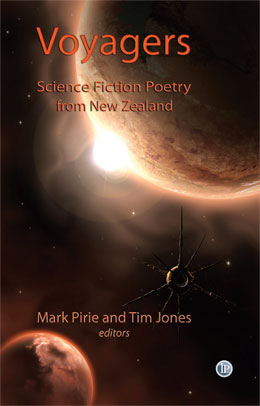
Voyagers Cover Released, Microsite Up

Voyagers: Science Fiction Poetry from New Zealand, the anthology of New Zealand science fiction poetry Mark Pirie and I have co-edited, is moving closer to its publication date: we expect it to be available in New Zealand on 1 June.

The publishers, Interactive Publications Ltd (IP) of Brisbane, have now put up both a mini-site and an orders page for the book:

The IP mini-site is now up at: http://ipoz.biz/Titles/Voy.htm

The IP Orders page is: http://ipoz.biz/Store/orders.htm

And here’s the cover. (Voyagers authors: You are welcome to use the cover image on your own blogs and sites, but please also include both the IP links above, and mention when the book will be available in NZ.)

Paekakariki City Limits

I spent several hours today engaged in a poetic expedition to Paekakariki, which is a small town on the Kapiti Coast north of Wellington – a rather beautiful small town nestled in the sandhills by the sea.

Helen Rickerby, Harvey Molloy and I travelled up in Harvey’s car to rendezvous with Helen Heath at the Paekakariki School Fair and give a joint poetry reading. Helen Heath set up the gig, and the rest of us were pleased to have the chance to take part.

I had very little idea what to expect, but I thoroughly enjoyed the day – though the heat was a bit much for my cold-adapted blood; the Kapiti Coast is usually hotter than Wellington, and by the time we got there just after 11am, Paekakariki was sweltering. The fair was big – I’ve never seen a fair with three different types of bouncy castle before, though I’m sure you city slicker types see that all the time. We moved through the fair to the hall, and set out our stall. We all had things to sell:

Helen Heath: CD “Seven Paekakariki Poets Reading”

Harvey Molloy: New poetry collection Moonshot

Helen Rickerby: New poetry collection My Iron Spine; previous collection Abstract Internal Furniture; and JAAM 26 – Helen publishes JAAM.

Tim Jones: Recent poetry collection All Blacks’ Kitchen Gardens and first poetry collection Boat People; new short story collection Transported and first short story collection Extreme Weather Events.

We did two reading sessions, half an hour apart, with a fine performance by a Thai dance troupe in between. I found the first session hard going, because most of the notional audience were actually in the hall to eat their lunch; but, by the second session, more of the people in the hall were paying attention – and if they weren’t, Harvey got their attention with the first poem he read! The sales table ticked along well, each of us met some people we knew whom we didn’t know would be there, and afterwards, we had a good time checking out Helen Heath’s craft stall and haunting the book stall, where it was lovely to see Dinah Hawken again.

Doing a solo reading can be stressful, and if the audience isn’t responding, there’s really nowhere to turn. Doing a joint reading with friends was fun, supportive, social, and as it turns out, profitable as well. If you’ve got an event coming up in the Wellington region which could benefit from a visiting poet or three, please get in touch!

The New Land

This 800-word story appears in my first short fiction collection, Extreme Weather Events (HeadworX, 2001).

The new land was discovered on a Thursday. The Prime Minister addressed the nation. “It’s large,” she said, “and damp, and all ours.” She announced that an expedition was already nearing its northern shores.

The expedition waded ashore and raised the flag in a moving ceremony. The new land was covered in seaweed, mud, and the carcasses of fish. It had a distinctive smell.

The discovery of the new land had significant implications for public policy. An inter-departmental working party was set up, with representatives from all affected Crown entities. Change agents were brought in to build a team culture that would be open, proactive, and outcomes-focused.

The Government welcomed tangata whenua participation. Several tribes had fished in the seas displaced by the new land, and consultative hui were quickly arranged. The participation of the Maori Fisheries Commission Te Ohu Kai Moana, and other stakeholders in the quota allocation process, was subject to pending High Court action.

With the cooperation of public and private service providers, an intensive effort began to map the new land. Global Positioning System data revealed that it had a total surface area of 387 ± 2.5 square kilometres, based on best practice assessments. The majority of the new land was only a few metres above sea level, but there was a gradual rise towards a prominent elevation in the southwestern quadrant, which satellite measurements revealed to be some sixty metres in height. A more accurate figure awaited the arrival of a ground party, which promptly left from Base Camp One.

Together with the composition of the All Black midfield, the new land was the prime topic of conversation over the weekend. Callers to talkback radio were unsure of its potential usefulness, but a prominent life sciences company suggested that it would make an ideal testbed for experiments in plant biotechnology.

On Sunday, the nation was treated to live reports from the party sent to investigate the southwestern elevation. The gradual rise previously reported was crowned by a rocky hill, atop which were strewn large blocks of grey stone. The superficial resemblance of these blocks to construction materials excited worldwide interest. Both print and electronic media carried a number of ill-considered and poorly researched stories making allusions to Atlantis, Mu, and/or Lemuria. The Skeptics Society responded with a strongly-worded statement.

The Government acted decisively to quell speculation. An exclusion zone, to be patrolled by all three services, was established around the hill in question. Any party wishing to land in the area was required to have government permission and pay a substantial fee. It was announced that samples from the quarantine zone would be sent to leading overseas laboratories for analysis, and that results were expected in six to eight weeks.

Sharemarket reaction, which had been muted the previous week, was strongly positive when trading opened on Monday, with the tourism, energy, and telecommunications sectors especially buoyant. Fishing industry shares suffered reverses, however, with analysts pointing to the loss of valuable fishing grounds and the uncertain future of several joint venture arrangements.

Other developments on Monday were primarily institutional in character. The Prime Minister announced that a naming rights sponsor was being sought for the new land. Major corporates, breweries, and communications companies had already expressed interest. On a less positive note, plans by the Tourism Board to brand the new land as an eco-tourism destination came under sustained criticism by environmental groups.

To widespread surprise, the new land slipped beneath the sea just after 5am on Tuesday. Loss of life was averted save for two adventurers who had illegally entered the exclusion zone earlier that night to explore the southwestern elevation. Their Zodiac pilot, who escaped, returned with lurid tales of strange lights in the sky and unearthly noises beneath the hill. These accounts were not corroborated, and the Zodiac pilot was subsequently deported to an undisclosed location.

A planned debate on the new land went ahead when Parliament resumed sitting that afternoon, but its character was much altered. The Prime Minister was put on the defensive by persistent questioning and responded with a blistering attack on the Leader of the Opposition. The disappearance was made worse for the Government because subsequent polling showed that the new land had been especially popular in the key North Island 18-45 male demographic.

After a week in which the new land showed no sign of reappearing, the inter-departmental working party was disbanded and the consultative hui cancelled. Fish stocks over the area were reported to be severely depleted, and the fishing industry pressed the Government for a compensation package. The National Institute of Water and Atmospheric Research was commissioned to conduct a bathymetric survey of the newly-restored sea floor.

The new land is commemorated by two Top 20 singles, an “Assignment” documentary, and a projected TV mini-series which has yet to receive New Zealand On Air funding. A leading authority on the uncanny, now hard at work on a book about the new land, has promised to reveal a scandalous cover-up of dramatic new evidence concerning humanity’s place in the Universe. If these claims are substantiated, they may yet revive public interest in the matter.


A Watched Book Never Sells

So I’m sitting in the food court area of Wellington Airport. I’m heading up to Auckland for a conference. Due to bad weather, my flight has been delayed for 90 minutes. That’s bad – it will make the kind person who’s picking me up from the airport late. But it has a good side: I’ve had the chance to sign the copies of my short story collection Transported in the Wellington Airport Whitcoulls.

The staff are very well organised. The books are on a nice little display cabinet near the entrance to the shop, and they have a pen and a bunch of “Personally Autographed” stickers close at hand. I kneel down in front of the display, sign each book, and carefully place a sticker on the front. There are 17 copies to sign – that’s good, because I know the bookshop started with 20. I rise to my feet (wishing I hadn’t decided to wear both my jacket and my raincoat onto the flight as the easiest way of carrying them).

But now I’m about 50 metres from the bookstore, nursing a coffee, doing a spot of work, and peering intently at the foot traffic into and out of Whitcoulls. Nobody is stopping at the display of Transporteds. Are they too low, too far below eye level? Should I have piled them up higher when I put them back on the stand? Is the blue “Personally Autographed” sticker on the front putting people off? (I prefer the way Unity does it – instead of putting stickers on each book, they put a nice “Signed Copies” notice on top of the pile.) And, though I really like the cover, does it stand out enough from the gaudier books around it?

Eventually they call my flight and I head off to Auckland. The conference goes very well. While waiting for my flight back to Wellington, I sign the copies in the Auckland Airport Whitcoulls. There are less of them, and they are modestly hidden on the shelves. It’s still good to see them, though, these old friends in unfamiliar places.

I’m aware this is all rather pathetic. I’m aware I should get over myself. Just as a watched pot never boils, so a watched book never sells. But whenever I walk past a bookstore that stocks Transported, I find it very hard not to go in and see if any have sold. Half the stock in the Wellington Borders has sold – joy! None have sold in Dymocks – damn, if only I’d been able to give a more exciting description of the book when Bruce Caddie asked me how they should describe it to customers.

The world faces multiple, interlocking problems: peak oil, climate change, food shortages … the list goes on. I have work to do, a family to love, and a novel to be getting on with. But I took some visitors to Wellington Airport today, and – I stopped after farewelling my visitors and counted – now there are only 15 copies on that display. Two more copies have sold – yes!

Even the outrageous carpark fees (if only we had light rail out to the airport!) can’t dampen the feeling, so precious, so fleeting, of success.

UPDATE

A review of Transported and author interview with me have just been published by The Short Review. Thank you, Tania and the team!

Frank O’Connor Transported to Montana

A few bits and pieces that relate to earlier posts:

Frank O’Connor Award: In addition to the interviews with New Zealand award longlistees Elizabeth Smither and Tim Jones, an interview with Witi Ihimaera about his longlisted short story collection Ask The Posts of the House is now up at The Good Books Guide.

Transported: I’ve now seen reviews from Craccum (Auckland University student newspaper), the Chronicle (Wanganui and Horowhenua) and the Nelson Mail. All have been positive. Jessica Le Bas, in the Nelson Mail, had some very nice things to say:

I read Jones’s first story, Rat Up a Drainpipe, and couldn’t put it down. I laughed out loud, and felt unusually good. It was fast paced and full of quirky incidents. When it ended I wanted more.

Typical of Jones, Transported crosses genres. There’s science fiction, comedy and satire, and even a few tales involving global warming. The Wadestone [sic] Shore has Pete rowing around a drowned Wellington foreshore between high-rise buildings, trawling for treasures. The seat of government has moved to Taupo. You have to laugh, but should we?

Jones’s bag of literary tricks is witty and refreshingly humorous. He’s not new to the literary scene, but with Transported, his second short story collection, he will not linger in the background again. Bring it on, Tim Jones!

That’s both very flattering, and a better summary of the book than any I’ve been able to come up with. Thank you, Jessica!

Montana Book Awards: Something of a furore has erupted over the fact that four, rather than the specified five, fiction titles have been shortlisted for the Montana Book Awards. Graham Beattie had a real go at the topic in his blog, and much fulmination has ensued.

I’m not in the camp that is treating this as a major scandal. Of course, I might feel differently if Transported had been among the books in contention (as it will be, perhaps, in 2009); but I think that the judging of literary awards is a subjective thing, a matter at least as much of the judges’ preference as of objective literary merit – if one allows the existence of such a thing.

Therefore, once the judges have been selected, they need to be left to get on with it. As long as their decisions are honestly arrived at – as I’m sure they were in this case – then there isn’t much point in second-guessing them.

Author Interviews at The Good Books Guide

Eric Forbes, who edits Quill magazine in Malaysia and blogs about books on The Good Books Guide, has made it his mission to interview (together with Tan May Lee) all the authors longlisted for the 2008 Frank O’Connor International Short Story Award. As part of that series, his interviews with me about Transported and with Elizabeth Smither about The Girl Who Proposed have now been posted on the site.

All the authors have been asked the same questions – the similarities and differences in their answers are fascinating!

One of the unexpected bonuses of this longlisting process for me is the opportunity to find out about so many fine short story writers throughout the world.

In other news: thanks to the New Zealand Book Council, you can Read at Work. It looks like an ordinary work PowerPoint – but look closer, and it’s literature!

Transported Longlisted for 2008 Frank O’Connor International Short Story Award

I’ve been blogging like crazy this week, but there’s good reason for one more post: my short story collection Transported (which you can pre-order online), which will be published by Random House New Zealand in June, is one of four New Zealand short story collections longlisted for the 2008 Frank O’Connor International Short Story Award.

The New Zealand collections longlisted are:

  • Transported, Tim Jones (Random House New Zealand)
  • Etiquette for a Dinner Party, Sue Orr (Random House New Zealand)
  • The Girl Who Proposed, Elizabeth Smither (Cape Catley)
  • Ask The Posts Of The House, Witi Ihimaera (Raupo)

The Guardian has the full longlist of 39 books and an article about it.

I’m really pleased about this, but it’s important to keep a sense of perspective. It’s a longlist – a looooong longlist. The quality of the other New Zealand selections (congratulations to all the authors!) indicates the strength of the field. The shortlist is announced in July, and I don’t expect Transported to be on it – but I won’t deny that I’ll be very pleased if it is!

It’s also good to see a prize specifically for short story collections, which are sometimes neglected beasts in the literary zoo.

UPDATE: If you’re looking for a review copy of Transported, or other ‘official’ publicity material about the book, please contact Jennifer Balle, jennifer (at) randomhouse.co.nz

Transported: The Tracklisting

I came back from a few most enjoyable days in Dunedin, visiting my lovely friends there – and making some new ones – to find an advance copy of my short story collection Transported waiting for me on my return. It looks great! The cover colours, which appear slightly washed out in the image to the left, are beautifully sharp on the book itself, and so far as I can tell, all the words inside are in the right place and in the right order.

No matter how excellent the publisher – and the team at Random House NZ (who have published the book under their Vintage imprint) are indeed excellent – opening one’s new book for the first time is still a nervous moment. The book doesn’t go on general release until 6 June, but it’s already available to pre-order at some bookshops, and publicity for it should appear shortly before it is released.

Released … tracklisting … yes, I think of it as something like a record (that cherishably old-fashioned artifact) with 27 tracks, some of which have already been released, in earlier versions, as singles. Here’s the “tracklisting” for Transported, with links to a few previously-published stories which are available online. I hope this will whet your appetite.

Rat Up a Drainpipe
Said Sheree
When She Came Walking
A Short History of the 20th Century, With Fries
Win a Day with Mikhail Gorbachev!
The New Neighbours
Sisters
Not Wanted on Voyage
Jim Clark
Alarm
The Wadestown Shore
Filling the Isles
Homestay
The Visit of M. Foucault to His Brother Wayne
Borges and I
Measureless to Man
The Seeing
After the War
Best Practice
Robinson in Love
Going Under
Morning on Volkov
The Royal Tour
Queen of the Snows
Going to the People
Cold Storage
Books in the Trees