Blog

Invitation to the launch of my new novel Emergency Weather

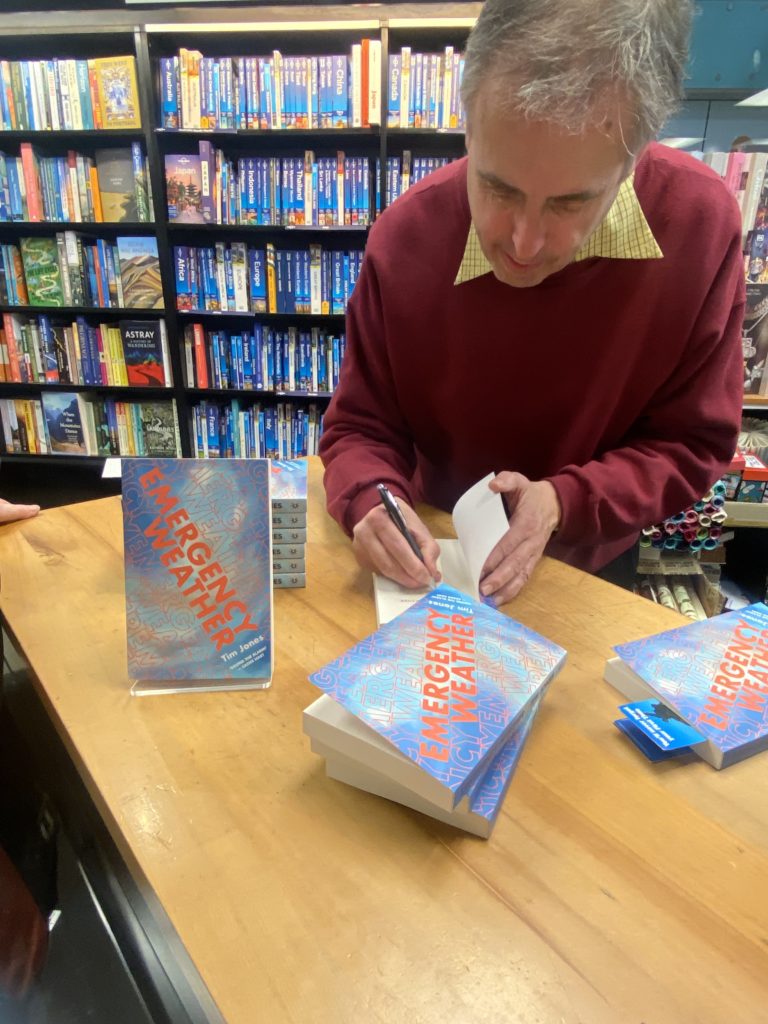
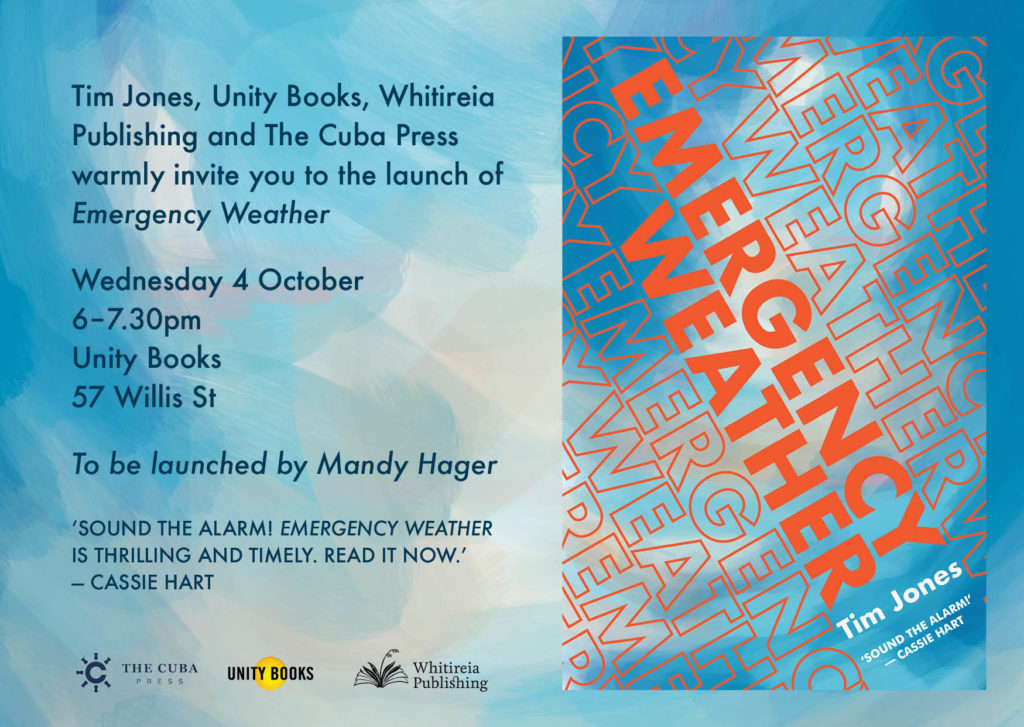
You are officially invited to the launch of my new climate fiction novel Emergency Weather – and here’s a look at the cover!

Emergency Weather launch invitation and cover image

The launch will take place on Wednesday 4 October at Unity Books Wellington, 57 Willis St, from 6pm – please encourage your friends to come along too!

Here is the Facebook event: https://www.facebook.com/events/667791528368999

Please sign up for this if you use Facebook, as it helps us know numbers attending.

Emergency Weather will be available from all good bookshops from 2 October – and also through https://thecubapress.nz/shop/

Writers on Mondays – August 2023

Full programme for 2023: https://www.wgtn.ac.nz/modernletters/about/events/writers-mondays

Events run from 12.15 to 1.15 pm on
Mondays at Rongomaraeroa, Te Marae,
Level 4, Te Papa


I’m looking forward to the 21st!

7 August
Other Worlds

Pip Adam‘s Audition features three giants: Alba, Stanley and Drew, who are squashed into a spaceship hurtling through space, and must talk to keep the spaceship moving. Tīhema Baker‘s Turncoat is set on a distant future Earth, colonised by aliens, where Daniel –a young, idealistic Human–is determined to make a difference for his people. These works of speculative fiction are exciting, inventive and compassionate in their exploration of systems of power. Dougal McNeill will talk to Pip and Tīhema about these other worlds in fiction, and the mirror they hold up to our world today.

14 August
Lioness

A new novel by Emily Perkins is an event in the literature of Aotearoa. Lioness is Emily’s first book in ten years and is set to be one of the most talked about novels of 2023. Join Damien Wilkins as he talks to Emily about Lioness and about a stunning career spanning more than 25 years, beginning with her classic debut Not Her Real Name, taking in her years in London, her time as a television books show presenter and a university teacher, and her more recent work for the theatre.

21 August
Ōrongohau | Best New Zealand Poems 2022

‘I tried to think of a visitor to our poetry shore—what could I include to show its terrain?’ wrote editor Louise Wallace, introducing some of our poetic landmarks of 2022. Hear Nick AscroftMorgan BachJames BrownTim JonesAnahera GildeaMichaela KeebleFrankie McMillanKhadro Mohamed, and Sarah Scott,  and  read work from this annual anthology in a warm-up for National Poetry Day. Introduced by Damien Wilkins.

28 August
Home and Away: Noelle McCarthy

Early in 2020, Noelle McCarthy travelled to Ireland where her mammy, Carol, was dying, then back to New Zealand as borders were slamming shut. Written through the years of the pandemic, Grand is about mothers and daughters, running away and going home, Noelle and Carol. It’s been a best-seller here, winning the E.H. McCormick Prize at the 2023 Ockham Awards. This June, Noelle flew to Ireland to launch the UK and Irish edition. Kate Duignan talks to 2023 Writer-in-Residence Noelle about the reception of the book on both sides of the world, and what’s left to write after a memoir.

There is no mercy in insurance

News that Tower Insurance and other insurance companies are considering refusing to insure houses in flood-prone areas reminded me of “Written Off”, a poem from my 2016 collection New Sea Land.

The set of climate change consequences outlined in this poem were not difficult to come up with. Perhaps, if our “leaders” had spent more time thinking about consequences and less time bowing and scraping to vested interests, we wouldn’t be in quite such a deep hole seven years after this poem was first published.

Written Off

They had insured

and re-insured,

still it was not enough.

They hunched over maps,

consulted climate science.

Beachfront property

went with the stroke of a pen:

no possible premium

could insure that level of risk.

And floodplains:

why do people choose to build on them?

Bigger floods, more often: gone.

East coast farmers, eyeball-deep

in debt, haunted by drought,

desperate to irrigate:

you backed the wrong horse.

Low-lying suburbs, factories

built next to streams:

there is no mercy

in insurance. The numbers speak,

and then there is no mercy.

Ōrongohau | Best New Zealand Poems 2022

It was a lovely surprise to learn that my poem “Restraints”, first published in takahē, had been selected for inclusion in the 2022 edition of Ōrongohau | Best New Zealand Poems, edited and introduced by Louise Wallace. It’s a beautifully produced selection of 25 poems first published in 2022 – please check it out:

Ōrongohau | Best New Zealand Poems 2022

Restraints

My first publication in Best New Zealand Poems was in 2004, with my poem The Translator, later included in my 2007 collection All Blacks’ Kitchen Gardens. It’s great to be back!

“Restraints” was inspired by the Our Other Mother campaign from Parents for Climate Aotearoa. They’re a great group that do vital climate education work – please check them out, too.

Dan Davin Literary Foundation Writer in Residence 2023 – Expressions of Interest

Tim says: From personal experience, I can say the Dan Davin Literary Foundation does a great job of looking after their writers – if you’re a short story writer, I encourage you to check this out and apply!

Logo of the Dan Davin Literary Foundation, including an image of a bust of Dan Davin

In 2023 the Dan Davin Literary Foundation is calling for expressions of interest from established New Zealand short story writers to undertake a Writer in Residence based in Invercargill for 3-6 weeks.

This is a new residency which we host on a biennial basis and started in 2019. This residency has been made possible through a generous bequest from Laurie King and the support of the Southern Institute of Technology.

In 2019 our inaugural writers in residents were Majella Cullinane and Maxine Alterio of Dunedin. They undertook a joint residency for 6 weeks in Southland. As part of their stay they went above and beyond, hosting a range of workshops and public talks across the region. We appreciate the great start they gave us for this residency programme. In 2021 we hosted Colleen Maria Lenihan, who arrived just in time for the August lock down. Despite this she was still able to experience all Murihiku has to offer.

In 2023 we are looking to host the writers in residence programme again. This residency is for an established short story writer who wishes to spend 3-6 weeks in Southland. The residency includes a trip to Stewart Island and to Milford Sound for the writer as well as accommodation and a stipend. In return we ask that the writer provides writing workshops for Southland residents and if possible and appropriate participates in public engagements. We also ask that they provide some commentary on their experience for our Facebook page and website.

The specific skills we are looking for from the resident are the ability to teach writing workshops.

In 2023 the Dan Davin Award for adults will be short story writing. The writer in resident may wish to be the judge for this competition.

Residency expectations:

  • The Residency length is at the discretion of the resident but is expected to be between 3-6 weeks and should conclude at or around 1st of September (Dan Davin’s birthday)
  • The Resident is expected to deliver the Dan Davin Lecture as part of the Dan Davin Award on or about 1 September
  • Accommodation will be provided for the resident. This possibly at Yule House, a historic home in Invercargill run by SIT. This is a 3 bedroom home which may be used by visiting tutors at SIT while the residency occurs
  • It is expected that the resident will stay in the accommodation provided for the duration of the residency
  • A stipend of $500 per week will be paid to the resident
  • The Foundation will cover costs of one return trip to Invercargill
  • Use of a vehicle can be arranged for the resident as required
  • As part of the residency the resident undertakes no less than 2 workshops for high school students and adults
  • The resident writes several blog or Facebook posts which the Foundation can use to showcase the residency
  • As part of the residency the Foundation will arrange a 2 night trip to Stewart Island and a Milford Sound experience
  • A co-working space will be available for writing if requested
  • This residency will not allow partners and children to stay at Yule House

If you are interested in applying for the Dan Davin Literary Foundation Writer in Resident please write to us care of dandavin@xtra.co.nz

Please provide the following information:

  • A brief outline of your writing experience (note this residency is for established writers)
  • A brief description of the work you would like to do
  • Experience in tutoring both students and adults
  • How many weeks you would be interested in being resident and proposed dates
  • If the above expectations are suitable for you

Expressions of Interest close 31 March 2023. We expect to notify the successful applicant by the end of May 2023 following a shortlisting process.

For any questions, please contact us through our email address above.

Regards

Rebecca Amundsen
Chair, Dan Davin Literary Foundation

What I learned from my year of submitting poetry to magazines in Aotearoa

Back into writing poetry

Earlier this year, I returned to writing poetry. I’d been focused on writing fiction since the publication of my 2016 poetry collection New Sea Land, with the exception of the music poems I wrote for my 2019 chapbook Big Hair Was Everywhere – most of which dated from 2016-17 anyway.

It was a real joy to return to writing poetry after five years focused on fiction, but I went into it thinking that there were few to no magazines left in Aotearoa that published poetry. Happily, I was wrong about that.

This isn’t meant to be a comprehensive list – check out the New Zealand Poetry Society website for more poetry markets – but here are some poetry magazines I submitted work to in 2022, together with how I got on.

(There are all sorts of ways to get your poetry out there – live performances, competitions, videos, anthologies. Time permitting, I’ll post more about those next year – including what I’ve learned about poetry in Aotearoa from editing the 2021 and 2022 New Zealand Poetry Society anthologies, Kissing a Ghost and Alarm & Longing.)

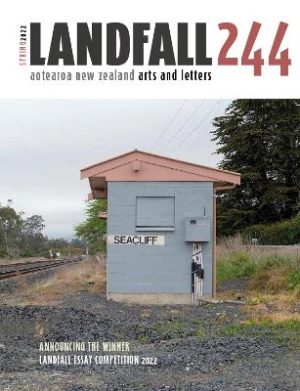
Landfall 244 cover - Seacliff train station

How I got on

I had poems accepted and published by:
a fine line – “Villagers” in a fine line, Autumn 2022, p. 24
takahē“Restraints” and “Bento Box, Mt Victoria” in takahē 105, August 2022 (online edition)
Landfall – “Uncles” in Landfall 244, pp. 154-155. (I’m particularly chuffed about that one, as I’ve had reviews published in Landfall previously, but never poetry.)
broadsheet – “The Passage South” in broadsheet 30, November 2022
Tarot – “She Fell Away” and “Closer to the river” in Tarot 5, December 2022.

Thank you to the editors of those magazines!

I submitted unsuccessfully to Poetry New Zealand (which is an excellent yearly magazine/anthology that I’ll definitely be trying again), two competitions, and in a swing-for-the-fences moment, Asimov’s – another place I haven’t been published but would like to be. Happily, there are plenty of other science fiction poetry markets.

I’m very pleased with that ratio of acceptances to submissions – but experience has taught me that one good year of getting work accepted doesn’t guarantee another. Nevertheless, once my current round of novel revisions is finished, I plan to dip my bucket in the poetry well once again – I still have a bunch of ideas for poems, and some partial drafts, to pursue. I hope there will be a collection’s worth of publishable poems by the time I’ve finished.

What I learned

These are pragmatic comments about how to maximise the effectiveness of your submissions, rather than advice on how to write poetry!

Follow the guidelines. If a magazine says they want to see up to five poems, don’t send them six – it will just piss them off. (Well, it would if I was the editor.) If they say they want poems of up to 40 lines, don’t send them a 50-line poem, and so forth. And whatever you do, don’t send the editor a poem they’ve previously rejected! (I don’t *think* I’ve ever done this, and I try really hard not to.)

Find out what the editor likes. What style of poetry do they write themselves? Is that the style of poetry they tend to select for publication, or do they select a wide range of poems and poets? Have they posted or commented about what sort of poems they are seeing too much of, or not enough of?

Find about the journal. Bonza Bush Poetry and the Extremely Academic Magazine of Post-Post-Post Modernist Poetics are unlikely to publish similar poems: which one is your work better suited for?

Send a range of work. This is one I have learned from editing poetry myself: if I have a range of poems I could submit, I try to include some shorter poems as well as those that are near the length limit, some lighter poems as well as serious ones, etc. Be that poet who gives the editor a range of options when they are completing their selection for an issue.

Submit earlier rather than later in the submission window if you can. Because I tend to be deadline-focused, I don’t often follow my own advice here. But if a magazine says “submissions are open from 1 September to 1 November” and you have poems that are ready to submit, I’d get them in early in the window if possible – that probably gives you the best opportunity to get your work, and particularly longer or more complex poems, selected.

Send your best work. What a cliche! But it’s true.

Be gracious. Nobody likes having work rejected – I certainly don’t – but don’t take it out on the editor. From my own experience, poetry editors are battling against time pressures, money pressures, fatigue and other commitments to do the best job they possibly can, and they almost always receive far more poems than can be fitted into an issue. Plus, complaining isn’t likely to make the editor look more favourably on your next submission.

The NZSA Peter & Dianne Beatson Fellowship

A few weeks ago, I heard my application for the 2022 New Zealand Society of Authors Peter & Dianne Beatson Fellowship had been successful – which was a wonderful surprise!

As I told the New Zealand Society of Authors when they announced the news:

“I’m honoured and delighted to receive the NZSA Peter and Dianne Beatson Fellowship for 2022. It’s great that this fellowship recognises the importance of supporting mid-career and senior authors, and I’m honoured to follow in the footsteps of the wonderful authors who have previously received it. I’d also like to thank the judges for selecting my project, and to thank Peter Beatson and The New Zealand Society of Authors Te Puni Kaituhi O Aotearoa (PEN NZ Inc).”

“I’ll be using the funding, and the writing time it allows, to help me work on revisions to my novel in progress, which has the working title ‘Emergency Weather‘. It’s a near-future climate fiction novel that looks at what it’s like for ordinary people to be addressing – or trying to avoid addressing – the climate emergency as the weather gets more extreme, the seas rise, and politicians continue to run round in tight little circles of inaction.”

I’m very grateful to the judging panel for choosing my project. I’ve started on the revisions to my novel – it’s hard work, but I’m enjoying it. I hope to have more good news to report about “Emergency Weather” in 2023.

Wellington decides 2022: Who deserves your vote in the local body elections?

Wellington is a city facing serious issues. Despite – or because of? – having a centre-right Mayor who’s been consistently outvoted by more progressive Councillors during the past three years, Wellington has made some important decisions to move towards a lower-emissions city that isn’t built on the cult of the car. But water, waste and sea level rise, plus the vital need to turn emissions reductions plans into action, mean there are huge issues to be addressed in the next term.

That’s why I’m thinking carefully about how to cast my votes for Mayor, Council and Regional Council. I haven’t finally decided how I’m going to vote, but here’s where I look for information and what I’m thinking.

Sources of information for voters

Here are some survey results and candidate analyses worth checking out:

Vote Climate (nationwide)
Generation Zero (nationwide)
Policy.nz (nationwide)
Living Streets Aotearoa Wellington candidates survey
Island Bay Healthy Streets candidate rankings

Personally, I vote mainly on climate policy, transport policy, environmental policy, and when it comes to sitting Councillors, whether they have shown the ability to get good outcomes in areas I care about. I always encourage people to pay attention to the Regional Council, not just the City Council, because the Regional Council plays a crucial role in Wellington’s transport system and many areas of environmental matters.

When it comes to existing or former Councillors who are standing again, a big factor for me is what they have actually achieved as Councillors, not just what they say they will do.

The elections I’ll be voting in are Mayor, Pukehīnau/Lambton Ward of Wellington City Council, and Poneke/Wellington Constituency of Greater Wellington Regional Council.

Mayor of Wellington

According to the only scientific poll I’ve seen, Paul Eagle (Labour-endorsed) entered the campaign very narrowly ahead of Tory Whanau (Greens-endorsed), with sitting Mayor Andy Foster not too far behind. These are three candidates the media has focused on.

I will be ranking Tory Whanau first of these three, followed by Andy Foster well ahead of Paul Eagle. Here’s why:

Tory Whanau has come across best on the campaign trail and appears to have the ability to bring a pro-climate action, pro-low carbon transport majority together on Council. My major reservation is her lack of experience in local body politics, but she has considerable experience at national level.

Andy Foster has been a mixed bag as Mayor. He got off to a very rocky start but has improved. He still tends to change sides at the last minute on major decisions, but has mostly supported climate action, low-carbon transport solutions, and the adoption of measures that embody Te Tiriti in local Government – or at least, stood aside and let them happen.

Paul Eagle is a former Councillor who is the current Labour MP for Rongotai. Despite his relative seniority, he has never been a Minister or chaired a Select Committee. The Labour Party want to replace him in Rongotai, and hit upon the solution of endorsing him as a Mayoral candidate. If he wins, this should trigger a by-election and allow Labour to select a more preferred candidate in Rongotai, such as Fleur Fitzsimons.

Paul, who as a Councillor was a known and at times vitriolic opponent of cycleways and other low-carbon transport options, has repaid Labour’s endorsement by running his own slate of centre-right candidates against Labour’s candidates, and refusing to support Labour candidates until put under duress. Instead, he has aligned himself with Diane Calvert, the leader of the right-wing faction on the existing Council.

I fear that the election of Paul Eagle as Mayor will result in Wellington going backwards on climate action, and lead to a hopelessly divided Council. I hope I am wrong about that, and if elected, I would urge him not to undo the good work of the previous term, and not to let his past positions on transport define him.

Of the candidates less talked up by the media, Ellen Blake has a great track record on walking and many other community issues, and a deep knowledge of how Council processes work.

Pukehīnau/Lambton Ward of Wellington City Council

In my local ward (from which three Councillors are elected), five candidates have impressed me. Sitting Councillors Iona Pannett and Tamatha Paul disagree strongly on housing policy, but nevertheless have worked both together and individually to get many important climate, transport, environment and Te Tiriti policies across the line. I’m backing both of them. Ellen Blake would make an excellent Councillor and her experience would be of benefit there.

Afnan al-Rubayee impressed me both when she came to my doorstep and at the Mt Victoria candidates’ meeting, though like all Labour candidates she faces the dilemma of whether she has to follow Paul Eagle’s lead if he is elected Mayor. I didn’t know anything about Jonathan Markwick prior to this campaign, but I liked him based on his presence at the MVRA meeting.

Pōneke/Wellington constituency of Wellington Regional Council

Your Regional Council vote is vital on transport & environment – it’s the Regional Council that is responsible for Wellington’s buses and trains. Five Regional Councillors are elected from this ward and I think seven candidates deserves careful consideration. Thomas Nash and Roger Blakeley have done excellent work throughout the previous term and are my top choices. Daran Ponter has done a good job overall. Yadana Saw impressed me at the candidates’ meeting, as did Chris Montgomerie – and there is a real dearth of women on the Regional Council. Thomas Bryan would be excellent to have on Council due to his personal experience of and knowledge of disability issues, and under the Dad jokes (which seemed to be a hit with the younger crowd at the MVRA meeting!) Chris Calvi-Freeman also knows his onions when it comes to transport.

A note on using your STV vote

I recommend ranking every candidate, with candidates you really don’t want elected ranked last.

As The Spinoff says in its guide: “Ranking someone last, and ranking every other candidate above them, is the best way to ensure a candidate you are really opposed to isn’t elected.”

No Other Place To Stand: An Anthology Of Climate Change Poetry From Aotearoa New Zealand

Pile of copies of poetry anthology "No Other Place to Stand" ion table, with trees shown through window in background

I’m very pleased that my poem “Not for me the sunlit uplands,” first published in New Sea Land, is included in this new anthology. I’m looking forward to the Wellington launch on 14 July – check out the details below:

Auckland University Press invites you to the launch of NO OTHER PLACE TO STAND: AN ANTHOLOGY OF CLIMATE CHANGE POETRY FROM AOTEAROA NEW ZEALAND.

Join editors Jordan Hamel, Rebecca Hawkes, Erik Kennedy and Essa Ranapiri – as well as plenty of special guests – to the celebration and launch party of this brilliant new anthology.

6pm, Thursday 14 July
Meow
9 Edward Street
Wellington
All welcome!

Facebook event: https://www.facebook.com/events/389905359776491

Editors’ note: We’re also planning a Te Waipounamu launch for the anthology with Word Christchurch later in the year. 

Festival of Flash, Sunday 19 June

I’m taking part in the Festival of Flash to celebrate 10 years of Flash Frontier magazine this Sunday, 19 June. There’s a lot going on – check it all out below.

Festival of Flash flyer

National Flash Fiction Day 2022 – an all-day Festival of Flash, closing with the awards night

A special day and evening celebrating ten years 2012-2022

Info and details here.  

Please join us at the Flash Frontier YouTube channel for our celebration of flash fiction in Aotearoa New Zealand.

Sunday 19 June 2022

Featuring: Special guests, musical interludes, new books, a celebration of languages of Aotearoa and features from NFFD’s centres
Youth stories & awards with Jack Remiel Cottrell
Adult stories & awards with Anne Kennedy and Kiri Piahana-Wong
NZ Society of Authors Regional awards
With special guests, raffle prizes and more!  
Please check out our panels and readings and then tune in for our national awards night.

Tune in here: Flash Frontier YouTube channel

Find this year’s Short List at the NFFD site, here,
with the youth Short List at
fingers comma toes.

Congratulations, all! 
A list of the festival events…

SUNDAY, 19 June 2022
Celebrating ten years 2012-2022!
 
 
lively discussions * guest readers * judges’ comments * NFFD awards * NZSA regional awards * raffle prizes * special features from our regions * musical performances * book giveaways
an all-day series of free events livestreamed to the Flash Frontier YouTube channel

more info here

09:00-10:00 AM Panel discussion: Shaping your narrative –novella-in-flash & story collections

10:15-11:15 AM Reading: Packing a punch in small spaces – nuance and humour

11:30-12:30 PM Panel discussion: Youth voices

12:45-01:45 PM Panel discussion: Fairy tales and myths

02:00-03:00 PM Reading: Selections from the youth long list

03:15-04:15 PM Panel discussion: Languages of Aotearoa

04:30-05:30 PM Panel discussion: Writing our world

06:00-08:00 PM ONLINE AWARDS NIGHT

Please go to the website for information
about festival topics, participants, links, etc.


nationalflash.org
Ngā mihi, Michelle Elvy   James Norcliffe   Gail Ingram 
 Rachel Smith   Vaughan Rapatahana
www.flash-frontier.com