My new poetry collection Dracula in the Colonies is launching at Unity Books Wellington on Wednesday 1 October from 6-7.30pm. It’s a double book launch: my Dracula in the Colonies and Mandy Hager’s new novel Revenge and Rabbit Holes.
All are welcome – no need to RSVP. And if you invite your friend, friends, partner, partners, or large and lavishly remunerated workplace* along, even better!
*Possibly fictional.
Dracula in the Colonies has received a couple of very nice endorsements from poets whose work I admire:
Janis Freegard:“Tim Jones’ powerful new collection takes us from Grimsby to Antarctica, traversing family life, migration, politics, climate change and loss. This is honest, tender, funny and intelligent writing from a story-teller poet.”
Erik Kennedy: “Eminently readable but never comfortable … Dracula in the Colonies is full of characters you’ll love to hate from a poet whose work we know to love.”
Thank you, Erik and Janis!
All the details
The launch will be at Unity Books, 57 Willis St, Wellington, from 6-7.30pm on Wednesday 1 October 2025. There will be drinks, nibbles, and books for sale and signing.
You and your friends are warmly invited to a double book launch at Unity Books on Wednesday 1 October: my new poetry collection Dracula in the Colonies and Mandy Hager’s new novel Revenge and Rabbit Holes.
All are welcome – no need to RSVP!
The launch will be at Unity Books, 57 Willis St, Wellington, from 6-7.30pm on Wednesday 1 October 2025. There will be drinks, nibbles, and books for sale and signing.
I heard Mandy Hager read the first chapter of Strays & Waifs on a climate fiction and poetry panel at Newtown Library. It was a gripping description of a house destroyed by flood as the person living there, the novel’s protagonist Bella, can only watch in horror.
We learn that Bella is a climate fiction author and former climate activist, and both these aspects play into the narrative, but this is a murder mystery with a supernatural component. The novel does not follow the path I was expecting, but once I had recalibrated my expectations I got fully on board with the new direction.
I called Bella the protagonist above, because we meet her first and gradually learn about her past as a climate activist and how what happened then has led to deep trauma that still affects her in the present. That, and an unwelcome reminder of her past who turns up in the present, is one of the ghosts present in the story, but far from the only one.
That brings us to Freyja, the other protagonist – I think she is central enough to this story that she crosses the porous line between important secondary character and protagonist. Freyja has some unusual abilities which Bella initially recoils from – as did I as a reader at first; but Mandy Hager shows with great skill how Bella comes to tolerate and then accept those abilities, which come in mighty handy as the pair become involved in bringing justice to the dead and rescue to the living.
I know people very like Bella, so I had no difficulty believing in her as a character; I don’t know many people like Freyja, but she is so well-drawn that I soon found myself believing in her as well.
Mandy Hager writes with tremendous immediacy. And this is no drawing-room mystery: there is action too, vividly described action in which the skills Bella learned as a committed direct activist come into play. As a reader, I felt myself slipping in mud, I felt branches slap my face as I ran through the bush with a bad actor in hot pursuit.
The identity and nature of the villain is all too plausible – all too depressingly plausible – but they’re not exactly subtle, and I would have welcomed a bit more misdirection in that regard. Though, looking at the world around us, villains now delight in boasting of their villainy – so maybe I’m the one clinging to outdated expectations?
There are some really satisying punch-the-air moments in this book, and if the biggest one for me is when Bella turns to the New Zealand Companies Register database to find vital information, equally satisfying moments are also there for people who are less interested in deep-dive research into corporate villains than I am!
Strays & Waifs does justice to its premise, to its main and secondary characters, and to the reader, and starts to pull on the dangling threads of Bella’s past in ways that make me excited for the possibility of further “Chasing Ghosts” mysteries. Very little stays hidden forever.
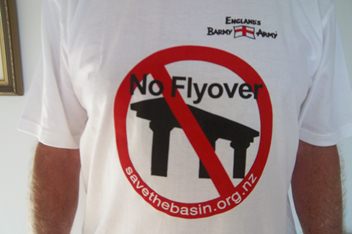
But we’ve been somewhere similar before – John Key’s Government tried to fast-track a similar range of projects. I was involved in stopping one of those projects, a motorway flyover the Government intended to build at the Basin Reserve cricket ground in Wellington.
It’s been a while since I’ve written any flash fiction, so I’m especially pleased to have my short-short story A Long Ball published in the Circle | Porowhita issue (December 2024) of Flash Frontier. Check them out!
Submissions on the Government’s odious Treaty Principles Bill close at 11.59pm on Tuesday 7 January. The Government recognises that Te Tiriti o Waitangi is a barrier to the resource expropriation they want to carry out – which is why Christopher Luxon has let ACT off the leash on this one.
If you, like me, think that this Bill is a betrayal of the fundamental basis on which our nation was established, please submit against the Bill. There are many excellent submission guides out there – Together for Te Tiriti has a good one. I know it’s the holidays (and I’m enjoying my break!), but this is too important to let slide.
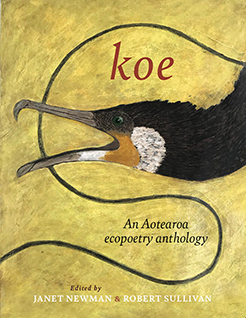
Koe: An Aotearoa ecopoetry anthology launches on 22 August – you’re invited to the launch!
I’m delighted that my poem “All That Summer”, first published in my collection New Sea Land (2016), has been selected for this new anthology of environmental poetry from Aotearoa / New Zealand, edited by Janet Newman and Robert Sullivan. I’ll be one of the poets reading at the Wellington launch, which is at Meow, 9 Edward Street, Wellington from 6pm on Thursday, 22nd August – the same day the anthology becomes available in bookstores.
Koeinvites readers to explore human connections with nature through a selection of over 100 poems composed in Aotearoa New Zealand from pre-European times to the present day. Including a substantial introduction and editors’ notes, Koe is the first anthology to provide a comprehensive overview of ecopoetic traditions in Aotearoa and to locate these traditions as part of the global ecopoetry scene.
In Koe, editors Janet Newman and Robert Sullivan reveal the genesis, development and heritage of a unique Aotearoa New Zealand ecopoetry derived from both traditional Māori poetry and the English poetry canon. Organised chronologically into three sections—representing the early years (poets born in or before the nineteenth century), the middle years of the twentieth century, and the twenty-first-century ‘now’—each segment presents a diverse array of voices. Across all these time frames, speaking from the conditions of their era, the poets delve into themes of humility, reverence and interconnectedness with the nonhuman world. They challenge traditional Eurocentric perspectives, highlight the significance of indigenous narratives, and wrestle with the impacts of European colonisation.
With more than 100 poems of celebration, elegy, apprehension, hope and activism, Koe gives us the history that holds our future.
New Poems Published in a fine line and Tarot
I’ve recently had new poems published in a fine line and Tarot – thanks very much to respective editors Gail Ingram and Kit Willett for selecting these poems for publication!
Where To From Here webinar for Our Climate Declaration
In July, I spoke to an Our Climate Declaration webinar about the nexus between climate writing and climate activism, referring both to my novel Emergency Weather and to the current political moment.. Thanks to Our Climate Declaration for the opportunity – check out the webinar below!
A Change In the Weather: The Climate Crisis In Poetry And Fiction
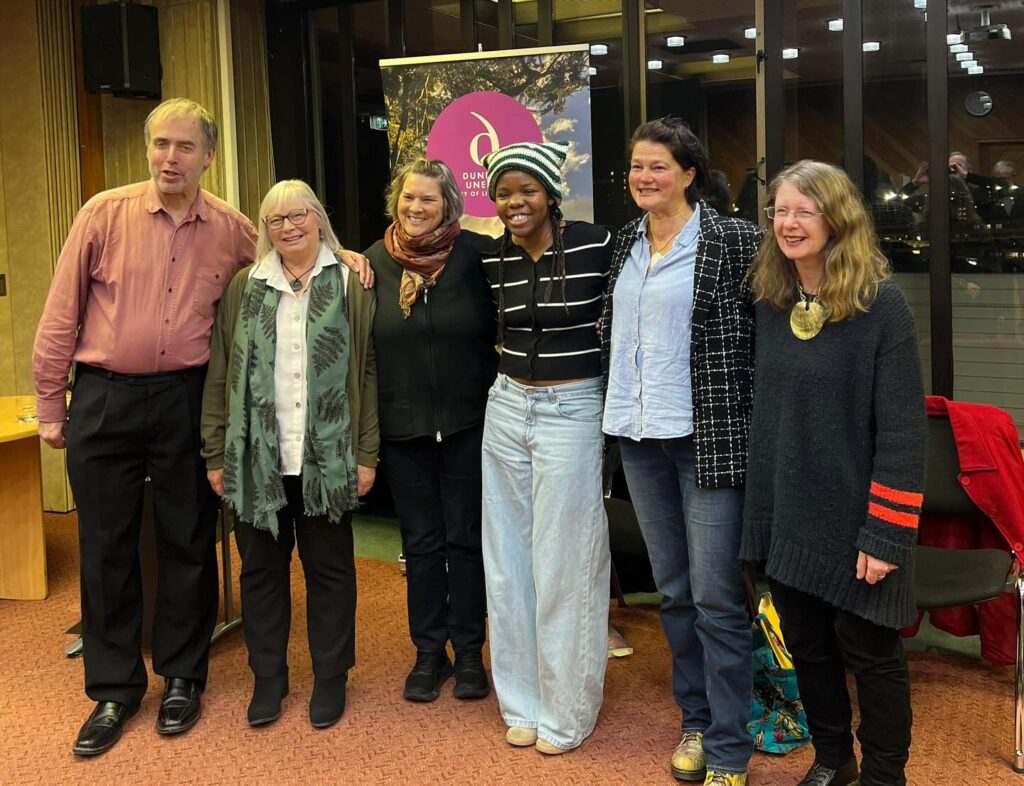
Tim Jones, Kay McKenzie Cooke, Michelle Elvy, Tunmise Adebowale, Mikaela Nyman, Jenny Powell – thanks to Kay for the photo!
I spent a couple of weeks in the south of the South Island in late June and early July, travelling with family and visiting friends. Along the way, I took part in a writing event in Dunedin, A Change In the Weather: The Climate Crisis In Poetry And Fiction on Thursday 4 July, which Michelle Elvy, Kay Mckenzie Cooke and I organised. The event was held in the Dunningham Suite at Dunedin Public Library – thanks very much to Ali and her team for setting the venue up & being such good hosts!
and everyone read wonderful pieces! Then, afterwards, we had a really good discussion, covering both climate & environmental writing and climate activism, with the audience. Books got sold, drinks were drunk, nibbles nibbled (thanks to Kay and Robert for getting the drinks and nibbles) – it was a very positive event and I enjoyed it a lot. I lived in Dunedin from 1976 to 1993, and I felt very welcomed by the Dunedin literary community at this event.
Tuesday 12 December 2023 dawned a fine summer’s day in Wellington. But in mid-afternoon, the weather changed. A southerly front raced up the country, bringing very strong winds, heavy rain and hail to Wellington and the Hutt.
I was sitting at my desk, and I felt and saw the change: the temperature dropped abruptly, and sunshine was abruptly replaced by cascading rain. It was all over within 90 minutes, and despite over 20 mm of rain falling at our place within a few minutes, we got off fairly lightly.
But friends I’ve talked to since weren’t so lucky. One was inside a mall that rapidly flooded; another had part of their roof torn off their house – one of a number of buildings in the Hutt that suffered serious damage.
“A day after finishing this book, a sudden and savage storm struck Wellington. At 2.50pm the sun was shining on what seemed to be a pleasant summer day. Ten minutes later the sky turned black, violent winds blew out windows, hail was smashing into the deck and sheets of water poured from the gutters. And that was in a less extreme part of the storm’s path. Elsewhere it was much, much worse.”
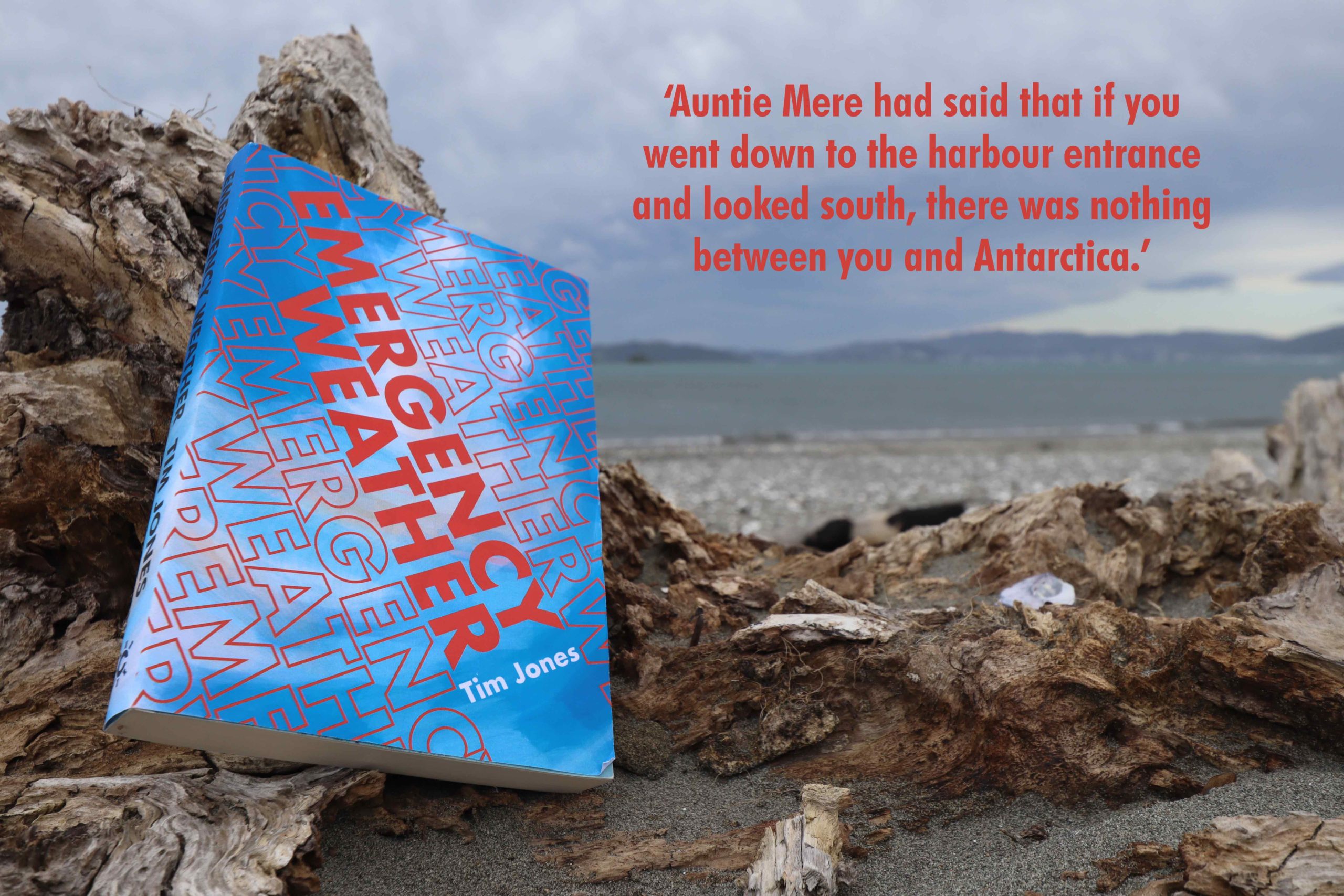
My novel Emergency Weather begins and ends with storms – the first causes death and damage from north to south, while the second and stronger storm zeroes in on Wellington. Wellington has always been prone to storms, but climate change is loading the dice, making it more likely that when storms come, they will be damaging and destructive.
My novel is set against the context of a government in which (some) Ministers are at least trying to do the right thing. But the recent election, which Labour lost by a combination of its own timidity and many voters’ desire for something different, has brought to power a government including climate deniers, environmental vandals, and worshippers at the altar of the car. If climate change is on their agenda at all, it’s well below culture wars.
But physical reality doesn’t care about ideology. So long as we keep loading the climate dice by burning fossil fuels and forcing cows to produce milk, piss nitrates and burp methane, the storms and the fires and the flooding will get worse. If we stop, the climate will have a chance to recover. No amount of denialism changes that.
(Excuse me, Tim! It’s just before Christmas and you’re supposed to be encouraging people to buy your book!)
Err … buy my book if you’re looking for a good summer read – it’s not all, or even mostly, doom and gloom! – and have a great holiday! Here’s to lots of good reading, and good organising for change, in 2024.
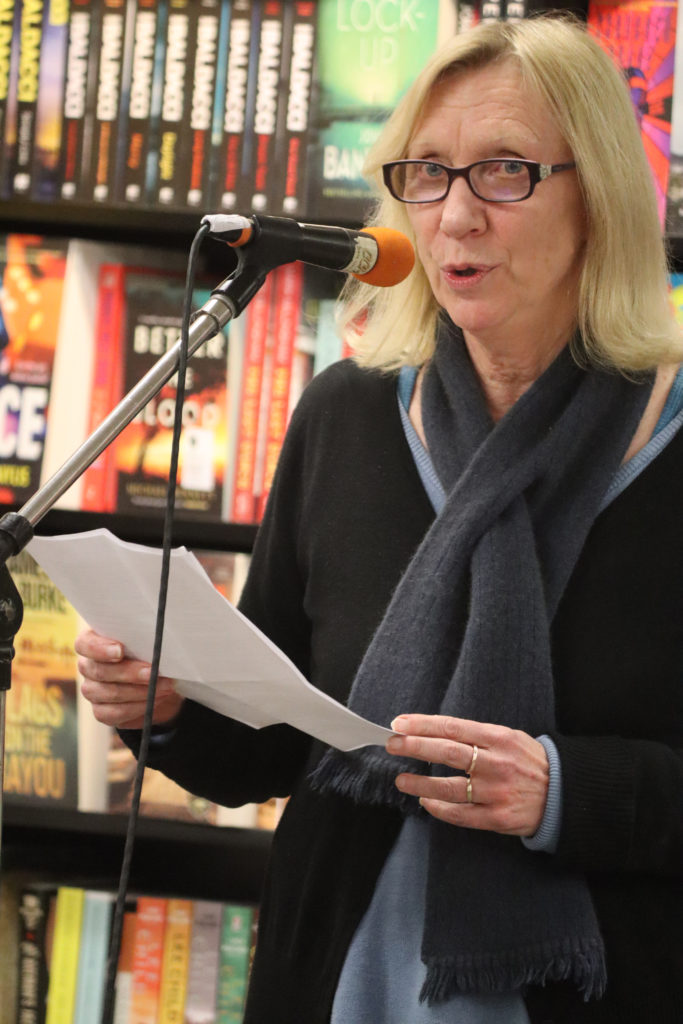
Mandy Hager launches Emergency Weather. Photo: Stephen Olsen
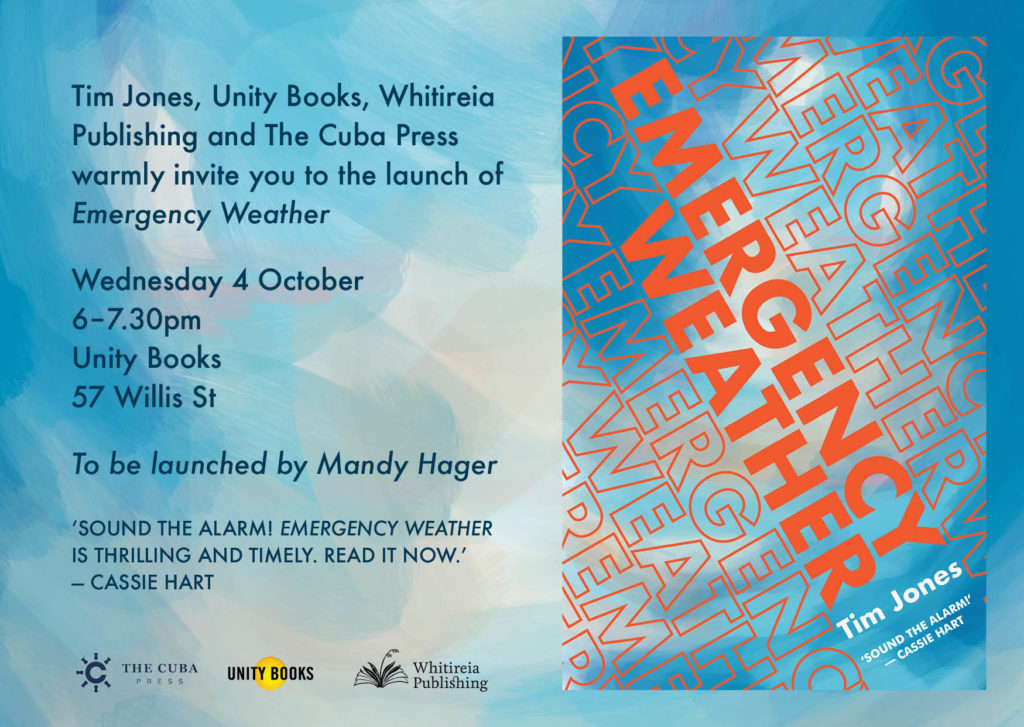
I was nervous heading into the launch of Emergency Weather. Unity is a great place for a launch, but it looks very empty if no-one comes – and there were other launches, as well as election meetings, on in downtown Wellington at the same time.
I needn’t have worried! Around 100 lovely people came to the launch, we sold plenty of books and I had a great time. It was good to see old friends, new friends, and people I’d never seen before!
Kate from Unity Books introduced the launch, then we heard from Paul from The Cuba Press and Cadence from the Whitireia Publishing programme before the book was launched by author Mandy Hager, whose speech really moved me. Then it was time for me to speak, read the very beginning of the novel, and sign lots of copies! If you missed the launch, the YouTube video is available or you can read Stephen Olsen’s report: https://wellington.scoop.co.nz/?p=155655 (he also took the photo above).
If you didn’t make the launch but would like to get on trend and buy a copy of Emergency Weather, it’s available:
* At Unity Books and Good Books in Wellington, and other independent bookshops nationwide, including UBS in Dunedin – if it’s not available from your nearest independent bookshop or Paper Plus, please ask them to order it in.
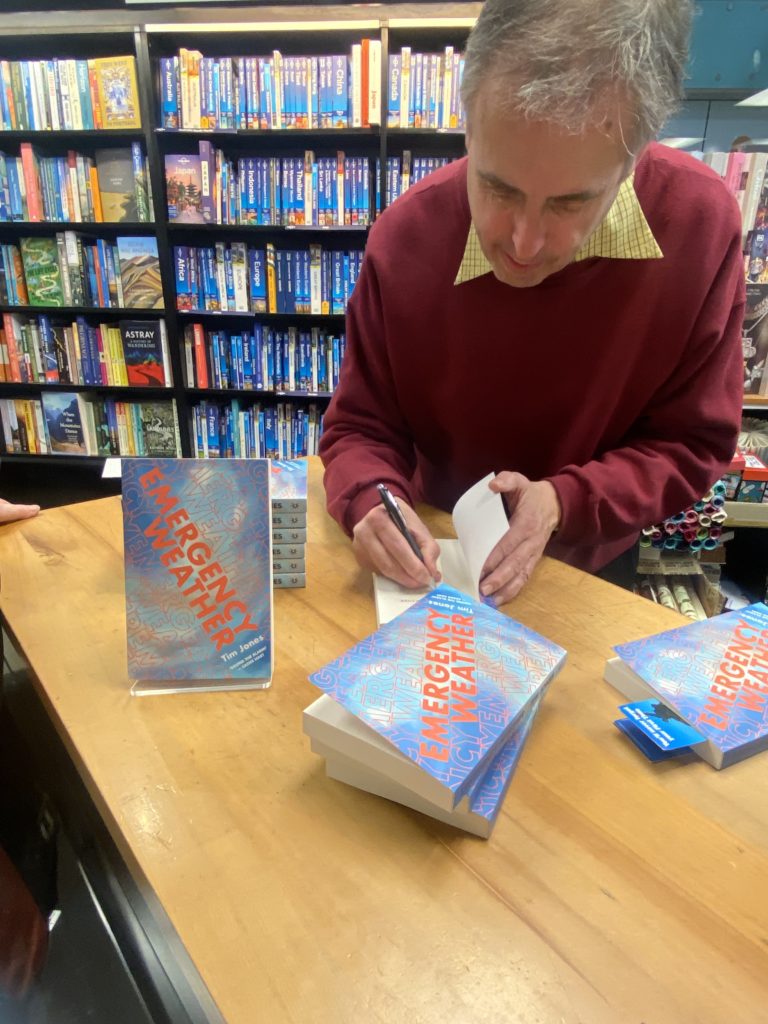
Tim Jones signs a copy of Emergency Weather (photo: Kate, Unity Books)
Well Reviewed
It’s also been good – and again, a testament to the hard work of The Cuba Press and Whitireia Publishing – to see reviews of Emergency Weather appearing. Online reviews:
It’s not quite the Taylor Swift Eras Tour, but here are some upcoming Wellington events I’m involved in that you’re warmly invited to attend:
Unity Books Panel, Wednesday 18 October, 12.30-1.30pm: “Talking Up a Storm: The Making of Emergency Weather”: https://www.facebook.com/events/288705720676072/ (Facebook event link). Find out how a novel is written, edited, published and marketed.
Verb Wellington event, 11 November, 3-5pm – this one is for Remains to be Told, but I might weave in a mention or two of Emergency Weather as well.
Events run from 12.15 to 1.15 pm on Mondays at Rongomaraeroa, Te Marae, Level 4, Te Papa
I’m looking forward to the 21st!
7 August
Other Worlds
Pip Adam‘s Audition features three giants: Alba, Stanley and Drew, who are squashed into a spaceship hurtling through space, and must talk to keep the spaceship moving. Tīhema Baker‘s Turncoat is set on a distant future Earth, colonised by aliens, where Daniel –a young, idealistic Human–is determined to make a difference for his people. These works of speculative fiction are exciting, inventive and compassionate in their exploration of systems of power. Dougal McNeill will talk to Pip and Tīhema about these other worlds in fiction, and the mirror they hold up to our world today.
14 August
Lioness
A new novel by Emily Perkins is an event in the literature of Aotearoa. Lioness is Emily’s first book in ten years and is set to be one of the most talked about novels of 2023. Join Damien Wilkins as he talks to Emily about Lioness and about a stunning career spanning more than 25 years, beginning with her classic debut Not Her Real Name, taking in her years in London, her time as a television books show presenter and a university teacher, and her more recent work for the theatre.
21 August
Ōrongohau | Best New Zealand Poems 2022
‘I tried to think of a visitor to our poetry shore—what could I include to show its terrain?’ wrote editor Louise Wallace, introducing some of our poetic landmarks of 2022. Hear Nick Ascroft, Morgan Bach, James Brown, Tim Jones, Anahera Gildea, Michaela Keeble, Frankie McMillan, Khadro Mohamed, and Sarah Scott, and read work from this annual anthology in a warm-up for National Poetry Day. Introduced by Damien Wilkins.
28 August
Home and Away: Noelle McCarthy
Early in 2020, Noelle McCarthy travelled to Ireland where her mammy, Carol, was dying, then back to New Zealand as borders were slamming shut. Written through the years of the pandemic, Grand is about mothers and daughters, running away and going home, Noelle and Carol. It’s been a best-seller here, winning the E.H. McCormick Prize at the 2023 Ockham Awards. This June, Noelle flew to Ireland to launch the UK and Irish edition. Kate Duignan talks to 2023 Writer-in-Residence Noelle about the reception of the book on both sides of the world, and what’s left to write after a memoir.
Mark Blackham’s A Sky of Wretched Shells is the third book in The Cuba Press’ novella series, following my novella Where We Land and Zirk van den Berg’s I Wish, I Wish. Both Where We Land and A Sky of Wretched Shells are climate fiction novellas, but they’re very different: Where We Land is about our near-future response to climate change, while A Sky of Wretched Shells is set further in the future, when most of the world has fallen victim to ecological disaster and only one island offers hope for survival.
On the island of Woleai, 15-year-old Mala and his people live in relative peace and safety as the rest of the world falls apart. The arrival of two Western outsiders brings an end to this fragile equilibrium.
I won’t say more about the plot, because a lot happens in this novella that it would be a shame to spoil. I will say that there’s some really beautiful descriptive writing and imagery in A Sky of Wretched Shells: I got a strong sense of place from Mark Blackham’s novella.
Nevertheless, I struggled with some of the choices the central character, Mala, made – from my point of view, he persistently makes choices that puts his island and his people at greater risk. (Though my decision-making at age 15 may not have been the greatest, either, and the end of the novel suggests that he has made better choices than it first appears.)
The ending took the story in directions I didn’t expect, reactivating the sense of wonder I used to get as a teenager from reading science fiction, even as my adult eye was casting a more sceptical gaze over proceedings. So I ended the novella with mixed feelings: but given the quality of his descriptive writing and the scope of his imagination, I’m keen to see what stories Mark Blackham writes next.