Book review: Halfway to Everywhere, by Vivienne Ullrich

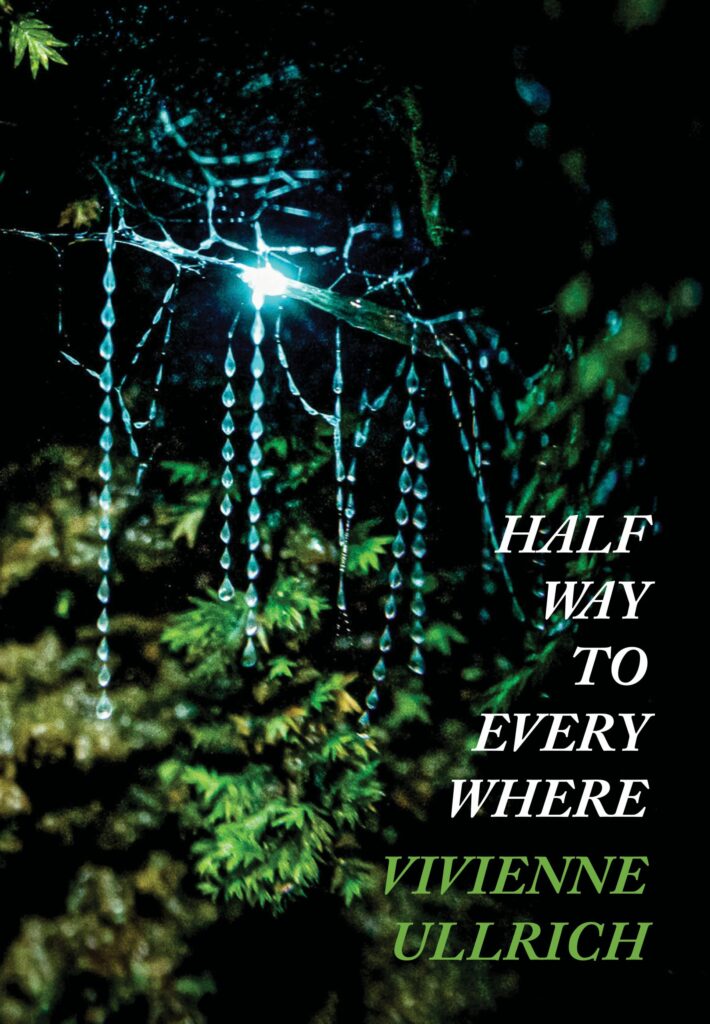
Cover of poetry collection "Halfway to Everywhere", by Vivienne Ullrich

Halfway to Everywhere, by Vivienne Ullrich (The Cuba Press, 2024), 70 pp. Available from https://thecubapress.nz/shop/halfway-to-everywhere/

Halfway to Everywhere is Vivienne Ullrich’s second poetry collection, and I’m impressed. The poems in Halfway to Everywhere show a lot of formal ability as a poet, and as the collection goes on, that formal elegance was increasingly matched with subject matter that engaged me emotionally.

Many of these poems take as their subject matter art, historical figures and fairy tales. Mary Queen of Scots, Little Red Riding Hood, Scheherazade, Jack of “Jack and the Beanstalk” fame and the artist Max Gimblett all put in an appearance, as the poet invites us to see the world from their points of view.

“Mary Queen of Scots” (p. 24) is a good example of these poems. It begins:

I die tomorrow. It is a simple thing
and yet it clamps my belly.
I pray for a clean stroke
and dignity.

From “Rutu” (p. 18), a poem inspired by Rita Angus’ painting of the same name:

… how is it we gift
this month with myths of rebirth, when an eye
towards our cross of stars would signal time
for harvest, time for tuning in to self.

I was very impressed by the quality of both the poetry, and the thought that had gone into the poetry, in Halfway to Everywhere. I did find that – perhaps because of the number of poems about artworks and historical figures – it took about half the collection before I started to engage with the poems emotionally – in other words, to connect with them as well as be impressed by them. But as I continued reading, I found poems that spoke to me more directly, like “Footprint” (p. 62):

I hear you. No doubt
it is different in my skin.
I am my peculiar set of molecules
after all, and I have the benefit of
context and the words I left out.

This skill in addressing multiply points of view comes to fruition on my favourite poem in the collection, “Little Red Riding Hood” (p. 48), a retelling in which the dramatis personae all get a turn as protagonist: the wolf, the huntsman, the grandmother, and the girl herself. This poem combines formal ability and sly wit in a way that works extremely well. An excerpt won’t do it justice – check out the whole poem!

Vivienne Ullrich is a talented, clever, thoughtful poet, and as I read through this collection, I found her poems and her poetry sneaking up on me. Halfway to Everywhere is a good place to be.

Book review: Strays & Waifs: A Chasing Ghosts Mystery, by Mandy Hager

Strays & Waifs: A Chasing Ghosts Mystery, by Mandy Hager (The Cuba Press, 2024), 286 pp. See https://mandyhager.com/chasing-ghosts/ and https://thecubapress.nz/shop/strays-and-waifs/

Reviewed by Tim Jones

I heard Mandy Hager read the first chapter of Strays & Waifs on a climate fiction and poetry panel at Newtown Library. It was a gripping description of a house destroyed by flood as the person living there, the novel’s protagonist Bella, can only watch in horror.

We learn that Bella is a climate fiction author and former climate activist, and both these aspects play into the narrative, but this is a murder mystery with a supernatural component. The novel does not follow the path I was expecting, but once I had recalibrated my expectations I got fully on board with the new direction.

I called Bella the protagonist above, because we meet her first and gradually learn about her past as a climate activist and how what happened then has led to deep trauma that still affects her in the present. That, and an unwelcome reminder of her past who turns up in the present, is one of the ghosts present in the story, but far from the only one.

That brings us to Freyja, the other protagonist – I think she is central enough to this story that she crosses the porous line between important secondary character and protagonist. Freyja has some unusual abilities which Bella initially recoils from – as did I as a reader at first; but Mandy Hager shows with great skill how Bella comes to tolerate and then accept those abilities, which come in mighty handy as the pair become involved in bringing justice to the dead and rescue to the living.

I know people very like Bella, so I had no difficulty believing in her as a character; I don’t know many people like Freyja, but she is so well-drawn that I soon found myself believing in her as well.

Mandy Hager writes with tremendous immediacy. And this is no drawing-room mystery: there is action too, vividly described action in which the skills Bella learned as a committed direct activist come into play. As a reader, I felt myself slipping in mud, I felt branches slap my face as I ran through the bush with a bad actor in hot pursuit.

The identity and nature of the villain is all too plausible – all too depressingly plausible – but they’re not exactly subtle, and I would have welcomed a bit more misdirection in that regard. Though, looking at the world around us, villains now delight in boasting of their villainy – so maybe I’m the one clinging to outdated expectations?

There are some really satisying punch-the-air moments in this book, and if the biggest one for me is when Bella turns to the New Zealand Companies Register database to find vital information, equally satisfying moments are also there for people who are less interested in deep-dive research into corporate villains than I am!

Strays & Waifs does justice to its premise, to its main and secondary characters, and to the reader, and starts to pull on the dangling threads of Bella’s past in ways that make me excited for the possibility of further “Chasing Ghosts” mysteries. Very little stays hidden forever.

Book Review: The thirty-one legs of Vladimir Putin, by P S Cottier and N G Hartland

Front cover of novella "The thirty-one legs of Vladimir Putin", by P S Cottier and N G Hartland

The thirty-one legs of Vladimir Putin, by P S Cottier and N G Hartland (Braidwood, NSW: Finlay Lloyd Publishing, 2024), 115pp, https://finlaylloyd.com/product/the-thirty-one-legs-of-vladimir-putin-ps-cottier-ng-hartland/

Reviewed by Tim Jones.

Autocrats and body doubles go together like Elon Musk and Nazi salutes. Stalin had body doubles, Saddam Hussein had body doubles, and I wouldn’t be surprised if, somewhere in America, a small fleet of actors are even now applying the orange spray tan and putting on the mannerisms, the cruelty, the tiny hands.

So it’s very likely Vladimir Putin has his own set of look-alikes. This excellent novella – maybe it’s more accurate to call it a collection of linked stories – takes that concept and runs with it. The thirty-one legs of Vladimir Putin won the annual 20/40 publishing prize, for works of fiction and nonfiction between 20K and 40K words, and that win was well deserved.

In 18 short chapters, plus a Prologue, the authors take us on a worldwide, whirlwind tour of men who have the good or ill fortune to resemble Vladimir Putin in appearance. They have been paid by Russian functionaries to stand by to stand in for the big boss. Some Putins are pleased with the deal, others are having doubts both practical and existential. From Valparaiso to The Hague, what with invading Ukraine and all, it’s hard out here for a Putin.

Each chapter is a snappy portrait of a man and a place. There are hints of an arc plot whirring away in the background, but it’s mostly implied rather than overt. It comes to the fore as the book nears its end, especially in the final two chapters, which revisit the Putins from the Prologue (Aussie Putin Dave McDermott) and Chapter 1 (English Putin Samuel Chatswood). A Putin’s life is not a happy one.

The quality of the prose and the specificity of the descriptions are among the pleasures of this book – but what I most enjoyed is the subtle shifts of tone within and between chapters, from menace to humour to those uncomfortable places in between.

Why thirty-one legs, you may ask? Buy the book to find out – and buy it for a short, punchy, amusing, thought-provoking read that, unlike taking on the role of a Vladimir Putin lookalike, you won’t regret.