A Suitable Anthology for Easter

Helen Lowe alerted me to the following competition and anthology, which seems like a suitable one to post about at Easter:

Spiritual Writing Competition

Closes: End of May

Judged by a church-based panel led by Pleasant Point writer Karalyn Joyce

Prizes: 1st $500; 2nd $250; 3rd $100

Up to 50 submissions are to be published in a new “Spiritual Anthology” launched in November 2009

Calling for all non-published poems/fiction/non-fiction work with a “words to inspire” based theme; i.e., life; death; creation; peace; miracles; wonder; reflection from new and established writers of all ages

For entry form send a stamped self-addressed envelope to: “Spiritual Anthology”, 4a Horton Street, Pleasant Point, South Canterbury; or email: daphnej (at) xtra.co.nz

The entry form has further details:

  1. Submissions (fiction/non-fiction or poetry) must be the original work of the entrant, previously unpublished and not under consideration elsewhere. A suggested length for stories is up to 1,500 words. Poetry is suggested to be no more than 50 lines. The editing team reserves the right to select work from the submissions received and will contact the writer to gain publishing rights but copyright will remain with the writer.
  2. Contributors published in the anthology to receive a free copy in lieu of payment, and the right to order further copies at a special rate. Prizes to be presented at special launch of the anthology in November, or forwarded to the writer following the launch.
  3. The theme is: “words to inspire” (i.e., life; death; love; peace; grace; miracles; healing; creation; reflection; spirituality).
  4. Winners and the writers of the chosen work for the anthology will be notified by email/telephone, others will be destroyed unless there is a stamped self-addressed envelope with the submission.
  5. The entry fee is $2 per poem/ $5 per short story and writers are welcome to enter two or more times. The competition is open to all ages.
  6. Entries are to be typed single sided A4 paper and double spaced.
  7. Judge’s decision is final.
  8. The writer’s name must not appear on the manuscript. Please use the entry form below. Photocopies are acceptable.
  9. The closing date is the 31st May 2009.

Reading Poetry at Madras Cafe Books in Christchurch (feat. North)

Last night, I was a guest reader, together with Fiona Farrell and Victoria Broome, at the first weekly session of the Canterbury Poets’ Collective Autumn Readings Series at Madras Cafe Books in Christchurch.

I had a terrible cold, but a good time. I was going to post a full and judicious report, but I discovered tonight that Catherine of Still Standing on her Head had got there before me, so I am going to recommend that you read her excellent report. I’ll just throw in a few additional comments:

  • I liked the venue. Madras Cafe Books does what it says on the label: There’s a cafe, with seating inside and out, and behind the cafe, a bookstore. The food at the cafe was delicious (I was very bad and had a mocha slice), and although the bookshop isn’t large, it has a good selection of interesting books from both New Zealand and overseas. Definitely recommended.
  • I was impressed by what I saw of the Canterbury poetry community (I’m not sure how many people came from out of town). There was a very good turnout, people were certainly friendly to me and seemed friendly to each other, and the standard of the poems read at the open mike part of the evening was high; there were many contenders for the prize for best poem from this section, won by Joanna Preston. It was great to meet poets I only knew by name or reputation, such as John O’Connor and James Norcliffe, as well as those I had met before – and I was especially pleased to be able to thank Fiona Farrell for including my story “Win a Day with Mikhail Gorbachev” in Best New Zealand Fiction 4.
  • It isn’t easy to read poetry to an audience when you have a sore throat. I was surprised my voice held out; I guess adrenalin got me through. Hardest of all the poems to read was “North”, from my first collection, Boat People. I do the Yorkshire-y bits in a variety of Yorkshire accents, and it isn’t easy trying to sound like the Clitheroe Kid when your voice is threatening to give way. Maybe I’ll put up an audio file one day, but in the meantime, here is North, inspired by my visit back to the land and accents of my birth in 1989 – with apologies to Harvey Molloy, who has had to put up with my lame renditions of accents not entirely dissimilar to his when he’s heard me read this poem.

North

On Ilkley Moor
I parked me red
Ford Laser hatchback
and gazed to the north.
Rain and smoke stood over Wharfedale.

It was all in its appointed place:
stone houses and stone smiles in Ilkley
the wind on the bleak
insalubrious bracken.

I was waiting for memory
to make the scene complete:
some flat-vowelled voice out of childhood
snatches of Northern song.

For memory read TV:
Tha’ve broken tha poor Mother’s heart
It were only a bit of fun.
Bowl slower and hit bloody stumps.

Tha’ll never amount to much, lad. In cloth cap and gaiters,
car forgotten, I pedal down the hill. Hurry oop
or tha’ll be late for mill. Folk say
I’ve been seeing the young widow Cleghorn.
Well, now, fancy that.

In my invented character
I trail my falsified heritage
down the long, consoling streets.

Enamel: The First Issue of a New Literary Journal

Emma Barnes, in addition to being a fine poet herself, is the editor of the new literary journal Enamel. The first issue of Enamel has just been published, and I’m pleased to say that I have two poems in it: “The Penciller” and “Nightlife”.

Emma starts her editorial by saying:

When I decided to start Enamel I naively placed the word pro-feminist in my call for submissions. At the time of writing I phrased it as a slight bias toward pro-feminist literature. Little did I know that this would cause a dearth of submisions from anyone who didn’t identify as a woman. Tumbleweeds rolled across my inbox.

Well, Emma seems to have dealt with that tumbleweed problem (you can probably turn rolling tumbleweeds off using a hidden option in Gmail), because there are some fine poems in this first issue of Enamel – although it’s true that not many of the poets are of the masculine persuasion. The poets represented in this issue are Johanna Aitchison, Anna Forsyth, Tim Jones, Miriam Barr, Jennifer Compton, Helen Heath, Reihana MacDonald Robinson, Andrew Coyle, Meg Davies, Elizabeth Welsh, Ruby Mulholland, Meliors Simms, Lori Leigh, Marcia Arrieta, and Helen Rickerby.

On my first, quick look at the issue, poems that stood out for me included “Extravagant Promises” by Meliors Simms, “Useful Cupboards” by Jennifer Compton, and “Nothinghead” by Helen Rickerby. But that’s just on a first look: I am sure there will be more when I take the time to look again.

Emma is selling hard copies of Enamel through TradeMe for a price between $10 and $15. PDF copies are available for a donation. And if you’re interesting in contributing, the next issue of Enamel is due to be published in March 2010.

Canterbury Poets Present: Autumn Readings 2009

Poetry in Performance: Autumn Readings 2009

  • Open microphone and guest readers 
  • Wednesdays 6.30pm $5 entry 
  • Madras Café Bookshop, 165 Madras St – licensed and BYO. 
  • Win a $20 MCB voucher – audience vote for the best open mike poet each night 

And here’s the lineup:

18 March: Tim Jones (that’s me, folks!), Fiona Farrell, Victoria Broome

25 March: David Howard, Marissa Johnpillai, Helen Lowe

1 April: Frankie McMillan, Tusiata Avia, Ben Brown

8 April: Ian Wedde, Charlotte Trevella, Helen Yong

15 April: Richard Reeve, Diana Deans, John O’Connor

22 April: Bernadette Hall, The Hagley Writers

29 April: Kevin Ireland, Joanna Preston, Koenraad Kuiper

Everyone welcome; enquiries to: joyces (at) clear.net.nz

Yes, I’m off to Christchurch! I’m really looking forward to the opportunity to read in my Dad’s home town, and to take part in a reading with Fiona Farrell, to whom I am indebted for choosing my story “Win a Day with Mikhail Gorbachev!” for The Best New Zealand Fiction: Volume 4. If you’re in Christchurch, please come along to one or more sessions. This looks like a great line-up.

Calls for Submissions

Two calls from submissions that may be of interest to New Zealand writers:

1) An Anthology of Writing about Canterbury

Wily Publications invites submissions of poetry and short prose (up to 2000 words) for an anthology featuring writings about Canterbury – coast, plains and high country. Fiction and non-fiction, current and historical works are welcomed, but copyright must be held by the person submitting the work. Work may be previously published, but not anthologised.

Submissions must be typed, double spaced (poetry may be single spaced), on one side of A4. Please ensure that name, postal and email addresses are included, a statement of ownership of copyright, as well as a stamped self-addressed envelope. Submissions will not be returned, and unaccepted work will be destroyed. Following publication, a small payment will be made for accepted work.

Please send submissions to: Canterbury Anthology, 37A Holly Road, Christchurch 8014

Submissions must be received by 28 February 2009.

2) US poetry journal looking for New Zealand poetry

Reconfigurations: A Journal for Poetics & Poetry / Literature & Culture

Reconfigurations is seeking excellent contemporary New Zealand poems for its November 2009 issue. Edited largely in the U.S., Reconfigurations is an electronic, peer-reviewed, international, annual journal for poetics and poetry, creative and scholarly writing, innovative and traditional concerns with literary arts and cultural studies.

Bryan Walpert will make the initial selection of poems. These will then be peer-reviewed by a panel of editors at Reconfigurations, who may opt to take all or only a selection of these. Please send up to five of your best poems by 15 April 2009 in a single Word file attachment to Bryan Walpert at b.walpert (at) massey.ac.nz along with a bio in the body of the email of up to 75 words. Please simply use “Reconfigurations” as your subject line. Unpublished work is preferred and will be given priority, but work published only in New Zealand will be considered. If you include published work, please indicate which poems have been published, where, and when.

Voyagers: A New Zealand Science Fiction Poetry Anthology

In 2004, Mark Pirie and myself decided that it would be a good idea to put together an anthology of New Zealand science fiction poetry. We knew that there were people writing science fiction poetry in New Zealand, and we knew of a few published examples of NZ science fiction poetry. How hard could such a project be? So we put out a call for submissions, and many poets responded with new or previously-published work.

At the same time, we split the corpus of New Zealand poetry (hmmm, “corpus”, never thought I’d use that word in a blog post) between us and looked everywhere we could for published NZ SF poems. We were amazed how many we found: nuclear apocalypses from the 1950s and 1960s, utopias and dystopias from the 1960s and 1970s. We used a reasonably broad definition of science fiction, but even so, we found more poems than we could use. We discovered that poets such as Allen Curnow, James K. Baxter and Cilla McQueen had written science fiction poetry.

The next problem, finding a publisher for the anthology, proved to be a little harder. Most New Zealand publishers we approached did not think the anthology was a commercial proposition; one publisher took on the project subject to its receiving Creative New Zealand funding, but the publishing application was unfortunately unsuccessful.

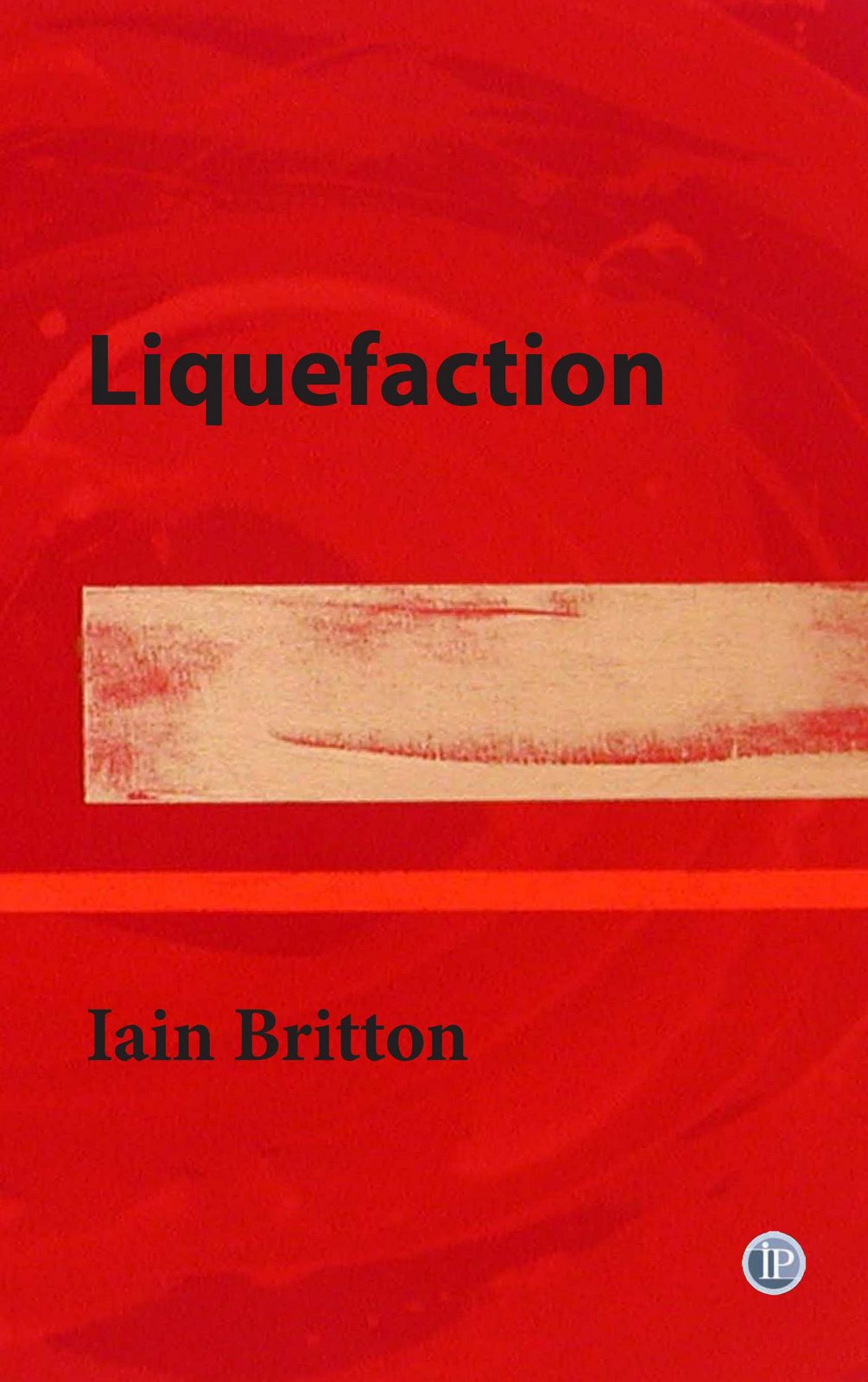
It seemed that we had run out of options to have an anthology of the desired size and quality published, but then Mark approached Australian publisher Interactive Publications, having heard that they were to publish a book of Iain Britton’s poetry. We were very pleased to hear that Interactive Publications were willing to publish the anthology in a print run large enough to make it worthwhile.

The next step was to go through the lengthy process of getting permissions from authors and publishers to reprint poems which had previously appeared elsewhere. Interactive Publications was unable to offer payment to authors, something we had wanted to do, and understandably, some authors and publishers pulled work from the anthology because of this. However, this gave us the opportunity to refresh the anthology with some newer poems, and at last the manuscript has been completed and sent to the publishers – except for the Contributors’ Notes, which I’m currently collating.

I’m really pleased that we have finally got this project off the ground after many years of trying. I think it’s going to be a fine anthology. I’ll tell you more as the publication date approaches.

“Swings and Roundabouts: Poems On Parenthood” Revisited

Shortly after the publication of Swings and Roundabouts: Poems on Parenthood (which you can buy online from Fishpond or New Zealand Books Abroad), I gave my initial thoughts on the book, but said that I wouldn’t review it because I have a poem in it.

Well, I changed my mind. I’ve completed reading Swings and Roundabouts over the past two weeks, and though I’ll leave my own poem Coverage to speak for itself, I want to reiterate what a good book this is.

It’s true that Swings and Roundabouts is likely to speak most strongly to parents, but these poems are strong as poems, not just as aspects of parenthood. After an excellent introduction by editor (and parent) Emma Neale, the book is organised in chronological order, starting with pregnancy and ending with the deaths of children and parents – though the tone of this final section is not morbid. The poems are interspersed with quirky and enjoyable photos by Mark Smith.

This is predominantly an Australasian anthology, but it also includes poems by Sylvia Plath, Sharon Olds and Louise Glück. In her introduction, Emma Neale suggests that Lauris Edmond could be regarded as the local poet laureate of childhood, and she has five poems here. Many well-known New Zealand poets are represented.

There are hardly any poems I don’t like, but poems that especially stand out include “Helpless” and “Yellow Plastic Ducks” by Graham Lindsay, “The Vending Machine” by Anna Jackson, “35/10” by Sharon Olds, “Your Secret Life” and “Your Secret Life 2” by Harry Ricketts, “It Allows a Portrait in Line Scan at Fifteen” by Les Murray (and yes, the title does make perfect sense, and is very moving, in the context of the poem), “Festive Lentils” by James Norcliffe, “Stay in Touch” by Laurice Gilbert, and “The Names” by Lauris Edmond.

But if I had to choose just one poem from this book, it would be “Child” by Sylvia Plath: small, vivid, memorable.

Like a child, like this book.

What I’m Writing

I set up this blog to write about and promote the three books I had published between September 2007 and June 2008 – All Blacks’ Kitchen Gardens, Anarya’s Secret and Transported – plus post about other writers, books, and matters of interest to me. I’ve been doing all that, and will keep doing it, but I realised a few days back that there was one topic I hadn’t tackled: what I’m writing now.

I write short stories, poetry, and novels. Inefficient, maybe, especially for someone who writes part-time, but that mix doesn’t seem likely to change in the near future – because I’ve got all three types of writing on the go. My main focus is my new novel, but short stories and poetry refuse to be entirely set aside.

First, the novel. I’m prone to calling it “my new novel”, but that’s not strictly accurate. Before I wrote Anarya’s Secret, I had written another novel, with the working title “Antarctic Convergence”. The jumping off point for “Antarctic Convergence” was a story I wrote in 2000, “The Wadestown Shore”, which is included in Transported.

[SPOILER ALERT]

This is the story that begins:

I cut the engine in the shadow of the motorway pillars and let the dinghy drift in to the Wadestown shore. The quiet of late afternoon was broken only by the squawking of parakeets. After locking the boat away in the old garage I now used as a boatshed, I stood for a moment to soak in the view. The setting sun was winking off the windows of drowned office blocks. To the left lay Miramar Island, and beyond it the open sea.

and ends:

The sunken office blocks of the Drowned city were far behind me. The rich waters and virgin shores of Antarctica lay ahead. I made my way forward to greet them.

[/SPOILER ALERT]

“The Wadestown Shore” is (in revised form) also Chapter 1 of the novel.

I finished the initial version of this novel in 2004, but was unable to get it published. I decided to shelve it for a while, write something else (that turned out to be Anarya’s Secret), and then revisit the novel and the feedback I’d had on it.

I did that earlier this year, and though there are some valid arguments against rewriting your first completed novel, I felt that the basic idea of “Antarctic Convergence” was still good, but that the novel had major structural problems, especially in its second half. So I’m rewriting it pretty much from scratch, and I’m almost half way through the redraft. More news, I hope, in 2009.

Next, the short stories. I’ve written three new stories since Transported was put to bed, and am currently working on a fourth which I’m trying to finish in time for an anthology submission deadline. That isn’t exactly enough for a collection, and I’m putting completing the novel ahead of writing lots more stories, but I will keep plugging away. When new stories of mine do appear in print or online, I’ll let you know.

Last but not least, the poetry. Although All Blacks’ Kitchen Gardens was published in 2007, I completed the manuscript (more or less) in 2005, so I have had three years to get some more poetry written. But, whereas I can decide that I’m going to work on my novel for the next two hours, sit down, and get 1000 or so words written, I have found that I can’t make myself write poetry: it arrives when it wants, and when it doesn’t want, nothing will induce it – yes, it’s that old favourite “the muse” again!

All the same, when checking the other day, I found that I had 29 poems which I’d consider putting towards a new collection – and what’s more, 29 poems that fit a theme. Will I write more poems that fit this theme and assemble them beautifully into a collection, or will I go off on a complete tangent? Watch this space!

Before the Sirocco

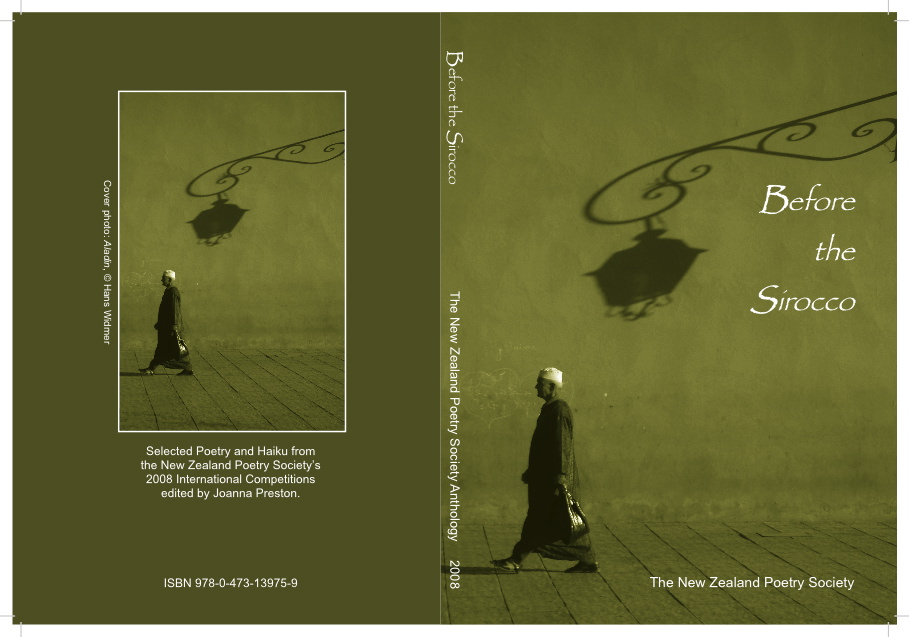
The New Zealand Poetry Society is launching its annual anthology, this year entitled Before the Sirocco and edited by Joanna Preston, in Wellington at 6pm this coming Saturday, New Zealand election day. Here are the details:

Date: Saturday 6 December

Time: 6pm

Venue: Turnbull House, 11 Bowen Street (near the Bowen St/Lambton Quay corner)

What it’s all about: Take your mind off elections for a couple of hours! Come along to the launch of the New Zealand Poetry Society’s 2008 anthology, Before the Sirocco, and hear poets young and old read their work from the anthology — including winners and runners-up in the Poetry Society’s annual International Poetry Competition.

The buzz: The NZPS anthology launch is one of the few occasions on which poets from around the country get together. If you want to take the temperature of the New Zealand poetry scene, this is the place to be – and you’ll get to hear some great poetry as well.

Plus, you can buy a copy of Before the Sirocco there. Isn’t the cover great?

An Interview with Harvey Molloy

Harvey Molloy is a Wellington teacher and poet whose first collection of poetry, Moonshot, has just been published – which made this a very good time to interview him by email.

First of all, congratulations on the publication of Moonshot. What can you tell me about the book, and where can interested readers find more information, and copies to buy?

Moonshot is my first book of poems. It’s divided into two sections. The first ‘Gemini spacewalk’ explores space, the universe, and how space features in the imagination. The second section ‘Learning the t’ is down to earth and concerned with travel, particularly my time in Singapore, and family relationships. The book is orchestrated to follow these themes but some poems don’t fit this pattern and I’ve included them because I like the poems. You can find out more about the book over at my blog at http://harveymolloy.blogspot.com and you can order the book from me from the blog.

Moonshot is your first poetry collection: a significant milestone for any poet. How long have you been working towards having this first collection published?

I started to write poetry again back in the mid 90s. In 2000 I moved to Singapore to work at the National University of Singapore. At this time I became interested in Asperger Syndrome, which is an autism spectrum disorder, and wrote some research articles in this area. After Latika and I finished our book Asperger Syndrome and Adolescence: Looking Beyond the Label, which was published in 2004, and moved back to New Zealand, I began to focus more seriously on the poetry. About four years ago I decided that I had enough poems published in different journals to put together a manuscript. So I guess I’ve been working on it seriously for four years or so although it’s been on my mind for around eight years.

They say “It’s tough oop North”, and if it is, the two of us should know, since you were born in Oldham and I in Grimsby. Though you’ve lived in many countries since then – the States, Singapore, New Zealand – do you think there’s a Northern English sensibility to your poetry?

Yes, I do. The northern sensibility comes through in the sound of the words. Living right on the Pennines also has a powerful effect: the northern landscape is incredibly varied: it’s both ruggedly rural and horribly industrial all within the same borough. I think that there’s a particularly Manchester sensibility: it’s part humour, part gothic horror, and part self-parody. Lancastrian is the only accent that sounds as if it’s mocking itself or refusing to take itself seriously whilst also sounding out the very roots of the language. And I also think there’s a ‘Lancastrian male hysteric’ element in the culture; northern masculinity is very different and more feminine than the ‘kiwi bloke’ culture: you see this in Billy Liar, in Alan Garner’s novels, in Amis’s Lucky Jim, and in bands like The Fall, Joy Division, Magazine and The Smiths, etc.

We have something else in common: an interest in science, and in science fiction. I was intrigued and impressed to see that you’ve put the science and science fiction poetry up front in “Moonshot”, whereas in my books, it’s been tucked discreetly down the back. What made you decide to put this section first?

Part of this has to do with Helen Rickerby’s advice. I sent an early version of the manuscript to her and she suggested that I organise my material more thematically and write more about space. Although all the threads were there until I had her help I couldn’t see the shape I wanted. I’m not that fixated on SF or space – the new work is different – but I am committed to what I very loosely think of as a SF or fantasy sensibility that I clicked on around age 12. I remember seeing J.G. Ballard on a BBC book programme when I was 13, talking about his novel Crash. It just reprogrammed me in much the same way that Alan Garner’s Redshift changed my life. Garner’s and Ballard’s work aren’t SF or fantasy but they are deeply concerned with ‘psycho-landscapes’ or unusual geographies. I wanted the astronomical poems up the front as many poets write about their families and their childhoods but few write about astronomy.

When I jotted down the recurring themes of this collection, the words “astronomy”, “history”, “geography” and “myth” appeared. Have I made them all up? Have I missed any? Why do these areas especially interest you?

No, I think that’s accurate but “history”, “geography” and “myth” are also connected with family life. I’m married to an Indian New Zealander and part of me lives in an Indian world and this hopefully comes through in some of the poems. In some ways, I think each individual is a culture with their own myths and I’m trying to explore some of these myths. But I’m also trying to include a variety of different voices and concerns in the poems.

Which poets have had the most influence on your work, and which poets do you most enjoy reading? (Of course, these might be one and the same.)

The following are a selection of poets I love to read and who have moved me: Hone Tuwhare, James K. Baxter, Elizabeth Smither, Sylvia Plath, Seamus Heaney, T.S. Eliot, Adrienne Rich (marvellous), Philip Larkin, etc. and I’m particularly fond of Alistair Paterson’s Qu’appelle (talk about a SF sensibility: Wellington gets nuked!). Recent books I’ve enjoyed are Sue Wootton’s Magnetic South and Helen Rickerby’s My Iron Spine.

How about prose writers?

Alan Garner’s an amazing writer and I think Neil Gaiman’s brilliant: it’s a pity that Gaiman’s film work doesn’t match his prose. And Samuel R Delany’s Dhalgren has a lot to answer for! I also enjoy reading good science writing and have wide ranging reading habits: I’m currently on the last chapters of George Eliot’s Middlemarch and next up will be Mary McCallum’s The Blue.

A tough one to end on: if you had to choose three words to describe your writing, what would they be?

On the line