Dracula Makes His Debut

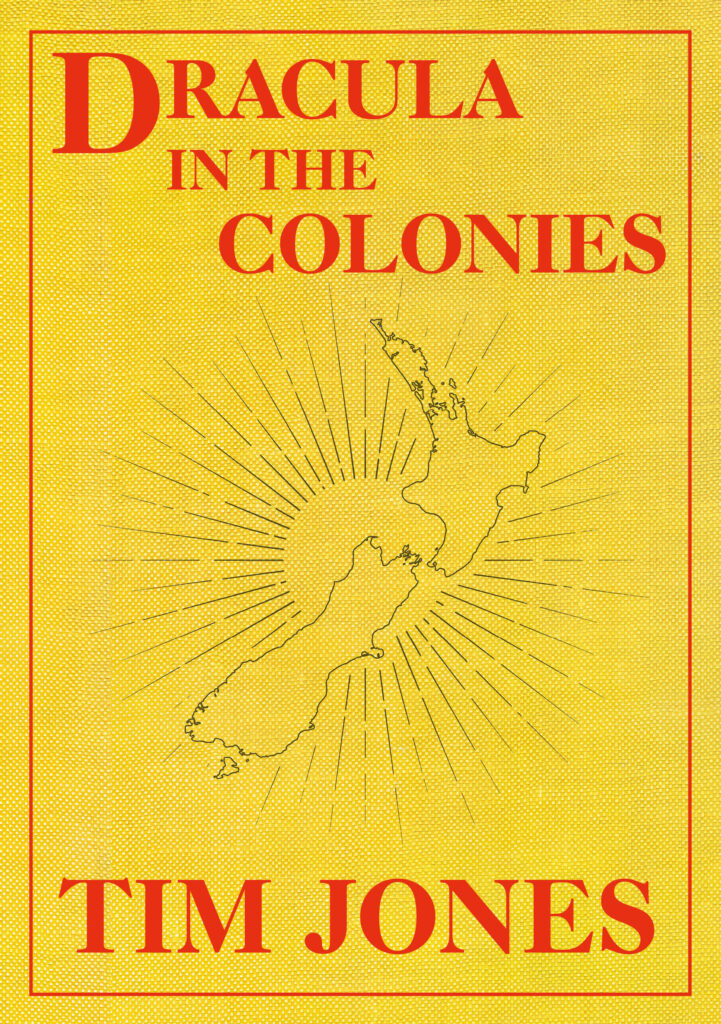
It was a dark and stormy night – no, really, it was! – when my new poetry collection Dracula in the Colonies, together with Mandy Hager’s new “Chasing Ghosts” mystery Revenge and Rabbit Holes, were launched at Unity Books Wellington earlier this month.

Photo of Tim Jones speaking at the launch of his new poetry collection "Dracula in the Colonies" at Unity Books Wellington on 1 October 2025. Author is speaking at a microphone with a desk to his left and bookshelves behind him.
Photo credit: James Fraser

Happily, that didn’t prevent a good crowd gathering to attend the launch, enjoy the lovely food put on by Unity Books, listen to the speeches, and buy some books.

Colin Marshall of the Whitireia Publishing Programme, who helped to put together the launch, also doubled as videographer – here are his videos of publisher Mary McCallum, my “launcher”, poet Harvey Molloy who said some lovely things about my work and my writing career, and myself speaking at the launch.

Mary McCallum from The Cuba Press gets the book launch underway:

Harvey Molloy’s launch speech for Tim Jones’ new poetry collection “Dracula in the Colonies”:

Tim Jones speaks at the launch of his new poetry collection “Dracula in the Colonies”:

Since then, I’ve had a nice My Wellington profile in The Post, although you may find it firewalled. Watch out for more interviews and events to come!

You can buy Dracula in the Colonies from Unity Books Wellington, other independent bookstores, and direct from the publisher.

Next, I’m looking forward to reading Mandy’s book! Here’s my review of the first in the series.

My new poetry collection “Dracula in the Colonies” is launching in Wellington on Wednesday 1 October!

My new poetry collection Dracula in the Colonies is launching at Unity Books Wellington on Wednesday 1 October from 6-7.30pm. It’s a double book launch: my  Dracula in the Colonies and Mandy Hager’s new novel Revenge and Rabbit Holes.

Image version of the launch details included in this post, showing the covers of Dracula in the Colonies and Revenge and Rabbit Holes

All are welcome – no need to RSVP. And if you invite your friend, friends, partner, partners, or large and lavishly remunerated workplace* along, even better!

*Possibly fictional.

Dracula in the Colonies has received a couple of very nice endorsements from poets whose work I admire:

Janis Freegard: “Tim Jones’ powerful new collection takes us from Grimsby to Antarctica, traversing family life, migration, politics, climate change and loss. This is honest, tender, funny and intelligent writing from a story-teller poet.”

Erik Kennedy: “Eminently readable but never comfortable … Dracula in the Colonies is full of characters you’ll love to hate from a poet whose work we know to love.”

Thank you, Erik and Janis!

All the details

The launch will be at Unity Books, 57 Willis St, Wellington, from 6-7.30pm on Wednesday 1 October 2025. There will be drinks, nibbles, and books for sale and signing.

The Facebook event is here: https://www.facebook.com/events/1159319136008748/

My thanks to everyone who has already said they plan to attend, and those who’ve let me know they can’t make it.

I can’t make it, but I’d love a copy of the book:

The Cuba Press has you covered! You can pre-order Dracula in the Colonies here: https://thecubapress.nz/shop/dracula-in-the-colonies/

You’re invited to a double book launch on Wednesday 1 October: Dracula in the Colonies by Tim Jones and Revenge and Rabbit Holes by Mandy Hager

image.png

You and your friends are warmly invited to a double book launch at Unity Books on Wednesday 1 October: my new poetry collection Dracula in the Colonies and Mandy Hager’s new novel Revenge and Rabbit Holes.

All are welcome – no need to RSVP!

The launch will be at Unity Books, 57 Willis St, Wellington, from 6-7.30pm on Wednesday 1 October 2025. There will be drinks, nibbles, and books for sale and signing.

The Facebook event is here: https://www.facebook.com/events/1159319136008748/

My thanks to everyone who has already said they plan to attend, and those who’ve let me know they can’t make it.

If you can’t make it, please pre-order Dracula in the Colonies here: https://thecubapress.nz/shop/dracula-in-the-colonies/

Book review: Halfway to Everywhere, by Vivienne Ullrich

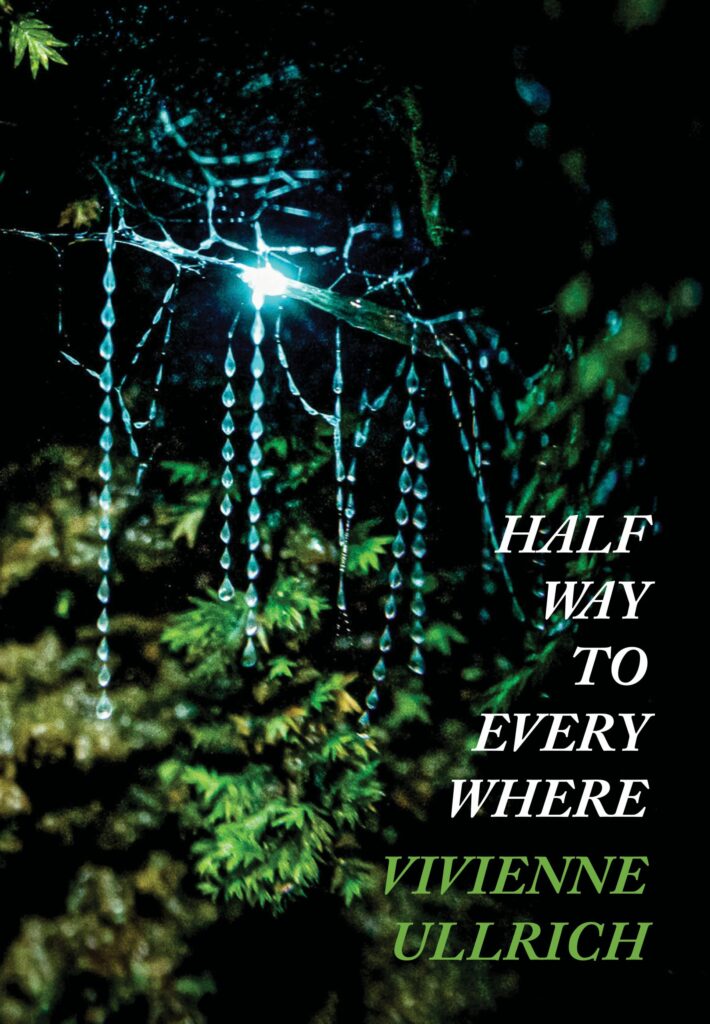
Cover of poetry collection "Halfway to Everywhere", by Vivienne Ullrich

Halfway to Everywhere, by Vivienne Ullrich (The Cuba Press, 2024), 70 pp. Available from https://thecubapress.nz/shop/halfway-to-everywhere/

Halfway to Everywhere is Vivienne Ullrich’s second poetry collection, and I’m impressed. The poems in Halfway to Everywhere show a lot of formal ability as a poet, and as the collection goes on, that formal elegance was increasingly matched with subject matter that engaged me emotionally.

Many of these poems take as their subject matter art, historical figures and fairy tales. Mary Queen of Scots, Little Red Riding Hood, Scheherazade, Jack of “Jack and the Beanstalk” fame and the artist Max Gimblett all put in an appearance, as the poet invites us to see the world from their points of view.

“Mary Queen of Scots” (p. 24) is a good example of these poems. It begins:

I die tomorrow. It is a simple thing
and yet it clamps my belly.
I pray for a clean stroke
and dignity.

From “Rutu” (p. 18), a poem inspired by Rita Angus’ painting of the same name:

… how is it we gift
this month with myths of rebirth, when an eye
towards our cross of stars would signal time
for harvest, time for tuning in to self.

I was very impressed by the quality of both the poetry, and the thought that had gone into the poetry, in Halfway to Everywhere. I did find that – perhaps because of the number of poems about artworks and historical figures – it took about half the collection before I started to engage with the poems emotionally – in other words, to connect with them as well as be impressed by them. But as I continued reading, I found poems that spoke to me more directly, like “Footprint” (p. 62):

I hear you. No doubt
it is different in my skin.
I am my peculiar set of molecules
after all, and I have the benefit of
context and the words I left out.

This skill in addressing multiply points of view comes to fruition on my favourite poem in the collection, “Little Red Riding Hood” (p. 48), a retelling in which the dramatis personae all get a turn as protagonist: the wolf, the huntsman, the grandmother, and the girl herself. This poem combines formal ability and sly wit in a way that works extremely well. An excerpt won’t do it justice – check out the whole poem!

Vivienne Ullrich is a talented, clever, thoughtful poet, and as I read through this collection, I found her poems and her poetry sneaking up on me. Halfway to Everywhere is a good place to be.

Koe: An Aotearoa ecopoetry anthology launches on 22 August 2024 – plus recent writing news & events

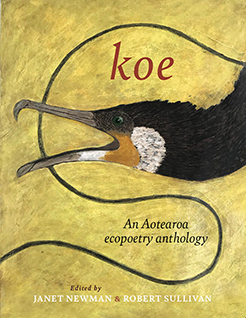
Koe: An Aotearoa ecopoetry anthology launches on 22 August – you’re invited to the launch!

I’m delighted that my poem “All That Summer”, first published in my collection New Sea Land (2016), has been selected for this new anthology of environmental poetry from Aotearoa / New Zealand, edited by Janet Newman and Robert Sullivan. I’ll be one of the poets reading at the Wellington launch, which is at
Meow, 9 Edward Street, Wellington from 6pm on Thursday, 22nd August – the same day the anthology becomes available in bookstores.

Please share the event with your friends, fellow poets, artists and activists on Facebook at:
https://www.facebook.com/share/tgMg2PTEwB58NmCL/ – and please come along!

More about Koe

Koe invites readers to explore human connections with nature through a selection of over 100 poems composed in Aotearoa New Zealand from pre-European times to the present day. Including a substantial introduction and editors’ notes, Koe is the first anthology to provide a comprehensive overview of ecopoetic traditions in Aotearoa and to locate these traditions as part of the global ecopoetry scene.

In Koe, editors Janet Newman and Robert Sullivan reveal the genesis, development and heritage of a unique Aotearoa New Zealand ecopoetry derived from both traditional Māori poetry and the English poetry canon. Organised chronologically into three sections—representing the early years (poets born in or before the nineteenth century), the middle years of the twentieth century, and the twenty-first-century ‘now’—each segment presents a diverse array of voices. Across all these time frames, speaking from the conditions of their era, the poets delve into themes of humility, reverence and interconnectedness with the nonhuman world. They challenge traditional Eurocentric perspectives, highlight the significance of indigenous narratives, and wrestle with the impacts of European colonisation.

With more than 100 poems of celebration, elegy, apprehension, hope and activism, Koe gives us the history that holds our future.

New Poems Published in a fine line and Tarot

I’ve recently had new poems published in a fine line and Tarot – thanks very much to respective editors Gail Ingram and Kit Willett for selecting these poems for publication!

Check them out here:

a fine line (Autumn 2024): Tuesdays [a reprint], The Hedgehog Heart In Conflict With Itself [new]

Tarot 8: The Richter Scale (p. 30), Balcony (2023) (p. 47)

Where To From Here webinar for Our Climate Declaration

In July, I spoke to an Our Climate Declaration webinar about the nexus between climate writing and climate activism, referring both to my novel Emergency Weather and to the current political moment.. Thanks to Our Climate Declaration for the opportunity – check out the webinar below!

A Change In the Weather: The Climate Crisis In Poetry And Fiction

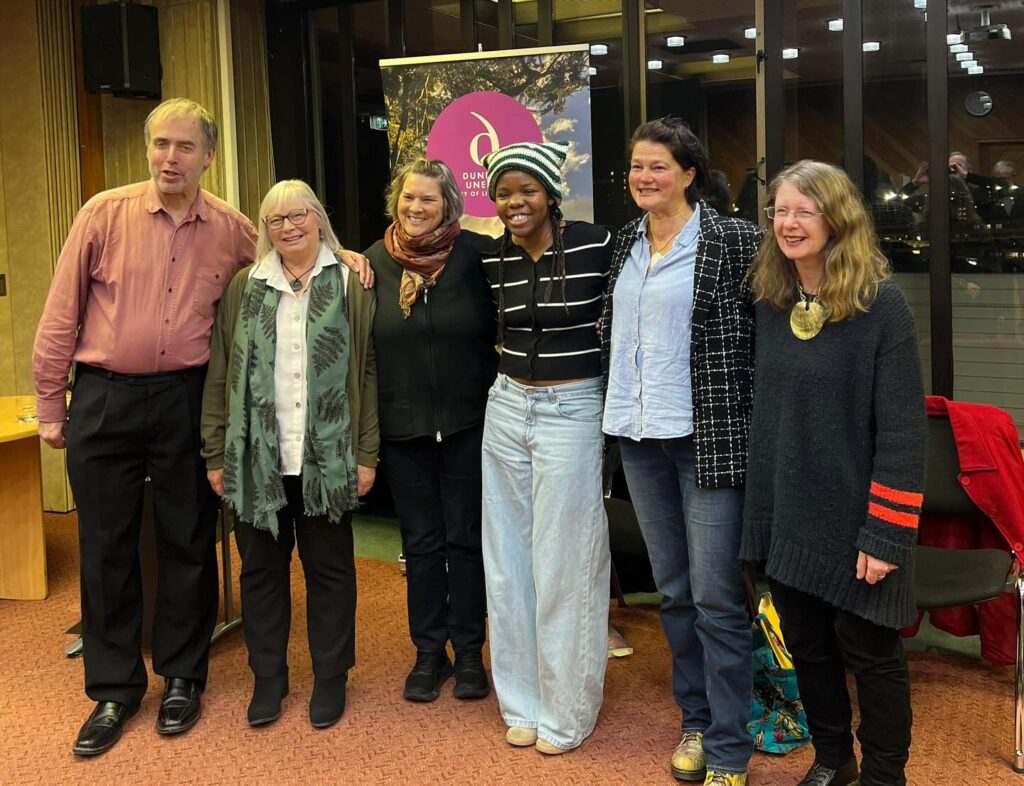
Photo of Dunedin writing event described in text

Tim Jones, Kay McKenzie Cooke, Michelle Elvy, Tunmise Adebowale, Mikaela Nyman, Jenny Powellthanks to Kay for the photo!

I spent a couple of weeks in the south of the South Island in late June and early July, travelling with family and visiting friends. Along the way, I took part in a writing event in Dunedin, A Change In the Weather: The Climate Crisis In Poetry And Fiction on Thursday 4 July, which Michelle Elvy, Kay Mckenzie Cooke and I organised. The event was held in the Dunningham Suite at Dunedin Public Library – thanks very much to Ali and her team for setting the venue up & being such good hosts!

We had six readers:

Tim Jones
Kay McKenzie Cooke
Michelle Elvy
Tunmise Adebowale
Jenny Powell
Mikaela Nyman

and everyone read wonderful pieces! Then, afterwards, we had a really good discussion, covering both climate & environmental writing and climate activism, with the audience. Books got sold, drinks were drunk, nibbles nibbled (thanks to Kay and Robert for getting the drinks and nibbles) – it was a very positive event and I enjoyed it a lot. I lived in Dunedin from 1976 to 1993, and I felt very welcomed by the Dunedin literary community at this event.

Thanks to all our sponsors: The Cuba Press, Ōtepoti – He Puna Auaha / Dunedin City of Literature, Dunedin Public Libraries and the University Book Shop.

Writers on Mondays – August 2023

Full programme for 2023: https://www.wgtn.ac.nz/modernletters/about/events/writers-mondays

Events run from 12.15 to 1.15 pm on
Mondays at Rongomaraeroa, Te Marae,
Level 4, Te Papa


I’m looking forward to the 21st!

7 August
Other Worlds

Pip Adam‘s Audition features three giants: Alba, Stanley and Drew, who are squashed into a spaceship hurtling through space, and must talk to keep the spaceship moving. Tīhema Baker‘s Turncoat is set on a distant future Earth, colonised by aliens, where Daniel –a young, idealistic Human–is determined to make a difference for his people. These works of speculative fiction are exciting, inventive and compassionate in their exploration of systems of power. Dougal McNeill will talk to Pip and Tīhema about these other worlds in fiction, and the mirror they hold up to our world today.

14 August
Lioness

A new novel by Emily Perkins is an event in the literature of Aotearoa. Lioness is Emily’s first book in ten years and is set to be one of the most talked about novels of 2023. Join Damien Wilkins as he talks to Emily about Lioness and about a stunning career spanning more than 25 years, beginning with her classic debut Not Her Real Name, taking in her years in London, her time as a television books show presenter and a university teacher, and her more recent work for the theatre.

21 August
Ōrongohau | Best New Zealand Poems 2022

‘I tried to think of a visitor to our poetry shore—what could I include to show its terrain?’ wrote editor Louise Wallace, introducing some of our poetic landmarks of 2022. Hear Nick AscroftMorgan BachJames BrownTim JonesAnahera GildeaMichaela KeebleFrankie McMillanKhadro Mohamed, and Sarah Scott,  and  read work from this annual anthology in a warm-up for National Poetry Day. Introduced by Damien Wilkins.

28 August
Home and Away: Noelle McCarthy

Early in 2020, Noelle McCarthy travelled to Ireland where her mammy, Carol, was dying, then back to New Zealand as borders were slamming shut. Written through the years of the pandemic, Grand is about mothers and daughters, running away and going home, Noelle and Carol. It’s been a best-seller here, winning the E.H. McCormick Prize at the 2023 Ockham Awards. This June, Noelle flew to Ireland to launch the UK and Irish edition. Kate Duignan talks to 2023 Writer-in-Residence Noelle about the reception of the book on both sides of the world, and what’s left to write after a memoir.

There is no mercy in insurance

News that Tower Insurance and other insurance companies are considering refusing to insure houses in flood-prone areas reminded me of “Written Off”, a poem from my 2016 collection New Sea Land.

The set of climate change consequences outlined in this poem were not difficult to come up with. Perhaps, if our “leaders” had spent more time thinking about consequences and less time bowing and scraping to vested interests, we wouldn’t be in quite such a deep hole seven years after this poem was first published.

Written Off

They had insured

and re-insured,

still it was not enough.

They hunched over maps,

consulted climate science.

Beachfront property

went with the stroke of a pen:

no possible premium

could insure that level of risk.

And floodplains:

why do people choose to build on them?

Bigger floods, more often: gone.

East coast farmers, eyeball-deep

in debt, haunted by drought,

desperate to irrigate:

you backed the wrong horse.

Low-lying suburbs, factories

built next to streams:

there is no mercy

in insurance. The numbers speak,

and then there is no mercy.

Ōrongohau | Best New Zealand Poems 2022

It was a lovely surprise to learn that my poem “Restraints”, first published in takahē, had been selected for inclusion in the 2022 edition of Ōrongohau | Best New Zealand Poems, edited and introduced by Louise Wallace. It’s a beautifully produced selection of 25 poems first published in 2022 – please check it out:

Ōrongohau | Best New Zealand Poems 2022

Restraints

My first publication in Best New Zealand Poems was in 2004, with my poem The Translator, later included in my 2007 collection All Blacks’ Kitchen Gardens. It’s great to be back!

“Restraints” was inspired by the Our Other Mother campaign from Parents for Climate Aotearoa. They’re a great group that do vital climate education work – please check them out, too.

What I learned from my year of submitting poetry to magazines in Aotearoa

Back into writing poetry

Earlier this year, I returned to writing poetry. I’d been focused on writing fiction since the publication of my 2016 poetry collection New Sea Land, with the exception of the music poems I wrote for my 2019 chapbook Big Hair Was Everywhere – most of which dated from 2016-17 anyway.

It was a real joy to return to writing poetry after five years focused on fiction, but I went into it thinking that there were few to no magazines left in Aotearoa that published poetry. Happily, I was wrong about that.

This isn’t meant to be a comprehensive list – check out the New Zealand Poetry Society website for more poetry markets – but here are some poetry magazines I submitted work to in 2022, together with how I got on.

(There are all sorts of ways to get your poetry out there – live performances, competitions, videos, anthologies. Time permitting, I’ll post more about those next year – including what I’ve learned about poetry in Aotearoa from editing the 2021 and 2022 New Zealand Poetry Society anthologies, Kissing a Ghost and Alarm & Longing.)

Landfall 244 cover - Seacliff train station

How I got on

I had poems accepted and published by:
a fine line – “Villagers” in a fine line, Autumn 2022, p. 24
takahē“Restraints” and “Bento Box, Mt Victoria” in takahē 105, August 2022 (online edition)
Landfall – “Uncles” in Landfall 244, pp. 154-155. (I’m particularly chuffed about that one, as I’ve had reviews published in Landfall previously, but never poetry.)
broadsheet – “The Passage South” in broadsheet 30, November 2022
Tarot – “She Fell Away” and “Closer to the river” in Tarot 5, December 2022.

Thank you to the editors of those magazines!

I submitted unsuccessfully to Poetry New Zealand (which is an excellent yearly magazine/anthology that I’ll definitely be trying again), two competitions, and in a swing-for-the-fences moment, Asimov’s – another place I haven’t been published but would like to be. Happily, there are plenty of other science fiction poetry markets.

I’m very pleased with that ratio of acceptances to submissions – but experience has taught me that one good year of getting work accepted doesn’t guarantee another. Nevertheless, once my current round of novel revisions is finished, I plan to dip my bucket in the poetry well once again – I still have a bunch of ideas for poems, and some partial drafts, to pursue. I hope there will be a collection’s worth of publishable poems by the time I’ve finished.

What I learned

These are pragmatic comments about how to maximise the effectiveness of your submissions, rather than advice on how to write poetry!

Follow the guidelines. If a magazine says they want to see up to five poems, don’t send them six – it will just piss them off. (Well, it would if I was the editor.) If they say they want poems of up to 40 lines, don’t send them a 50-line poem, and so forth. And whatever you do, don’t send the editor a poem they’ve previously rejected! (I don’t *think* I’ve ever done this, and I try really hard not to.)

Find out what the editor likes. What style of poetry do they write themselves? Is that the style of poetry they tend to select for publication, or do they select a wide range of poems and poets? Have they posted or commented about what sort of poems they are seeing too much of, or not enough of?

Find about the journal. Bonza Bush Poetry and the Extremely Academic Magazine of Post-Post-Post Modernist Poetics are unlikely to publish similar poems: which one is your work better suited for?

Send a range of work. This is one I have learned from editing poetry myself: if I have a range of poems I could submit, I try to include some shorter poems as well as those that are near the length limit, some lighter poems as well as serious ones, etc. Be that poet who gives the editor a range of options when they are completing their selection for an issue.

Submit earlier rather than later in the submission window if you can. Because I tend to be deadline-focused, I don’t often follow my own advice here. But if a magazine says “submissions are open from 1 September to 1 November” and you have poems that are ready to submit, I’d get them in early in the window if possible – that probably gives you the best opportunity to get your work, and particularly longer or more complex poems, selected.

Send your best work. What a cliche! But it’s true.

Be gracious. Nobody likes having work rejected – I certainly don’t – but don’t take it out on the editor. From my own experience, poetry editors are battling against time pressures, money pressures, fatigue and other commitments to do the best job they possibly can, and they almost always receive far more poems than can be fitted into an issue. Plus, complaining isn’t likely to make the editor look more favourably on your next submission.

No Other Place To Stand: An Anthology Of Climate Change Poetry From Aotearoa New Zealand

Pile of copies of poetry anthology "No Other Place to Stand" ion table, with trees shown through window in background

I’m very pleased that my poem “Not for me the sunlit uplands,” first published in New Sea Land, is included in this new anthology. I’m looking forward to the Wellington launch on 14 July – check out the details below:

Auckland University Press invites you to the launch of NO OTHER PLACE TO STAND: AN ANTHOLOGY OF CLIMATE CHANGE POETRY FROM AOTEAROA NEW ZEALAND.

Join editors Jordan Hamel, Rebecca Hawkes, Erik Kennedy and Essa Ranapiri – as well as plenty of special guests – to the celebration and launch party of this brilliant new anthology.

6pm, Thursday 14 July
Meow
9 Edward Street
Wellington
All welcome!

Facebook event: https://www.facebook.com/events/389905359776491

Editors’ note: We’re also planning a Te Waipounamu launch for the anthology with Word Christchurch later in the year.